



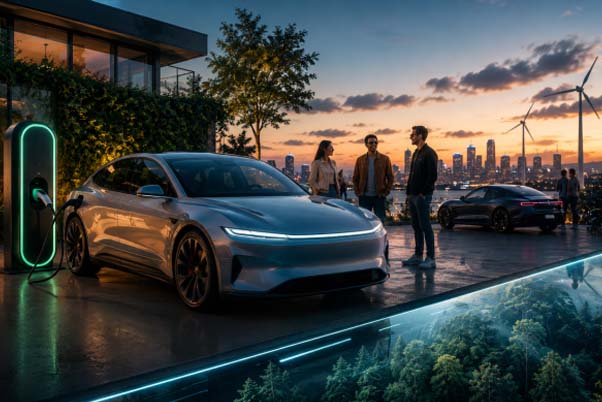
For most of automotive history, “cool” was relatively easy to define. It had a familiar formula: a loud engine, a manual gearbox, aggressive styling, and a sense that the machine was doing something slightly untamed. Cool was auditory as much as visual. You could hear it before you saw it.
Electric vehicles have disrupted that formula completely. By removing one of the most emotionally charged elements of driving—the engine sound—they have forced a rethink of what makes a car desirable in the first place. In doing so, they are reshaping not just the technology of cars, but the culture around them.
The End of Noise as Identity
Internal combustion engines have always been more than mechanical systems; they were identity markers. The deep rumble of a V8, the high-pitched whine of a performance inline-four, or the uneven idle of a tuned engine all communicated something about the driver.
Electric vehicles remove that layer entirely. Acceleration becomes almost silent, with torque delivered instantly and without drama. For some enthusiasts, this initially felt like a loss. Without sound, where does the personality of the car go?
But this silence has created space for other forms of expression. Instead of auditory presence, EVs rely on design clarity, software interaction, and driving refinement to communicate character.
Design Becomes the New Performance
With fewer mechanical components to showcase, electric vehicles place greater emphasis on exterior and interior design. Clean lines, aerodynamic efficiency, and minimalist surfaces are no longer just aesthetic choices—they are functional necessities.
This has led to a shift in how manufacturers compete. Where horsepower figures once dominated marketing conversations, design language and user experience are now equally important. Vehicles are judged on how they feel to interact with, not just how fast they accelerate.
Inside the cabin, the change is even more noticeable. Digital interfaces replace traditional instrument clusters, and physical controls are often reduced to essential functions. The result is a space that feels closer to consumer technology than traditional automotive engineering.
Technology as the New Status Symbol
In the past, status in car culture was often communicated through visible performance cues: exhaust systems, body kits, or engine modifications. In the EV era, status is increasingly defined by technology.
Software capabilities, autonomous driving features, over-the-air updates, and ecosystem integration are now key differentiators. A car that updates itself overnight or learns driver behaviour carries a different kind of prestige—one rooted in intelligence rather than noise.
This shift mirrors broader changes in consumer culture. Just as smartphones replaced hi-fi systems as status objects, EVs are repositioning cars as intelligent devices rather than purely mechanical objects.
Sustainability and Subtle Prestige
Another major factor redefining “cool” is sustainability. Electric vehicles are closely associated with reduced emissions and a lower environmental footprint, which has become a significant cultural value in many markets.
However, sustainability alone does not create desirability. What makes EVs culturally interesting is how sustainability is being integrated into design and identity. Modern EVs are not positioned as compromises, but as premium, forward-looking products.
This has changed the emotional language of car ownership. Driving an EV is increasingly associated with being informed, future-oriented, and design-conscious rather than simply practical.
The Role of Digital Identity in Modern Cars
As vehicles become more connected, they also become more personal. Settings, preferences, and driving behaviour can now follow the driver across different vehicles and platforms.
This has introduced a subtle but important shift: the car is no longer a static object, but part of a broader digital identity system. The experience of driving is shaped as much by software profiles and interfaces as by mechanical engineering.
In this context, even physical elements of the vehicle are beginning to reflect personal identity in more considered ways. Details such as finishes, trims, and external presentation contribute to how a vehicle is perceived in a world where visual identity is constantly shared and documented.
For drivers investing in personalisation, companies like Number 1 Plates operate within this evolving landscape, where the boundary between physical design and personal expression continues to blur.
Social Media and the Rewriting of Cool
Social media has also played a significant role in redefining automotive desirability. In the past, car culture was experienced primarily in person—at meets, on roads, or through magazines. Today, it is heavily mediated through digital platforms.
This has shifted attention toward visual impact and shareability. Cars are now designed not just for driving, but for being photographed, filmed, and circulated online. Clean aesthetics, futuristic interiors, and distinctive lighting signatures tend to perform well in this environment.
Electric vehicles naturally align with this shift. Their minimalist design language and futuristic associations make them highly compatible with digital culture. In many ways, EVs were already “social media-ready” before they became mainstream.
Performance Without Drama
One of the most interesting paradoxes in EV culture is the redefinition of performance itself. Traditional performance cars were defined by drama—sound, vibration, and visible effort. Electric cars deliver performance without these cues.
Acceleration is instant, smooth, and often surprisingly violent in terms of speed, yet emotionally restrained. This creates a different kind of experience: less theatrical, more clinical.
For some drivers, this is a loss of emotional engagement. For others, it represents a more refined form of performance—one that prioritises control and precision over spectacle.
The New Hierarchy of Desirability
As EVs become more common, a new hierarchy of desirability is emerging in car culture. It is no longer enough for a car to be fast or loud. Instead, desirability is shaped by a combination of factors:
- Design coherence
- Software intelligence
- Range and efficiency
- Brand philosophy
- User experience
This does not eliminate traditional car enthusiasm, but it expands it. Enthusiasts now evaluate vehicles through multiple lenses, including digital performance and experiential quality.
Conclusion
Electric vehicles have not removed “cool” from car culture—they have redefined it. Where once emotion was delivered through sound and mechanical drama, it is now communicated through design clarity, technological intelligence, and cultural relevance.
This shift is still unfolding, and different drivers will interpret it in different ways. But the direction is clear: cool is no longer just about how a car behaves on the road. It is about how seamlessly it integrates into modern life, how intelligently it responds to its driver, and how convincingly it represents the future of mobility.
In that sense, EVs are not just new machines. They are a new language for what it means to want a car at all.
