



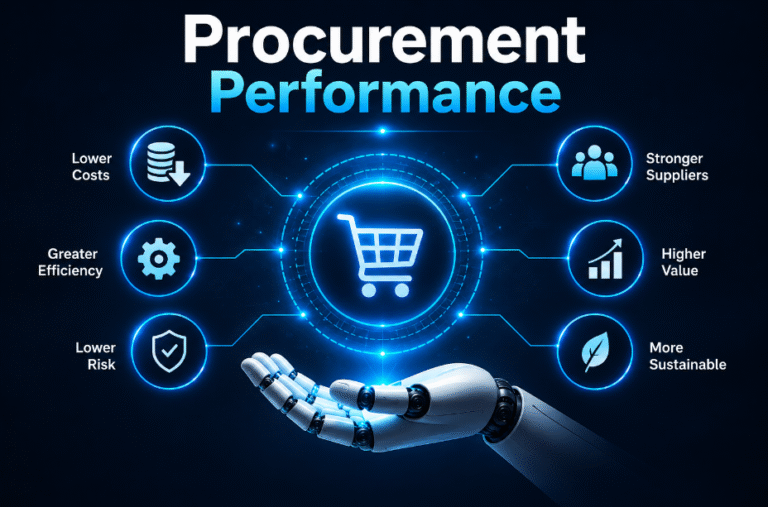
Procurement leaders are expected to deliver more than cost savings. They must improve supplier performance, strengthen resilience, manage risk, increase productivity and support broader business priorities. Measuring Procurement Performance therefore requires a more comprehensive view of how effectively the function manages spend, suppliers, processes and enterprise value.
AI in Procurement is creating new opportunities to improve this performance. By combining machine learning, generative AI, predictive analytics and intelligent automation, procurement organizations can analyze larger volumes of information, automate routine work and support faster sourcing and supplier decisions.
This article explores how AI in Procurement can strengthen Procurement Performance, the metrics that matter, key AI applications and the priorities organizations should consider when building a more intelligent procurement function.
What is Procurement Performance?
Procurement Performance refers to how effectively the procurement function delivers against its financial, operational and strategic objectives. It can be evaluated through measures related to cost, productivity, sourcing effectiveness, supplier performance, risk, compliance and service delivery.
Traditional procurement measurement has often emphasized savings. While savings remain important, they provide only one perspective on the function’s contribution.
A broader approach evaluates whether procurement is managing spend effectively, improving supplier outcomes, reducing process friction and supporting enterprise priorities. This provides leaders with a more complete understanding of procurement’s performance and opportunities for improvement.
What is AI in Procurement?
AI in Procurement refers to the use of artificial intelligence across sourcing, spend analysis, supplier management, contracting, purchasing and procurement operations.
These capabilities can include machine learning, generative AI, predictive analytics, intelligent automation and AI agents. AI can analyze procurement information, identify patterns, generate recommendations and automate repetitive activities.
Unlike traditional rules-based automation, AI can support processes that require interpretation and contextual analysis. This enables procurement teams to address both transactional work and more complex decision-making activities.
Why Procurement Performance matters
Procurement influences a significant portion of enterprise spending and has direct relationships with suppliers that support business operations. Weak performance can contribute to higher costs, inefficient processes, supplier problems and increased operational risk.
Effective performance measurement helps procurement leaders understand where these gaps exist.
For example, savings may appear strong while sourcing cycle times remain high or supplier performance deteriorates. Similarly, increasing spend under management may provide limited value if contract compliance remains weak.
Procurement Performance should therefore be evaluated across multiple dimensions so leaders can identify trade-offs and prioritize improvements based on business impact.
How AI in Procurement improves performance visibility
One of the most valuable applications of AI is its ability to analyze information distributed across procurement systems, contracts, transactions and supplier records.
AI in Procurement can classify spend, identify unusual purchasing patterns, summarize supplier information and highlight potential risks. Generative AI can also make complex procurement information easier to access through natural-language queries.
This provides procurement professionals with faster access to relevant information and reduces time spent manually compiling reports.
More importantly, better visibility allows leaders to understand why performance is changing and determine where intervention may be required.
Key Procurement Performance metrics
Organizations should select metrics based on their business objectives and procurement operating model. Several measures can provide a balanced view.
Cost and savings
Metrics can include realized savings, cost avoidance and procurement operating costs. These measures help leaders understand procurement’s financial contribution.
Spend under management
This measures the proportion of organizational spend actively influenced or managed through procurement processes and strategies.
Procurement cycle time
Cycle-time measures can identify delays across sourcing, contracting, approvals and purchasing activities.
Supplier performance
Organizations can evaluate suppliers across delivery, quality, service, commercial performance and other relevant measures.
Contract compliance
Compliance measures help determine whether purchases follow negotiated agreements and established procurement policies.
Procurement productivity
Metrics such as workload per procurement employee can help leaders understand resource efficiency and operating model performance.
Together, these measures provide a more complete picture of Procurement Performance than savings alone.
Key applications of AI in Procurement
AI can improve performance across several stages of the procurement lifecycle.
Spend analysis
AI can classify transactions across suppliers and categories, helping procurement teams identify spending patterns, consolidation opportunities and potential leakage.
Strategic sourcing
AI can analyze supplier information, historical sourcing events and market data to support sourcing strategies and supplier evaluation.
Contract management
Generative AI can summarize agreements, identify important clauses and retrieve information related to pricing, obligations and renewal dates.
Supplier risk management
AI can combine supplier performance information with external signals to identify potential financial, operational or supply risks that require attention.
Procurement operations
Intelligent automation can streamline requisitions, approvals and routine purchasing processes while directing exceptions to procurement professionals.
Supplier performance management
AI can analyze multiple supplier measures and highlight performance changes, helping procurement teams focus attention on suppliers requiring intervention.
These applications show how AI in Procurement can influence both operational efficiency and strategic performance.
Business benefits of AI-enabled procurement
When AI is connected with clearly defined procurement priorities, organizations can improve several dimensions of performance.
Greater procurement productivity
Automation reduces time spent on repetitive activities, enabling procurement professionals to focus on sourcing, negotiations and supplier relationships.
Better spend visibility
AI can analyze large volumes of transaction information and provide leaders with a clearer understanding of organizational spending.
Faster decision-making
AI-generated insights can reduce the time required to analyze suppliers, contracts and sourcing information.
Stronger supplier management
Predictive insights and performance analysis can help procurement teams identify supplier issues earlier and support more proactive management.
Improved process efficiency
Intelligent workflows can reduce manual handoffs and improve sourcing, contracting and purchasing cycle times.
How AI can strengthen Procurement Performance management
AI can change performance management from a primarily retrospective activity into a more continuous process.
Traditional reporting typically shows leaders what has already happened. AI in Procurement can complement these reports by identifying emerging patterns and highlighting areas that may require attention.
For example, AI could detect an increase in off-contract spending, identify declining supplier delivery performance or flag sourcing processes experiencing longer cycle times.
Procurement leaders can then investigate these changes before they become larger performance issues.
This creates a more proactive approach to managing Procurement Performance.
Best practices for implementing AI in Procurement
Successful implementation requires organizations to connect AI with clearly defined procurement outcomes.
- Establish current Procurement Performance baselines before implementing AI.
- Identify specific performance gaps that intelligent technologies can address.
- Improve supplier, spend and contract data quality.
- Prioritize AI use cases according to value, feasibility and time to value.
- Integrate AI capabilities with procurement, ERP and supplier management platforms.
- Establish governance for security, confidentiality and responsible AI.
- Maintain human accountability for negotiations, supplier selection and other strategic decisions.
- Measure whether AI initiatives are improving procurement KPIs and delivering expected business value.
This approach helps organizations avoid implementing technology without a clear connection to performance.
Common implementation challenges
Data quality is one of the most significant barriers to AI in Procurement. Supplier records, spend classifications and contract information may be fragmented across multiple enterprise systems.
Legacy technology can also make integration difficult, particularly when procurement processes span different platforms and business units.
Another challenge is selecting the right performance measures. Too many KPIs can make it difficult to distinguish strategically important trends from routine operational information.
Organizations should therefore focus on a balanced set of measures that connect procurement activity with financial, operational and strategic outcomes.
The future of Procurement Performance
The future of Procurement Performance management will increasingly combine benchmarking, real-time analytics, predictive insights and AI-enabled decision support.
AI agents could further extend these capabilities by monitoring procurement processes continuously, identifying exceptions and initiating approved workflows. For example, an agent could detect deteriorating supplier performance, retrieve relevant contract information and alert the appropriate procurement professional.
As these capabilities mature, procurement teams may spend less time compiling performance reports and more time interpreting insights and taking action.
AI in Procurement will therefore increasingly become part of how performance is managed rather than a separate technology initiative.
Conclusion
Procurement Performance is becoming a broader measure of how effectively procurement manages cost, suppliers, processes, risk and business value. Organizations need visibility across these dimensions to understand where the function is performing well and where improvement is required.
AI in Procurement can strengthen this capability by improving spend visibility, automating routine work and providing more timely insights into supplier and process performance. Organizations that combine intelligent technologies with strong procurement data, relevant KPIs and effective governance will be better positioned to build productive, resilient and high-performing procurement functions.
