



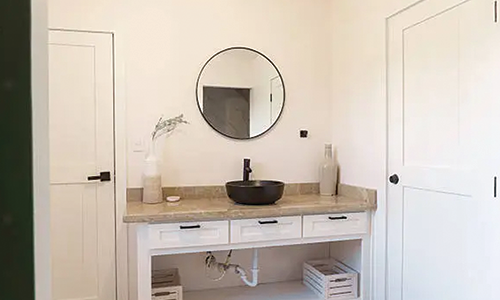
Homeowners undertaking a bathroom renovation today face a market that offers a great deal of choice but surprisingly little precision. Box-store vanities are widely available, shipped in standard sizes, and designed to fit the broadest possible range of spaces. The result is a product that fits almost anywhere but suits almost nowhere particularly well. For homeowners who have invested in a well-considered home — whether a restored farmhouse, a newly built rural property, or a suburban home with a traditional aesthetic — that gap between what is available and what is actually needed has become a genuine source of frustration.
This frustration has quietly driven a shift in how American homeowners approach bathroom cabinetry. Rather than accommodating their space to a product, they are beginning to expect the product to accommodate their space. That expectation is not unreasonable. It reflects a broader change in how people think about interior durability, material quality, and the long-term value of built fixtures in a home. The bathroom vanity, historically treated as a commodity, is increasingly being treated as a built element — something that should fit a room with the same care and intention as a kitchen cabinet or a custom closet system.
Understanding how that shift is playing out in practice, and what it means for the homeowners and contractors who are navigating it, is worth examining in some detail.
What a Custom Farmhouse Bathroom Vanity Actually Involves
The term “farmhouse style” has become so widely used in home décor that it risks losing meaning. But when applied to cabinetry and vanity construction specifically, it refers to a recognizable set of design principles: solid wood construction, simple panel door profiles, furniture-like proportions, and finishes that suggest age, use, and craftsmanship without being distressed purely for effect. A custom farmhouse bathroom vanity built to these principles is a different object from a factory-produced piece with a shaker-style door and a painted finish. The difference lies in how the piece is made, from what materials, and to what tolerances.
A genuinely custom vanity begins with the dimensions of the actual space it will occupy, not with a standard cabinet size that a homeowner then works around. It accounts for plumbing rough-in positions, ceiling heights, the presence or absence of adjacent walls, and the specific basin or countertop material the homeowner intends to use. This level of specificity is what separates custom cabinetry work from semi-custom or stock alternatives. According to the National Association of Home Builders, cabinetry and millwork consistently rank among the most influential factors in both perceived home quality and long-term resale value — a finding that aligns with what custom cabinet makers have observed for decades in their own client relationships.
Concept32 Designs approaches the custom farmhouse bathroom vanity as a built furniture problem, not a product selection problem. That distinction shapes how projects are scoped, how materials are chosen, and how finished pieces perform over time in environments that experience daily humidity, temperature variation, and physical wear.
The Role of Wood Species and Finish Selection in Long-Term Performance
One of the most consequential decisions in custom vanity production is the choice of wood species. Bathrooms are demanding environments for wood. Humidity levels shift throughout the day, surfaces are exposed to water contact and cleaning products, and joints are placed under repeated thermal and moisture stress. A wood species that performs well in a dry kitchen environment may not hold up as reliably in a bathroom over a period of years.
Hardwoods with tight, consistent grain structures — such as maple, oak, and cherry — tend to respond more predictably to moisture than softer, more porous woods. The finish applied over the wood matters as much as the species itself. A catalyzed lacquer or conversion varnish creates a harder, more moisture-resistant surface than a standard oil-based paint, though it requires proper application conditions and equipment to cure correctly. These are not decisions that a homeowner can make from a product listing. They require a working knowledge of how materials behave in real conditions, applied to the specific context of a given bathroom.
Why Standard Sizing Creates Problems That Custom Work Solves
Stock vanities are manufactured in fixed width increments to maximize production efficiency and shipping logistics. This means that a bathroom with an unusual wall length, a non-standard plumbing position, or an architectural feature like a sloped ceiling or a recessed alcove will rarely accommodate a stock piece without visible compromise. Filler strips, trim pieces, and modified countertops become necessary — each one a visible reminder that the vanity was never designed for that particular room.
Custom fabrication removes that constraint entirely. The piece is designed to the room from the beginning, which means the finished installation can be flush against adjacent walls, properly aligned with plumbing, and proportioned to the room’s scale without the need for workarounds. In older homes, where walls are rarely perfectly plumb and floor levels are not always consistent, this precision becomes especially important. A custom builder can accommodate those imperfections during fabrication rather than during installation, which produces a cleaner result and reduces the amount of on-site adjustment required.
The Design Considerations That Distinguish Farmhouse Vanities From Other Styles
Farmhouse-style cabinetry occupies a specific position in the broader range of cabinet design. It draws from early American furniture traditions, where joinery was functional and visible, proportions were generous, and surfaces showed the character of the material rather than obscuring it. Applied to a bathroom vanity, these principles produce a piece that reads differently from a contemporary flat-panel design or a traditional raised-panel European style. The lines are clean but not austere. The construction details — exposed hinges, face-frame joinery, open shelf sections — are part of the aesthetic rather than elements to be hidden.
Balancing Aesthetic Authenticity With Functional Requirements
A farmhouse vanity that looks the part but fails to meet basic functional requirements is not a successful piece of work. Storage organization, drawer depth, door clearance, and hardware durability are all functional considerations that have to be addressed within the constraints of a style that tends toward simplicity and restraint. A drawer box that is too shallow to hold everyday toiletries, or a door hinge that is not rated for bathroom humidity, undermines the value of the piece regardless of how well it is built aesthetically.
Skilled custom fabricators treat aesthetic and functional requirements as equally weighted. They do not subordinate one to the other. The goal is a vanity that operates cleanly day to day — drawers that extend smoothly on quality slides, doors that close without binding, surfaces that can be wiped down without damaging the finish — while also contributing something considered to the visual character of the room.
How Material Choices Affect the Visual Weight of a Finished Piece
The physical presence of a vanity in a bathroom is partly a function of its dimensions and partly a function of its material density and finish. A solid wood vanity with a painted finish reads differently than one with a natural stained or wiped-oil finish, even at identical dimensions. The finish affects how light interacts with the surface, how shadows fall across panel reveals, and how the piece relates visually to other elements in the room — the flooring, the wall tile, the hardware selections.
These are not decorative decisions made arbitrarily. They are decisions that affect whether a finished room feels coherent and settled or whether individual elements compete with each other for visual attention. A well-specified custom farmhouse vanity sits in a room without demanding attention. It contributes to the room’s character without overwhelming it, which is precisely what built furniture is supposed to do.
What Homeowners Should Expect From a Custom Fabrication Process
Working with a custom cabinet maker is a different experience from selecting a product from a catalog. It requires a degree of active participation from the homeowner: sharing accurate measurements, making clear decisions about material and finish preferences, and understanding that custom work has lead times that reflect actual production rather than warehouse inventory. These are not inconveniences to be minimized — they are part of what ensures the finished piece is made correctly for the specific application.
The Importance of Clear Communication During the Design Phase
Most problems in custom fabrication can be traced back to the design phase. A misunderstood dimension, an ambiguous finish description, or an unresolved decision about hardware can result in a finished piece that requires modification or, in some cases, rework. Clear, documented communication between the homeowner and the fabricator during the design phase is the most reliable way to prevent those problems from occurring downstream. This means reviewing drawings carefully, asking questions about material behavior and finish options, and confirming that all decisions are documented before production begins.
Closing Thoughts
The growing interest in custom farmhouse bathroom vanities reflects something real about how homeowners are thinking about their living spaces. It is not simply a style preference. It is a recognition that the objects built into a home affect how that home functions and how long it holds its value, and that those objects deserve the same level of care and precision that people apply to other significant investments in their property.
Concept32 Designs has positioned itself within this space by treating custom vanity fabrication as a discipline that requires technical knowledge, material honesty, and genuine attention to the conditions each piece will face over its lifetime. For homeowners who are ready to move past the limitations of stock cabinetry, that approach represents something worth considering carefully. The decision to invest in a custom-built piece is not a small one, but for a bathroom that will be used daily for the next decade or more, it is a decision that tends to hold up well over time — in both function and appearance.
