



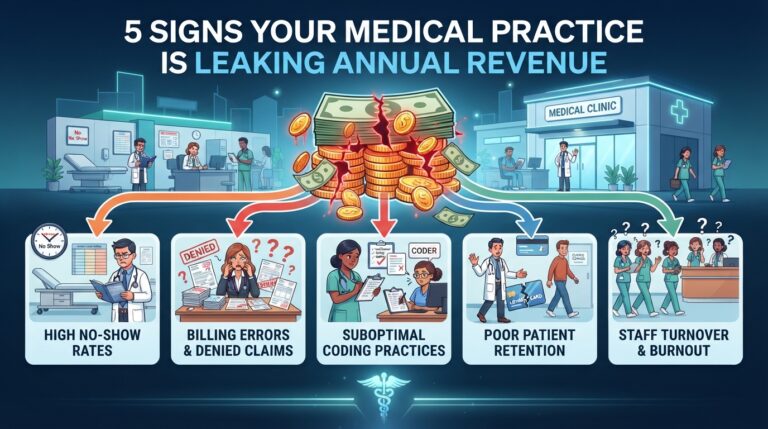
A busy waiting room and a fully booked provider schedule are traditionally viewed as indicators of a thriving medical practice. However, high patient volume does not always translate to a healthy cash flow. Across the healthcare industry, practices lose between 3% and 10% of their total potential earnings every year to silent operational inefficiencies.
This phenomenon—known as medical practice revenue leakage—occurs when money owed for rendered clinical services is lost due to administrative errors, uncollected patient balances, unbilled procedures, or abandoned insurance denials. Identifying where your practice is shedding cash is the essential first step toward reclaiming your hard-earned revenue.
1. A High First-Pass Claim Denial Rate
Quick Answer: A first-pass claim denial rate above 5% indicates severe front-desk or coding bottlenecks that delay practice cash flow and risk permanent revenue loss.
When insurance claims are submitted, clean claims pass through the clearinghouse and payer rules engine seamlessly on the first attempt. However, if your practice experiences a high first-pass claim denial rate, a significant portion of your claims are being bounced back for preventable errors.
Common triggers include outdated patient demographic information, incorrect policy numbers, missing prior authorizations, or mismatched CPT and ICD-10 codes. Re-working denied claims costs an average of $25 to $118 per claim in staff time and overhead. Over time, many denied claims simply sit unresolved until they pass timely filing windows, turning clean revenue into bad debt write-offs.
2. Aging Accounts Receivable (A/R) Extending Past 60 Days
Quick Answer: Having more than 15% to 20% of your total accounts receivable sitting past 60 days signals a breakdown in insurance follow-up and patient collection workflows.
Accounts receivable (A/R) measures how quickly your practice converts rendered healthcare services into actual revenue. While some delay is expected when dealing with commercial payers and government programs, aging A/R is a primary indicator of revenue drag.
Effective aging accounts receivable management requires tracking A/R buckets (0–30 days, 31–60 days, 61–90 days, and 120+ days). If your 90+ day A/R bucket continues to expand, your billing staff is likely overwhelmed, under-resourced, or lacking structured appeal workflows. The older an unpaid claim becomes, the less likely your practice is to ever collect on it.
3. Poor Point-of-Service (POS) Patient Collections
Quick Answer: Collecting less than 70% of patient copays and deductibles at the time of service dramatically increases collection costs and uncollectible patient balances.
With the widespread adoption of High-Deductible Health Plans (HDHPs), patients are responsible for a significantly larger portion of their healthcare bills than ever before. If your front desk staff allows patients to leave the clinic without paying copays, coinsurance, or outstanding balances, your probability of collecting that money drops significantly.
Mailing paper statements, paying merchant processing fees, and making collection calls eats away at the value of small balances. Establishing a strict point-of-service collection policy—supported by card-on-file agreements and pre-visit cost estimates—prevents small patient balances from accumulating into uncollectible financial debt.
4. Uncaptured Charges and Defensive Under-Coding
Quick Answer: Uncaptured charges happen when performed lab tests, injections, or minor procedures are omitted from superbills, while under-coding understates service complexity out of fear of audits.
Charge capture leaks occur at the point of care when clinical documentation fails to reflect every billable service provided during a visit. For instance, if a physician performs an in-office EKG, applies a splint, or administers an immunization but forgets to select the corresponding code on the EHR encounter form, that service is performed for free.
Conversely, many providers engage in “defensive under-coding”—habitually billing a lower-level Evaluation and Management (E/M) code (such as CPT 99213 instead of 99214) out of fear of triggering payer audits. Under-coding legitimate clinical work deprives your practice of earned reimbursement and distorts your practice’s productivity metrics.
5. Reliance on Outdated, Manual Billing Systems
Quick Answer: Manual claim entry and legacy billing software increase human data errors, miss automated claim scrubbing rules, and lack real-time eligibility verification.
Manual billing processes are inherently prone to error. If your practice relies on paper superbills, manual insurance verification, or outdated software that lacks automated clearinghouse scrubbing, your staff is spending hours fixing avoidable mistakes.
Modern practice management tools automate real-time insurance eligibility checks at check-in, flag claim errors before submission, and track unpaid claims automatically. Utilizing advanced doctors office billing software in Utah or reliable national cloud solutions enables practices to streamline revenue cycle management, reduce billing errors, and accelerate claim turnaround times.
6. Myth vs. Fact: Practice Revenue Cycle Management
Clearing up common misconceptions helps practice owners address financial bottlenecks proactively:
| Misconception | Commercial Reality |
| “A full schedule guarantees a profitable medical practice.” | High patient volume only increases overhead if claims are denied, under-coded, or left uncollected. |
| “Appealing small denied claims is not worth staff time.” | Small $30 to $50 claim denials accumulate into tens of thousands of dollars in lost annual revenue over a year. |
| “Patients will always pay their bill once they receive a statement in the mail.” | Collection rates drop below 30% once a patient walks out the door without paying at the point of service. |
7. Actionable Medical Practice Revenue Audit Checklist
Run through this operational checklist to locate and fix cash flow leaks across your practice:
- [ ] First-Pass Ratio: Calculate your monthly first-pass clean claim rate; target a benchmark of 95% or higher.
- [ ] A/R Bucket Review: Verify that less than 15% of total outstanding A/R sits beyond 60 days.
- [ ] Front-Desk POS Metrics: Audit front-desk copay and deductible collection rates at check-in.
- [ ] Denial Tracking Log: Categorize claim denials by reason code (e.g., eligibility, authorization, coding) to address root causes.
- [ ] EHR Charge Capture Audit: Compare provider clinical notes against submitted billing codes monthly to catch unbilled services.
Plugging annual revenue leaks requires a combination of clear administrative policies, trained staff, and intelligent technology. By actively monitoring your clean claim rates, enforcing point-of-service patient collections, auditing provider charge capture, and updating legacy billing software, you can protect your practice’s bottom line. Taking a proactive approach to revenue cycle management ensures that your practice remains financially strong, allowing you to focus on delivering high-quality patient care.
