



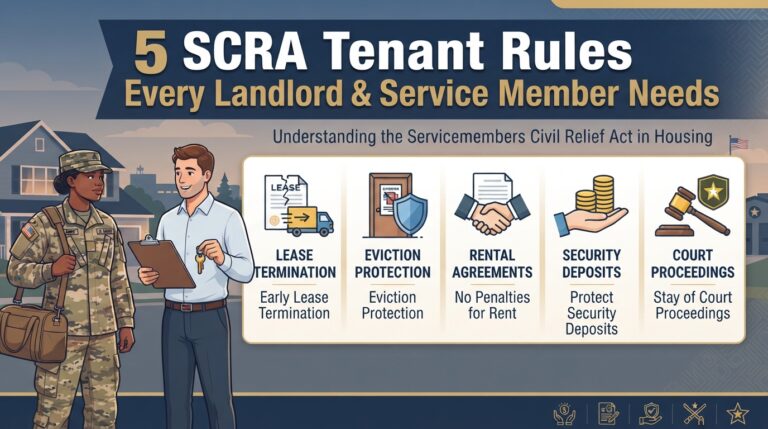
Renting property to active-duty military personnel provides landlords with a highly reliable tenant pool. Service members possess steady employment, strict professional accountability, and guaranteed housing allowances. However, managing military tenancies requires a clear understanding of federal protection laws—specifically the Servicemembers Civil Relief Act (SCRA).
Whether you are a civilian real estate investor or an active-duty military service member renting out your primary residence while stationed elsewhere, violating the SCRA can lead to severe legal penalties, mandatory financial restitution, and costly court judgments. Understanding landlord military tenant compliance protects your property business while supporting those who serve. Here are five essential SCRA rules every property owner must follow.
1. Early Lease Termination Rights for Deployment and PCS Orders
Quick Answer: The SCRA allows active-duty service members to break a residential lease legally and penalty-free upon receiving Permanent Change of Station (PCS) orders or deployment orders lasting 90 days or longer.
Under federal law, military service members cannot control when or where the Armed Forces send them. When a tenant receives official military orders that require relocation, the SCRA grants them the explicit right to terminate an existing residential lease agreement early.
To legally exercise military lease termination rules, the tenant must meet three basic requirements:
- Active-Duty Status: The tenant entered military service during the lease term, or received orders while already on active duty.
- Qualifying Orders: The tenant receives Permanent Change of Station (PCS) orders or military deployment orders for a period of not less than 90 days.
- Written Delivery: The tenant provides the landlord with a formal written notice of termination along with a copy of their official military orders or a signed letter from their commanding officer.
2. The Exact 30-Day SCRA Lease Termination Timeline
Quick Answer: A SCRA lease termination takes effect 30 days after the next regular rent payment due date following the landlord’s receipt of the written notice and official orders.
A common misconception among landlords is that a service member can hand over military orders and walk away from the property the very next day without paying further rent. The SCRA establishes a precise, fair timeline for lease cancellation.
For month-to-month leases or standard fixed-term agreements where rent is due on the first of the month, the termination timeline operates as follows:
- Notice Date: The tenant delivers written notice and orders on October 15th.
- Next Rent Due Date: November 1st.
- Effective Termination Date: November 30th (30 days after the next rent due date).
During this 30-day window, the tenant remains responsible for paying the full rent amount. However, once the effective date passes, the lease is legally concluded, and no future rent obligations accrue.
3. Prohibition of Early Termination Penalties and Deposit Rules
Quick Answer: Landlords are legally prohibited from charging early termination fees, forfeiting security deposits, or penalizing military tenants who lawfully cancel a lease under the SCRA.
When a tenant breaks a standard commercial lease early, property owners typically charge an early termination fee or retain a portion of the security deposit to cover vacancy losses. Under the SCRA, applying financial penalties to a military tenant exercising their statutory rights is strictly illegal.
Landlords must treat an SCRA termination as a natural lease expiration. Security deposits must be processed and returned in full according to standard state security deposit timeline laws, minus any documented deductions for physical property damage beyond normal wear and tear. Attempting to withhold a deposit to recover lost future rent violates federal law.
4. Eviction Protections During Military Service
Quick Answer: Landlords cannot evict a service member or their dependents from a primary residential dwelling during active military service without first securing a court order.
The SCRA provides robust SCRA eviction protections for service members and their families. If a military family falls behind on rent while the service member is deployed or on active duty, a landlord cannot execute a self-help eviction, change locks, or file standard summary eviction proceedings without judicial oversight.
When a landlord requests an eviction order against a military tenant, the court evaluates whether the tenant’s military service materially affects their ability to pay rent. Judges frequently stay (pause) eviction proceedings for up to 90 days or adjust the lease terms to allow the family to resolve back rent without losing housing.
5. Professional Management and Local Military Compliance
Quick Answer: Partnering with an experienced property management company ensures all lease agreements, military addendums, and order verifications comply fully with federal SCRA statutes and local landlord-tenant laws.
Navigating federal military housing regulations alongside state-specific landlord laws requires continuous legal oversight. A single improper lease clause or delayed deposit return can result in federal civil enforcement actions by the Department of Justice (DOJ).
For landlords owning rental properties near active military installations or major metropolitan hubs, managing military leases demands precise legal adherence. Working with experts who specialize in residential property management in Salt Lake City ensures your rental agreements incorporate required SCRA addendums, track official order submissions, and process security deposits accurately while keeping your investment cash flow protected.
6. Myth vs. Fact: SCRA Lease Rules
Clearing up common legal misconceptions prevents costly administrative mistakes:
| Misconception | SCRA Legal Reality |
| “A service member can break a lease verbally without showing paperwork.” | Written notice and official military orders (or a command letter) are legally required to trigger SCRA rights. |
| “Landlords can charge a re-keying fee when a military tenant leaves early.” | SCRA prohibits imposing any fees or penalties associated with early lease termination. |
| “SCRA protections only apply to the service member, not their spouse.” | Spousal co-signers who share the primary residence are protected under the same SCRA lease termination rights. |
7. SCRA Landlord Compliance Checklist
Use this operational checklist when processing a military tenant’s notice to vacate:
- [ ] Request Official Documentation: Verify receipt of written termination notice alongside official PCS or deployment orders (90+ days).
- [ ] Calculate Termination Date: Establish the effective termination date (30 days after the next regular rent payment due date).
- [ ] Audit Account Statements: Ensure no early termination, re-letting, or administrative fees are added to the tenant’s ledger.
- [ ] Conduct Move-Out Inspection: Document physical property conditions and differentiate between tenant damage and normal wear and tear.
- [ ] Process Security Deposit: Return the remaining security deposit with an itemized statement within the state-mandated timeframe.
Complying with the Servicemembers Civil Relief Act is both a legal duty and sound business practice for residential landlords. By recognizing early termination rights, following exact 30-day timelines, eliminating improper penalty fees, and respecting judicial eviction protections, real estate investors can maintain a compliant, profitable rental operation while providing high-quality housing to active-duty service members.
