



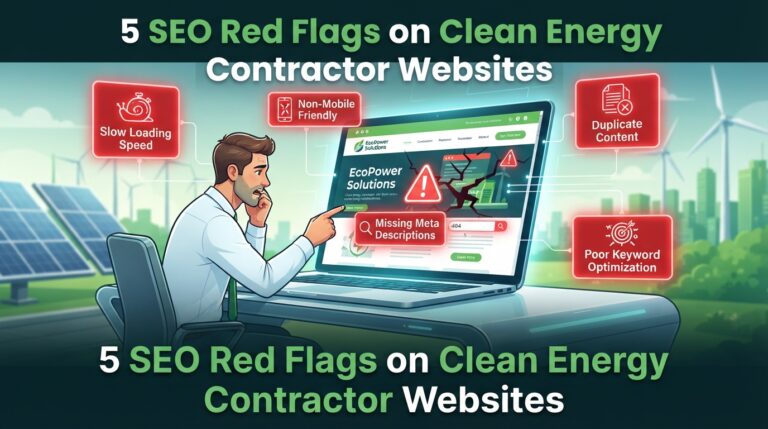
Demand for residential solar installations, heat pumps, EV charging stations, and home battery storage continues to surge across the country. Yet, many green energy contractors struggle to capture local online search traffic. They invest heavily in modern website redesigns, only to watch competitors dominate the top Google rankings and map packs.
When a clean energy website fails to generate organic leads, the culprit is rarely a lack of market interest. More often, underlying search engine optimization (SEO) flaws actively suppress search visibility. Identifying and resolving these technical and structural red flags allows renewable energy contractors to stop wasting ad spend and build a steady pipeline of organic customer inquiries.
1. Doorway Pages and Duplicate City Location Content
Quick Answer: Creating dozens of identical location pages that only swap out town names triggers search engine spam filters for doorway pages, eroding your domain authority.
Many solar and HVAC contractors attempt to expand their geographic reach by generating hundreds of automated landing pages for every surrounding suburb. These pages usually feature identical paragraphs with only the city name, zip code, or county swapped out.
Search engines treat these as “doorway pages.” Rather than helping you rank across an entire metropolitan area, mass-producing thin, repetitive content signals low quality to search algorithms. To build sustainable solar contractor local SEO, focus on creating unique, high-value regional landing pages that showcase real local projects, customer reviews from that specific zip code, and regional incentive or permitting information.
2. Missing Local Business Schema and NAP Inconsistencies
Quick Answer: Omitting structured schema markup and publishing inconsistent Name, Address, and Phone (NAP) details confuses search engines and drops your business out of local Google Map packs.
Clean energy installation is inherently local. When a homeowner searches for “heat pump installer near me” or “best solar panel company,” search algorithms rely on explicit localized trust signals to build local search packs.
A major red flag during a clean energy website SEO audit is the absence of JSON-LD schema markup. Without structured data, search crawlers struggle to verify your exact service radius, operating hours, and licensing. Furthermore, mismatched addresses or phone numbers across your website footer, Google Business Profile, and local trade directories undermine search engine trust.
3. Slow Mobile Load Times and Uncompressed Asset Files
Quick Answer: Heavy, uncompressed installation photos and unoptimized scripts slow down mobile load times, driving away high-intent homeowners and lowering search rankings.
Homeowners frequently research renewable energy upgrades on mobile devices while looking at their monthly utility bills. If your website takes more than three seconds to load on a smartphone, over half of those visitors will hit the back button.
Clean energy websites are notoriously image-heavy, featuring high-resolution drone shots of rooftop solar arrays or complex mechanical room heat pump installs. Uploading raw, multi-megabyte JPEG files directly to your server cripples mobile performance. Compress all media into modern WebP formats, implement lazy loading for images below the fold, and minify background JavaScript files to keep your site fast and responsive.
4. Thin Content Lacking E-E-A-T and Regulatory Depth
Quick Answer: Publishing generic, AI-generated content without credential verification, NABCEP certifications, or state licensing details fails Google’s E-E-A-T quality standards.
Installing high-voltage electrical equipment or solar arrays represents a major financial investment for homeowners. Because clean energy purchases involve significant consumer expenditure, search engines evaluate these websites under strict Experience, Expertise, Authoritativeness, and Trustworthiness (E-E-A-T) guidelines.
Generic articles that fail to explain local net metering policies, federal tax credits (such as Inflation Reduction Act incentives), or local utility interconnection rules signal a lack of real-world expertise. To establish authority, contractor websites should explicitly display:
- NABCEP and Trade Certifications: Highlight master electrician licenses and manufacturer certifications.
- State License Numbers: Display contractor license details prominently in header or footer sections.
- Detailed Case Studies: Detail real system sizing, production estimates, and verified utility bill savings for real clients.
5. Ignored Technical Errors and Broken Site Architecture
Quick Answer: Broken internal links, missing 301 redirects, and orphaned service pages prevent search bots from indexing your full catalog of clean energy services.
As contractor websites grow to include new services—such as adding EV charger installation or commercial battery storage—site architecture often becomes cluttered. Broken links, internal 404 errors, and missing 301 redirects during domain migrations drain your website’s crawl budget.
Resolving underlying technical SEO for green energy contractors requires auditing site structure regularly. Ensure primary services are organized logically under clear parent categories, maintain an updated XML sitemap, and verify that every service page is linked internally from relevant blog posts or main navigation menus.
Fixing the Leaks: Modern Search Strategy for Contractors
Quick Answer: Partnering with an experienced digital marketing agency eliminates technical site errors, structures your local content, and turns organic search traffic into qualified installation estimates.
Eliminating technical debt and optimizing site architecture requires specialized digital expertise. Clean energy contractors often lack the internal bandwidth to fix structured data errors, optimize server response speeds, and map out hyper-local content strategies while managing active installation crews.
To build an organic lead generation engine, working with a specialized SEO company in Utah or regional digital marketing partner ensures your website adheres to modern search standards. Professional SEO specialists conduct comprehensive technical audits, eliminate doorway page risks, optimize Google Business Profiles, and craft authoritative content that converts local searches into booked site assessments.
Myth vs. Fact: Clean Energy Website Optimization
Understanding current search realities prevents contractors from wasting resources on outdated tactics:
| Misconception | Modern SEO Reality |
| “Adding a list of 50 city names to my homepage footer helps me rank regionally.” | Search engines view keyword-stuffed location footers as web spam, which can harm your overall rankings. |
| “Stock photos of solar panels work just as well as real project pictures.” | Original photos of your actual installation crews build superior E-E-A-T trust signals for both users and search bots. |
| “Focusing only on high-volume keywords like ‘solar panels’ drives the best leads.” | Long-tail, local intent keywords (e.g., “ground mount solar cost in [County]”) convert at a significantly higher rate. |
Clean Energy Contractor SEO Health Checklist
Run through this diagnostic checklist to evaluate your website’s search readiness:
- [ ] Schema Verification: Is LocalBusiness or SolarInstaller schema active and error-free in Google’s Rich Results Test?
- [ ] NAP Audit: Are your business name, physical address, and phone number 100% identical across all web pages and directories?
- [ ] Mobile Speed Test: Does your site score above 80/100 on Google PageSpeed Insights for mobile devices?
- [ ] E-E-A-T Signal Check: Are contractor license numbers, certifications, and real team photos clearly visible?
- [ ] Unique Location Content: Is every regional service page filled with unique local case studies and real project photos?
- [ ] Crawl Audit: Are there zero 404 broken link errors or orphaned service pages in your search console report?
Building a dominant online presence in the clean energy sector requires moving past superficial design and addressing core search fundamentals. By eliminating duplicate doorway pages, implementing local schema, accelerating mobile page speeds, displaying explicit industry credentials, and resolving technical crawl errors, clean energy contractors can outperform local competitors. Treating your website as a high-performance sales asset ensures a steady stream of qualified local homeowners finding your business naturally through organic search.
