



Search for almost any peptide and the results fill up with sellers. Search for retatrutide in particular — a compound that has completed Phase 3 trials and has been approved nowhere — and the phrase “reta peptides where to buy” has become one of the most-typed queries in the space. That is not a coincidence, and it is not a sign of a healthy market. It is what happens when clinical demand runs years ahead of a legal supply chain. People who set out to buy peptides online are not buying a medicine, and the difference is not a formality.
None of the checks in this article will make an unapproved compound safe. What they will do is separate a supplier who documents what they sell from one who is selling an unknown quantity in a vial with a label on it — and that separation is the only meaningful quality signal available in this market.
Why the market looks like this
The structure of the problem is worth stating plainly, because it explains every red flag that follows.
An approved medicine arrives with guarantees that are largely invisible to the patient: the active ingredient is what the label says, at the stated dose, manufactured to a defined standard, tested for sterility and contamination, released batch by batch, and tracked after release so that rare harms get found. None of that is free, and none of it exists for a compound that has not been approved.
When demand for such a compound appears anyway — and with retatrutide it appeared the moment the first weight-loss figures were reported — the market that serves it has to substitute something for all of those guarantees. What it substitutes, in most cases, is a disclaimer. For research use only. Not for human consumption. That sentence is the entire quality system for a large part of this industry. A search to buy retatrutide today returns hundreds of sellers and not one approved medicine.
What the disclaimer actually means
It is a legal position, not a safety claim. It exists because these compounds cannot legally be sold as medicines, so the seller distances the transaction from a use the product is not licensed for.
It tells you nothing about the contents of the vial. A properly manufactured, analytically verified peptide and an inert powder carry exactly the same label. Reading it as reassurance — in either direction — is a category error, and sellers know that buyers do it.
What the disclaimer does tell you is where the verification burden has moved. Downstream of an approval, the manufacturer carries it. Without one, the buyer does. Every check below exists because of that single fact.
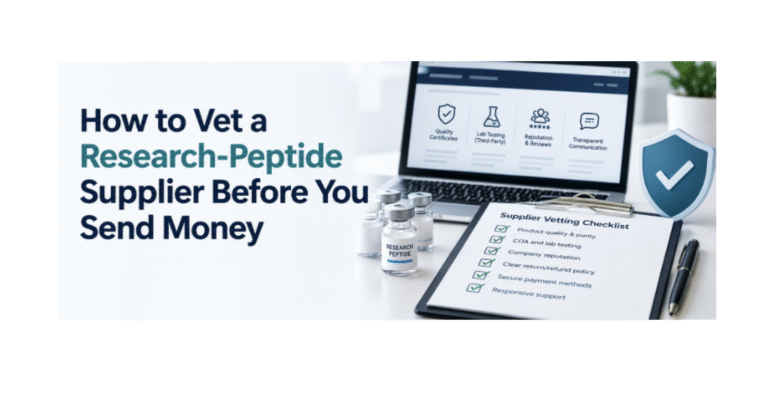
The five checks worth running before you send money
1. A batch-specific certificate of analysis, with the raw data
This is the first question and the one that filters most effectively.
What you want: a certificate that names the specific batch number printed on the vial you are buying, was produced by an independent laboratory rather than in-house, and includes the underlying analytical data — a chromatogram showing a single clean peak and a mass spectrometry result confirming the molecular weight.
What you do not want: a headline purity figure with nothing behind it. “99.2% purity” with no chromatogram is a claim about a test you cannot see, and it is trivial to produce. A certificate that has been reused across months of listings is describing a sample that no longer exists. A certificate with a batch number that does not match the vial in the product photograph refers to a different object entirely.
The check takes two minutes. Ask for the certificate, then confirm the batch number matches. Suppliers who publish this material openly — a catalogue like dragonpharmastore.to, for instance, lists documentation alongside the compound rather than on request — have already answered the question. Where it is absent, the absence is the answer.
2. Sterility and endotoxin testing
For anything injectable, this matters more than a purity percentage, and it is the check most often skipped.
Purity tells you how much of the peptide is the peptide rather than related substances. It says nothing about whether the vial is sterile, and nothing about bacterial endotoxin — the contaminant responsible for the acute fever, rigors and hypotension people describe after a bad injection. Endotoxin is not a theoretical concern; it is the reason pharmaceutical manufacturers test every batch against a stated limit.
Look for a named method against a recognised standard — membrane filtration or direct inoculation for sterility, and a limulus amebocyte lysate assay for endotoxin, with the limit stated in the certificate. A supplier who tests for purity but not for sterility has tested the thing that is easy to test rather than the thing that causes harm.
3. Cold chain and shipping
Peptides degrade with temperature and time, which is why they are freeze-dried in the first place. That protection only holds if the product is stored and shipped appropriately.
Ask how it is dispatched, how long transit typically takes, and what happens if a parcel sits in a depot over a weekend. Lyophilised powder tolerates short excursions; reconstituted material tolerates almost nothing. A supplier who cannot describe their shipping method in specific terms — packaging, temperature control, typical transit time — is not describing the product that will arrive.
Sellers based far from you, offering expedited international shipping at low cost, are a particular category to think about: a peptide that has spent a week in transit at ambient temperature may still pass a purity test on arrival and behave nothing like the sample that was tested. The gap between a cheap sermorelin for sale listing and one that ships properly is usually exactly this.
4. Payment method, and what it tells you
The payment options are a risk profile, not an inconvenience.
Card payments give you a dispute mechanism. Bank transfers, crypto and payment apps generally do not: once sent, they are gone, and a seller who has asked for them has also removed the only leverage you would have had. That does not automatically make a supplier dishonest — legitimate sellers use crypto — but it does mean the recourse you are giving up should be weighed against everything else you know about them.
Be sceptical of a seller who offers several payment methods and pressures you toward the one with no recourse. That pattern is common enough to be worth naming.
5. Contact details and a trackable history
A supplier worth using has an identity you can examine: a domain with a history, a working contact address that answers, published terms, and a presence that predates the current demand spike.
Check the domain registration date. A site selling a compound that went viral this year, registered three months ago, with no history and no answer to email, is not a business with a reputation to protect. Most of the risk in this market sits in exactly that category, because very little of it sits anywhere else.
The red flags, in one place
Any one of these can be explained away. Two or three together describe a pattern, and the pattern is what matters.
The questions, in writing
One habit separates buyers who get what they paid for from buyers who do not: asking in writing, and reading the answer rather than the tone of it.
Five questions cover it. What is the batch number on the vial I am about to receive, and can I see the certificate for that batch? Which laboratory produced the certificate, and is it independent of your business? Does the certificate include sterility and endotoxin results, with the method and limit stated? How is the parcel shipped, how long does transit typically take, and is it temperature controlled? And what is your returns position if the batch number on arrival does not match the certificate?
A supplier with documentation answers these in a paragraph, or points at a page that already does. A supplier without it answers the first question with a different question, or with a sentence about how long they have been in business. That difference is the entire exercise, and it takes less time to run than reading the reviews.
When something goes wrong
There is no refund mechanism for a poor-quality peptide, and no regulator to complain to about the product itself. What exists is a reporting system.
Adverse events following self-administered, unapproved compounds can be reported to the FDA through MedWatch, and reports of this kind have already been filed for retatrutide specifically. Reporting matters more than it might appear: the safety database for these compounds is being assembled from exactly this kind of report, and the fact that reporting exists at all is a useful thing for buyers to know.
The other thing worth knowing is what to do in the moment. Because the compounds are unapproved and often self-administered, the treating clinician may have no baseline to work from. Being able to say exactly what was taken, at what concentration, from which batch, with the certificate in hand, changes the quality of the care that follows. Documentation is not just a purchasing check — it is the record you will want if anything goes wrong.
The short version
The research-peptide market exists because demand for compounds outpaced approval, and everything difficult about it follows from that. The label does not protect you, the price does not tell you much, and the reviews are largely worthless.
What is left is documentation and behaviour: a batch-specific certificate with real data behind it, sterility and endotoxin testing, a described cold chain, payment terms that do not remove all of your leverage, and a supplier with a history to lose. Those five checks will not tell you whether a compound is appropriate to use. They will tell you whether the person selling it knows what they are selling — and in a market with no other guarantees, that is the whole of the question.
