



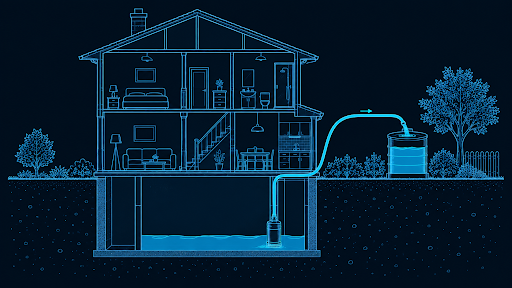
Why does one corner of the lawn stay wet for a week after every downpour, while the rest dries out in a day? Most homeowners ask that question for the first time in autumn, when the ground is already saturated and the rain keeps arriving. By the time water is sitting against the back door or seeping into a cellar, the search for a solution gets urgent, and that’s rarely the best moment to be learning about pumps.
Best water pumps roundups usually open with a list of brand names, which is the wrong starting point. The useful question is what job you need doing: shifting standing water, watering a garden, raising the pressure in a shower, or moving waste water uphill. Specialist retailers organise their ranges around exactly that logic. Waterpump.co.uk, which has been selling pumps across Europe since 2011, sorts its catalogue by situation and even offers a short questionnaire to narrow the choice, because a pump that’s perfect for one of those jobs is useless for another.
Match the pump to the problem
Before looking at power ratings, work out what you’re actually moving and where it needs to go. This table covers the situations most UK households run into.
| The problem | Type of pump | The thing to check first |
| Standing water in a cellar, garage or light well | Submersible pump | Whether the water is clean or contains grit and debris, since dirty-water models pass larger particles |
| Watering the garden from a butt, pond or ditch | Garden pump, a self-priming type | How far the pump sits above the water surface |
| Weak pressure at taps and showers, or feeding a rainwater system | Pressure pump | Whether it switches on and off automatically with demand |
| Drawing from a well or borehole | Borehole pump | The diameter of the shaft, since these are built narrow |
| A toilet or utility room below the level of the drains | Macerator or a sewage pumping station | Whether it handles waste water as well as clean |
| Radiators heating unevenly | Central heating circulation pump | Compatibility with your existing heating system |
Most of the confusion in pump shopping comes from mixing these up, usually by buying a garden pump to clear a flooded floor and finding that it can’t lift water it isn’t submerged in.
The three families of pump, and why it matters
Beneath all those categories sit three basic designs. Knowing which one you’re looking at explains most of what a pump can and can’t do.
Self-priming pumps
These sit outside the water and pull it up through a suction hose. Inside the housing are impellers, closed rotor blades that create suction and pressure as they spin. As a rule, the more impellers a pump has, the more pressure it can generate, which is why pressure pumps and borehole pumps use several. There’s a physical ceiling on the suction side, though: a self-priming pump can draw water from a maximum depth of about 8 metres, whatever the marketing says.
Centrifugal pumps
Centrifugal designs are close cousins with little or no self-priming ability, so they have to be started manually or fed water by the system they sit in. That makes them common in closed circuits, such as central heating, or wherever the water arrives at the pump under its own head.
Submersible pumps
These go into the water rather than beside it. Their open impellers push water against the inside of the housing and out through the delivery outlet, where a hose carries it away. That design is what makes them the right tool for a flooded basement, a pond that needs emptying or a sump that fills after heavy rain.
Buying sensibly, and planning ahead
A pump bought in a panic is usually the wrong one. If your property has any history of water problems, it’s worth checking the long-term risk on the government’s flood information service and buying the right equipment before you need it. A few practical points make the difference between a pump that solves the problem and one that sits in the shed:
- Look at flow rate and head together. Litres per hour tells you how fast the pump moves water; the head figure tells you how high it can push it. A pump with plenty of flow can still fail if it has to lift water up two flights of stairs.
- Check the maximum particle size for anything draining a cellar or a pond, because silt and grit will jam a clean-water model.
- Think about where the water goes. Discharging into a drain that’s already overwhelmed just sends it back to you.
- Plan the power supply. Outdoor sockets and extension leads used with pumps need proper weatherproofing and RCD protection, and this is the part worth handing to an electrician.
- Store it ready to use. A pump still in its box in the loft, with no hose attached, is no use at two in the morning.
Buying advice is easy to find, but much of it is written for a different climate or a different plumbing system. For more home and garden reading aimed at UK households, the Bents Magazine blog collects practical guides across the site. And if you’re unsure which category your problem falls into, most specialist suppliers, including Waterpump.co.uk, will take a phone call and talk it through before you spend anything.
