



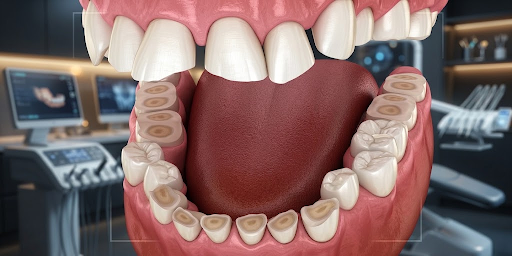
Porcelain veneers last longer. On front teeth, a well made porcelain veneer typically holds up for 10 to 15 years, and a good number keep going well beyond that, while composite bonding usually needs repair, repolishing or replacement somewhere between year four and year eight. Porcelain simply wins on the measures that decide longevity: surface hardness, stain resistance and colour stability over time.
That answer comes with a condition worth understanding before you book anything. Veneers usually require a small amount of enamel to be removed, often in the region of 0.3mm to 0.7mm on the front surface, and that change is permanent. Composite bonding is additive, which means it sits on top of your existing tooth and can be adjusted, patched or removed with far less consequence. So the real question is not just which lasts longer, but which type of maintenance you would rather sign up for over the next two decades.
How long composite bonding really lasts on front teeth
Modern nano hybrid composites are a long way ahead of the materials used fifteen years ago, and clinical follow up studies generally put anterior bonding survival in the five to seven year range before some form of intervention is needed. That intervention is often minor. A chipped incisal edge can be rebuilt in twenty minutes, and a dulled surface can be repolished at a routine hygiene appointment.
Where composite loses ground is at the margins and on the surface. The material is porous compared with ceramic, so it absorbs pigment from coffee, red wine, tea, turmeric and tobacco. Most people notice the shade drifting slightly warmer or greyer around the two to three year mark, particularly along the join where the composite meets natural tooth.
Edge bonding, the small additions used to even out worn or slightly uneven incisal edges, tends to have a shorter life than full facial bonding. Those edges take the direct force of biting, so a thin composite lip on an upper central incisor lives a harder life than composite covering the middle of the tooth. Anyone who bites nails, opens packaging with their teeth or holds hair grips between their incisors should assume the lower end of that range.
Why porcelain veneers hold their appearance for longer
Porcelain veneers are made from ceramics such as lithium disilicate or layered feldspathic porcelain, fired in a laboratory and bonded to the prepared tooth. Glazed ceramic is effectively non porous, so it does not take on stains the way composite does. A veneer placed in 2026 should look close to the same shade in 2036, which is not a claim composite can make.
The failure modes are different too. Veneers rarely dull or discolour. When they fail, they usually fracture, debond or develop a visible margin as the gum recedes over the years and exposes the junction between porcelain and tooth. Recession is slow, so this is more of a year eight to year twelve concern than an early one.
There is also a durability point people miss. A veneer bonded to healthy enamel lasts considerably longer than one bonded to dentine or to an old filling, because the adhesive bond to enamel is stronger and more stable. If your front teeth have already been heavily restored, the expected lifespan drops, and that is worth asking about directly rather than accepting a generic figure.
Cost, appointments and what you are actually paying for
In the UK, composite bonding on a front tooth commonly falls somewhere between £250 and £500 per tooth, with higher figures in central London practices where the work is done freehand by a dentist with a specific cosmetic focus. Porcelain veneers usually sit between £800 and £1,500 per tooth, occasionally higher when a specialist ceramist is involved in the shade layering.
Divide those numbers by expected lifespan and the gap narrows more than most people expect. Six years of bonding at £400 works out at roughly £67 a year per tooth. Twelve years of porcelain at £1,000 works out at about £83. Porcelain is still more expensive annually, but not dramatically so, and the difference shrinks further if the veneers outlive their estimate.
The time commitment differs as well. Composite bonding is usually completed in a single appointment, often 45 to 90 minutes for two to four teeth, with no laboratory stage and no temporaries. Veneers typically need two or three visits across two to four weeks, including preparation, temporary veneers and a fitting appointment, plus a trial smile or digital mock up beforehand if you want to see the shape before anything is cut.
How your bite, your habits and your age change the answer
Grinding is the single biggest predictor of early failure for both materials. If you clench at night, composite chips and porcelain fractures, and no amount of skill at the fitting appointment changes the physics of that. The NHS notes that teeth grinding is frequently linked to stress or anxiety and that a mouth guard or splint made to fit precisely is the standard way to protect teeth from the damage it causes. A properly fitted night guard, worn consistently, is the cheapest longevity insurance available for either treatment, and most practices will recommend one as part of the plan rather than as an afterthought.
Age matters too, and it works in an interesting direction. For someone in their early twenties whose gum levels are still settling and whose tastes may change, composite is often the sensible starting point because it preserves enamel and keeps every option open later. For someone in their forties or fifties with existing wear, old bonding and a shade that has darkened over decades, porcelain usually makes more sense because it addresses colour and structure at the same time.
Then there is what you actually need corrected. Small chips, minor spacing and slightly short edges suit bonding well. Deep internal staining, tetracycline discolouration, significantly worn or misshapen teeth and cases where the smile line needs redesigning tend to sit beyond what composite can do convincingly, which is why a consultation at a specialist cosmetic dental practice often begins with photographs and a discussion of proportion rather than a straight material comparison.
The maintenance question nobody asks about early enough
Both options need upkeep, and the schedules differ. Composite benefits from a polish every 12 to 18 months to restore surface gloss and slow staining, which most dentists will fold into a hygiene visit for a modest fee. Porcelain needs no polishing at all, but it does need the hygienist to avoid certain instruments and air polishing powders that can scratch the glaze, so the practice keeping your records matters.
Whichever you choose, plan for the replacement rather than hoping it never comes. Composite bonding will need refreshing at least twice in twenty years, and porcelain veneers will need replacing eventually, at which point removing them and preparing again takes a little more tooth structure. Ask at the consultation what the second round looks like, what it will cost and how much enamel will be left. The dentist who answers that question honestly, with reference to your specific enamel thickness and bite, is the one worth trusting with your front teeth.
