



Why Startups Need an AI Stack
AI has stopped being an experiment for startups and become an operating requirement. A three-person team can now handle research, product development, marketing, sales, support, and admin work that used to take a much larger headcount. The shift isn’t about having access to AI; almost every founder does. It’s about how deliberately that access gets used.
That’s where the idea of an AI startup stack comes in: a coordinated set of tools that cover a startup’s core functions, rather than a pile of disconnected subscriptions collected because they looked useful at the time. The difference matters. A founder with fifteen AI tools and no plan usually isn’t more productive than one with five tools that actually talk to each other. The goal isn’t the most tools, it’s the right combination for the problems that matter most right now.
If you want to browse individual tools once you know what you’re looking for, HyScaler’s guide to 100 AI tools for startup founders is a useful reference point to come back to throughout this article.
What Is an AI Startup Stack?
An AI startup stack is the collection of AI-powered tools, software, automations, and agents a startup relies on across its core operations- not a single app, but a layered system.
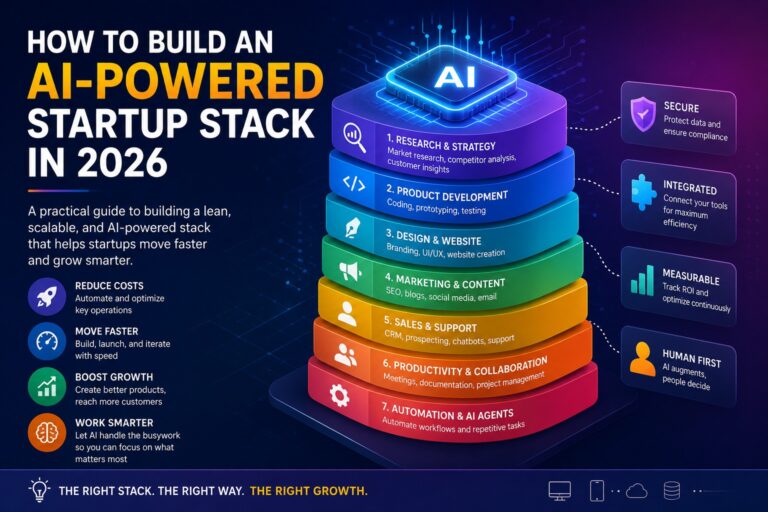
The Core Layers of an AI Startup Stack
- Research & strategy: market research, competitor analysis, customer insights
- Product development: coding, prototyping, testing
- Design & website: branding, UI/UX, website creation
- Marketing & content: SEO, blogs, social media, email
- Sales & customer support: prospecting, CRM, chatbots, support
- Productivity & collaboration: meetings, documentation, project management
- Automation & AI agents: repetitive workflows and autonomous tasks
The best AI stack isn’t the one with the most tools. It’s the one that solves the most important problems with the least complexity.
Why AI-Powered Startup Stacks Matter in 2026
Reduce Operational Costs
AI automates repetitive work and cuts reliance on multiple standalone services, letting lean teams accomplish more without proportional headcount growth.
Accelerate Product Development
AI-assisted coding, rapid prototyping, and faster debugging shorten the distance between an idea and a working MVP.
Increase Marketing Output
Faster content production, SEO research, social repurposing, and campaign assistance let small teams produce at a pace that used to require a full marketing department.
Improve Founder Productivity
Meeting summaries, research assistance, task management, and internal knowledge retrieval free up hours that founders can redirect toward decisions only they can make.
The Essential AI Tools Every Startup Stack Should Cover
Rather than listing dozens of individual products, it’s more useful to know what to look for in each layer.
1. AI Research Tools
Covers market research, competitor research, customer discovery, and trend analysis. These tools help founders move faster, but important business decisions should still be checked against reliable sources and real customer feedback, not treated as final answers.
2. AI Development Tools
Covers AI coding assistants, AI-native development environments, no-code/low-code AI builders, and testing and debugging tools. Technical and non-technical founders will lean on this layer very differently: one group ships faster, the other ships at all.
3. AI Marketing & Content Tools
Covers blog content, SEO, social media, email campaigns, and content repurposing. AI should accelerate the workflow, not replace editorial judgment; the fastest content isn’t worth much if it doesn’t sound like the brand.
4. AI Sales & Customer Support Tools
Covers lead research, lead qualification, personalized outreach, chatbots, and customer support automation. This is often where founders see the clearest ROI, since support and prospecting are time-heavy and repetitive by nature.
5. AI Productivity & Automation Tools
Covers meeting notes, documentation, task management, workflow automation, and AI agents that handle multi-step processes without constant supervision.
How to Build an AI Startup Stack Step by Step
Step 1: Audit Your Current Workflows – Identify the processes that are repetitive, time-consuming, or expensive relative to the value they produce.
Step 2: Prioritize High-Impact Problems – Rank potential AI use cases by time saved, cost reduction, revenue impact, and ease of implementation, in that rough order.
Step 3: Choose One Primary Tool Per Function – Resist subscribing to three tools that do the same job. Pick one, learn it well, and add a second only if there’s a real gap.
Step 4: Connect Your Tools – Look for integrations with your CRM, project management software, communication platforms, cloud storage, and developer environments. A stack that doesn’t talk to itself creates as much manual work as it removes.
Step 5: Establish Human Oversight – AI-generated content, customer responses, code, and business recommendations should all get an appropriate level of human review before they go out the door.
Step 6: Measure ROI – Track hours saved, cost per task, revenue generated, conversion improvements, and productivity gains, not just whether the tool feels useful.
AI Startup Stack by Business Stage
Growing Startup
Goal: scale operations without adding unnecessary complexity. For startups exploring AI agents, this AI agent blueprint offers a practical framework for getting started.
Pre-Launch / Solo Founder
Prioritize research, MVP development, website creation, content, and basic automation. Goal: validate the idea with minimal spending.
Early-Stage Startup
Prioritize product development, marketing, CRM, customer support, and collaboration tools. Goal: build repeatable processes.
Growing Startup
Prioritize advanced automation, AI agents, sales intelligence, customer support automation, and data/knowledge management. Goal: scale operations without adding unnecessary complexity.
Common Mistakes When Building an AI Stack
- Using too many AI tools: more subscriptions often create more complexity, not more productivity.
- Choosing tools because they’re trending: evaluate against actual business requirements instead.
- Ignoring integrations: disconnected tools create manual work and duplicate data.
- Automating the wrong process: AI can’t fix a poorly designed workflow; it just makes the mess move faster.
- Ignoring data security: understand how vendors handle your business and customer data before you commit.
- Not measuring ROI: a tool that isn’t demonstrating measurable value is a subscription, not a stack component.
Where to Find the Right AI Tools for Your Startup
There’s no universal AI stack that works for every startup; the right combination depends on the founder’s role, industry, team size, technical capability, budget, and growth stage. Rather than researching hundreds of products individually, it helps to start from a curated directory and narrow down from there.
Build a Leaner, Smarter AI Stack
Successful AI adoption is about fixing workflows, not collecting tools. Start with the problems that matter most, choose tools that integrate cleanly, keep people involved where judgment counts, and measure ROI so you can drop what isn’t earning its place.
Building the right AI stack starts with knowing what’s available. For a deeper look at the tools available across research, development, design, marketing, sales, productivity, automation, and AI agents, explore HyScaler’s guide to 100 AI tools every startup founder should know; it’s organized by function, which makes it easier to find what fits your current stage rather than scrolling through an undifferentiated list.
