



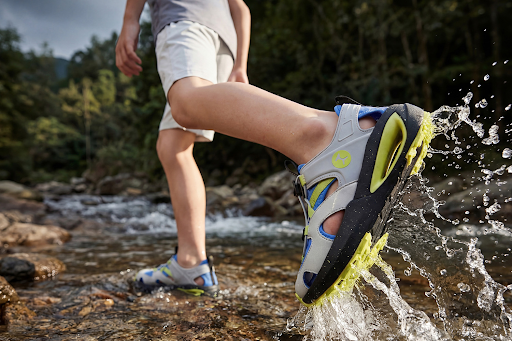
Children’s feet put in a serious shift. They run, jump, pivot and land hundreds of times a day, usually on something hard, usually at full tilt. And they’re still growing, which is what makes buying the right shoe both more important and easier to get wrong than people expect.
Here’s what’s actually worth paying attention to in 2026, once you get past the colour and whatever character is printed on the side.
Fit matters most, and it keeps changing
Feet grow in fits and starts, and a shoe that fit fine two months ago can already be too tight. You want roughly a thumb’s width of room at the toe, a heel that stays put without rubbing, and comfort straight out of the box — kids’ shoes shouldn’t need breaking in. Because the growing never really stops, it pays to check the fit every couple of months rather than assuming a size will see them through.
It should bend where the foot bends
A child’s foot needs to flex naturally. Shoes that are too rigid fight that and make running feel clumsy. A good kids’ running shoe bends at the ball of the foot — where the foot actually bends — while still holding the rest steady.
Lighter helps more than you’d think
Kids are working with smaller, still-developing muscles, so a shoe that feels light to you can feel like a brick to them. A lighter shoe means less fatigue and more time spent moving, which is usually the entire point of buying it.
Let the feet breathe
Active feet get hot and sweaty. A breathable upper — mesh, basically — keeps things cooler and drier and heads off the blisters that bring play to a sudden stop.
Grip, but the right kind
Traction matters, though what you need depends on where they play. For most kids, a versatile, well-cushioned everyday trainer handles the playground, gym class and casual sport without fuss. Sport-specific outsoles only really come into it once a child is training seriously on a particular surface.
Cushioning, in proportion
Children don’t need the elaborate support systems sold in adult performance shoes. They need responsive cushioning to soak up the landings, plus a stable, secure fit. An over-engineered shoe can be just as unhelpful as a flimsy one.
Where good design shows up
As kids’ activewear has grown into its own category, some specialists have carried that movement-first thinking into footwear. moodytiger, for example, makes light kids’ trainers — including cooling, cushioned summer styles — on the same principle that runs through its clothing: design it for how children move, rather than shrinking down something built for adults.
What changes as kids get older
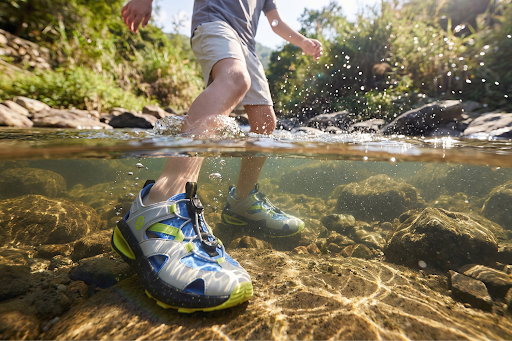
A four-year-old and a ten-year-old need fundamentally different things in a shoe, even if they’re doing the same activity. Younger children are still developing the arch and the small muscles of the foot, which means a softer, more flexible sole is usually appropriate — the foot itself is doing a lot of the work. Older kids have more developed foot structure and often more specific sporting demands, so a shoe with a bit more directional support starts to make sense.
The transition years — roughly eight to twelve — are also when kids start to develop preferences of their own. Giving them some input into the choice isn’t just easier on you: children who like their shoes tend to wear them more, and a shoe that gets worn is doing its job. That said, fit and function should still lead. A shoe a child chose but immediately finds uncomfortable will sit by the door unworn inside a week.
Common mistakes and how to avoid them
Buying too big is the one parents do most. The logic is reasonable — buy a size up, get more wear out of them — but a shoe with too much room shifts around and causes blisters just as readily as one that’s too tight. The thumb’s width of growing room at the toe is the right amount. More than that and the heel lifts.
Measuring too infrequently is the other easy mistake. Children’s feet can jump a full size in three months. A shoe bought in September may be too small by Christmas, with no obvious sign until a child starts complaining about their feet or, more often, stops complaining and just quietly stops wanting to run. A quick check every two months for younger children, every three for older ones, is the simplest way to stay ahead of it.
And then there’s buying on looks alone. Kids’ shoes are full of bold colourways and licensed characters, and children form strong opinions. But a shoe built around a graphic rather than a foot is almost never a shoe built around a foot. The brands worth buying from in 2026 — moodytiger included, with its cooling, cushioned trainers designed specifically around children’s movement patterns — start with the engineering and let the design follow.
The short version
- A thumb’s width at the toe, heel secure and not rubbing.
- Flexes at the ball of the foot.
- Light enough to keep fatigue down.
- Breathable upper.
- Responsive cushioning and a stable fit, nothing over-built.
- A fit check every couple of months.
The best shoe for a kid is the one they stop thinking about the second they start moving.
FAQs
How much room should kids’ shoes have?
About a thumb’s width between the longest toe and the end of the shoe, with a heel that stays secure without rubbing. Feet grow fast, so check every couple of months.
Do kids need proper running shoes, or will any trainers do?
For most children, a light, well-cushioned, versatile trainer covers running, play and gym class. Specialist footwear only really matters once they train seriously in one sport.
How often should I replace them?
Usually when they’re outgrown, which for active kids can be every few months, or when the cushioning and tread are visibly worn down.
