



For many years, smartphones have been the heart of our digital life. We use them when we wake up. We use them to send messages, take photos, watch videos, check maps, pay bills, shop online, and even work. For most people, the phone feels like the one device they cannot live without.
But in 2026, something interesting is happening. New phones still come out every year, but they do not feel as exciting as before. A better camera, a faster chip, or a brighter screen is nice. But for many users, it is not enough to make them rush to buy a new phone.
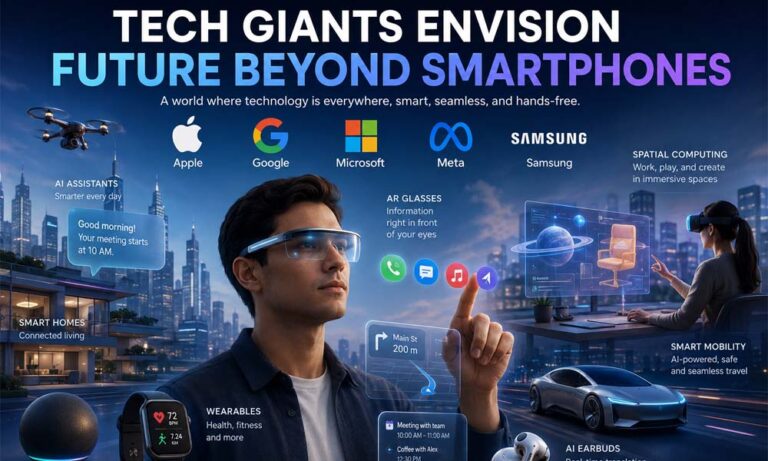
This is why tech giants envision future beyond smartphones. Big companies like Apple, Google, Meta, Samsung, Microsoft, and others are already planning what comes next. They are working on smart glasses, AI helpers, wearables, spatial computing, and new ways to use technology without always holding a phone.
In this article, we will look at why phones are slowly losing their magic. We will also explore how tech giants envision future beyond smartphones and what this change may mean for daily life, work, learning, shopping, and entertainment.
Why Smartphones Are Losing Their Magic
There was a time when every new smartphone felt exciting. A new model could bring a much better camera, a bigger screen, faster internet, or a fresh design. People waited for phone launches with real interest. Buying a new phone felt like a big upgrade.
But today, things are different. Most modern phones are already very good. They take clear photos. They run fast. They have smooth screens. They can handle games, videos, calls, work apps, and almost everything else. So when a new phone comes out, many people ask a simple question: “Do I really need this?”
This is one big reason why people are upgrading less often. A phone from two or three years ago may still work well. It may still have a strong camera and fast speed. So users do not feel the same pressure to replace it quickly.
Another reason is screen fatigue. Many people now feel tired of looking at screens all day. They scroll through social media, reply to messages, watch videos, and use work apps. After some time, the phone can feel less like a fun tool and more like a daily burden.
This change has created a big challenge for tech companies. If phones are no longer exciting enough, where will the next big growth come from? That is where the new race begins. This is where tech giants envision future beyond smartphones and start building the next digital world.
Tech Giants Envision Future Beyond Smartphones for a New Digital Life
When we say tech giants envision future beyond smartphones, it does not mean smartphones will disappear tomorrow. Phones are still useful. They will still be part of daily life for many years. But they may no longer be the center of everything.
Think of it this way. Today, your phone handles almost every digital task. It is your camera, map, wallet, music player, calendar, message box, and work tool. In the future, these tasks may move across many smart devices. Your watch may track your health. Your glasses may show directions. Your AI helper may send messages. Your smart home may manage daily tasks.
This means the phone may become just one part of a bigger system. It may stay in your pocket or bag while other devices do the work around you. The goal is not to remove technology from life. The goal is to make technology feel smoother, easier, and less distracting.
This is a very important shift. For many years, technology asked us to look down at a screen. Now, the next step is to bring digital help into the world around us. Instead of opening apps again and again, users may simply speak, look, move their hands, or let AI handle simple tasks.
That is why tech giants envision future beyond smartphones as a future of less tapping and more natural use. It is a future where technology works quietly in the background and helps when needed.
Tech Giants Envision Future Beyond Smartphones With Wearables
Wearables are already one of the clearest signs of this change. A few years ago, smartwatches and earbuds were seen as small phone accessories. They were useful, but they depended heavily on the phone. Today, they are becoming much more powerful.
A smartwatch can track your heart rate, count your steps, show alerts, answer calls, send quick replies, and even make payments. Wireless earbuds can translate speech, use voice assistants, and help with calls. Smart rings can track sleep and health data. These devices are small, but they are slowly taking over tasks that once needed a phone.
Imagine going for a morning walk. You do not want to carry your phone. Your watch tracks your steps. Your earbuds play music. A call comes in, and you answer it from your wrist. You check your health data later without opening many apps. This is a simple example of how daily life is already moving beyond the phone.
This is why tech giants envision future beyond smartphones with wearables as a key step. Wearables are always with us. They are light, easy to use, and close to the body. They can collect useful data and give quick help without pulling us into a screen.
Apple has the Apple Watch. Google has the Pixel Watch and its Android ecosystem. Samsung has Galaxy wearables. Meta is moving into smart glasses. Many other companies are also building smart rings, fitness bands, health sensors, and connected earbuds.
The idea is simple. Instead of one device doing everything, many small devices will work together. This makes life easier because you do not always need to stop, unlock your phone, open an app, and tap through menus.
AR Glasses May Be the Next Big Device
AR glasses may be one of the most exciting parts of the post-smartphone future. AR means augmented reality. In easy words, it means digital information is added to the real world. Instead of looking down at your phone, useful details may appear in front of your eyes.
Think about walking in a city you do not know. Today, you open a map on your phone. You look down, walk a little, stop, check again, and try not to miss a turn. With AR glasses, arrows could appear on the road in front of you. You could follow the path without looking away from the world.
Now imagine talking to someone who speaks another language. Your glasses could show a live translation as they speak. Or imagine getting a message while cooking. Instead of touching your phone with messy hands, the message could appear softly in your view, and you could reply by voice.
This is why many people believe AR glasses could become the next major device. They can show information without pulling your full attention away. They can help with maps, messages, calls, shopping, learning, and even work.
Meta is already working with Ray-Ban on smart glasses. Apple has introduced spatial computing with Vision Pro and is expected by many watchers to keep moving toward lighter devices. Google has also shown strong interest in AR, AI, and real-time visual help. Samsung is also part of the larger XR and wearable future.
This is one of the clearest ways tech giants envision future beyond smartphones. They want the screen to move from your hand to your view. Instead of holding your interface, you may wear it.
Of course, AR glasses still need to improve. They must become light, stylish, affordable, and comfortable. Battery life must get better too. But the idea is powerful. If glasses can do many phone tasks in a natural way, they could change how people use technology every day.
Tech Giants Envision Future Beyond Smartphones With AI Helpers
AI is another major reason this shift is happening. In the past, voice assistants were simple. You asked for the weather, set a timer, or played music. They were useful, but limited. In 2026, AI is becoming much smarter and more helpful.
Modern AI can understand longer questions. It can summarize long text. It can help write emails. It can plan tasks. It can answer questions in a more natural way. It can also work across apps, devices, and services. This changes the way people interact with technology.
Today, if you want to book a trip, you may open many apps. You check flights, compare hotels, read reviews, look at maps, and message someone. In the future, your AI helper may handle much of this for you. You may simply say what you need, and the assistant can help with the steps.
This matters because smartphones were built around apps. You tap an icon, open a screen, search, scroll, type, and make choices. AI can reduce this work. It can become the layer between you and your devices.
This is why tech giants envision future beyond smartphones with AI helpers at the center. Apple is working to make its ecosystem smarter. Google is building powerful AI into search, Android, and daily tools. Meta is adding AI to its glasses and apps. Microsoft is using AI across work tools. OpenAI is helping shape how people think about personal AI helpers.
In a post-smartphone world, AI may not live inside one device. It may live across your watch, glasses, laptop, car, speaker, and home. It may understand your day, your habits, and your needs. It may remind you, guide you, and complete simple tasks before you even open a screen.
This does not mean humans lose control. A good AI helper should make life easier, not confusing. The best version of this future is one where AI saves time, reduces stress, and helps people focus on what matters.
Spatial Computing Could Change Work and Fun
Spatial computing sounds like a big term, but the idea is easy to understand. It means digital content can appear around you in physical space. Instead of using one small screen, you can work with virtual screens, 3D objects, and digital tools placed in the room around you.
Apple made this idea more popular with Vision Pro. But spatial computing is bigger than one device. Meta, Microsoft, Samsung, Google, and other companies are also working on mixed reality and immersive tools. The goal is to make digital work feel more natural and more open.
Imagine sitting at your desk with no physical monitor. You put on a headset or smart glasses, and three large screens appear in front of you. One screen shows your article. Another shows research. Another shows your video call. You can move them with your hands or eyes.
This could change work in a big way. Designers could build 3D models in the air. Teachers could show students a human heart, a planet, or an ancient city in 3D. Office teams could meet in a shared virtual room, even if they are in different countries.
It could also change fun. Movies may feel like large floating screens. Games may fill your room with characters and objects. Sports could show live stats near the players. Shopping could let you see how furniture looks in your home before you buy it.
This is another reason tech giants envision future beyond smartphones. A phone screen is small. Spatial computing opens the digital world around you. It gives users more space, more control, and more immersive experiences.
Still, this future is not fully ready yet. Headsets can be expensive. Some are heavy. Some people do not want to wear them for long periods. But just like early smartphones improved over time, spatial devices may also become smaller, lighter, and easier to use.
For now, spatial computing is one of the biggest signs that the future will not be limited to a small screen in our hands.
Tech Giants Envision Future Beyond Smartphones Through Smart Ecosystems
The future beyond smartphones will not be built around one device. It will be built around many devices working together. This is called a smart ecosystem. In simple words, it means your phone, watch, glasses, TV, car, home speaker, laptop, and AI helper can all connect smoothly.
Today, this already happens in small ways. You can start a call on your phone and continue it on your laptop. You can unlock a device with your watch. You can send music from your phone to a speaker. But in the future, this connection may become much deeper and easier.
This is why tech giants envision future beyond smartphones through smart ecosystems. They want every device to feel like part of one simple system. You may not need to think about which device you are using. The right device will help you at the right time.
For example, your smart glasses may show your morning schedule. Your watch may track your health. Your car may suggest the best route. Your home assistant may adjust the lights and temperature. Your AI helper may remind you about a meeting. All of this can happen without you opening your phone again and again.
Apple is strong in this area because its devices already work closely together. Google is building smart links between Android, AI, home devices, and search. Samsung is connecting phones, watches, TVs, home products, and appliances. Meta is trying to make smart glasses a key part of daily communication.
This shows one important thing. The next big tech shift is not just about replacing the phone. It is about making technology feel more natural, more connected, and less stressful.
Foldable Phones Are a Step Between Old and New
Foldable phones are also part of this journey. They may not be the final future, but they are an important step. They show that companies are trying to move away from the old flat phone design.
A foldable phone gives users a larger screen when they need it. You can open it like a small tablet and use it for videos, games, reading, work, or multitasking. Then you can fold it back into a smaller size and carry it like a normal phone.
This is useful because people want more screen space, but they do not always want to carry big devices. Foldables try to solve that problem. They give users both a phone and a tablet-like screen in one device.
But foldables are not the full answer. They still depend on screens. They still need tapping and swiping. They still keep users inside the phone world. That is why many experts see foldable phones as a bridge, not the final stop.
Still, foldables teach tech companies many useful lessons. They show how people use bigger screens. They show how users handle more than one app at a time. They also show what kind of flexible designs people enjoy.
This is another reason tech giants envision future beyond smartphones while still improving foldables. These devices help companies learn what users want before moving deeper into AR glasses, spatial computing, and wearable screens.
Tech Giants Envision Future Beyond Smartphones With New Ways to Control Devices
For years, we have used phones in the same basic way. We tap. We swipe. We type. We pinch the screen. This feels normal now, but it may not be the main way we use technology in the future.
New controls are already growing. Voice control lets you speak instead of type. Gesture control lets you move your hands to select or move things. Eye tracking lets a device understand where you are looking. Some systems may even use small body signals to control digital tools.
This is one more way tech giants envision future beyond smartphones. The goal is to make technology feel less like a machine and more like a natural part of life. You should not always need to stop what you are doing just to use a device.
Imagine cooking dinner and asking your AI helper to read a recipe out loud. Imagine fixing a machine while instructions appear in your glasses. Imagine moving a virtual screen with your hand instead of dragging it with a mouse. These examples show how simple future controls could feel.
There is also talk about brain-computer interfaces. This means using brain signals or nerve signals to control devices. This technology is still in an early stage. It will not replace smartphones soon. But it shows how far companies are thinking.
The main idea is clear. The future will not depend only on fingers and screens. It may use voice, eyes, gestures, body movement, and AI. That could make technology faster, easier, and more helpful for many people.
How Daily Life May Look Without Phone Dependence
Now let’s imagine a normal day in this future. You wake up in the morning. Instead of reaching for your phone, your smart glasses show your schedule. Your AI helper tells you about the weather, your first meeting, and your travel time.
You go for a walk. Your watch tracks your heart rate. Your earbuds play soft music. Your glasses show directions if you need them. You do not need to keep checking a screen. The information comes when it is useful.
At work, your desk may not need many screens. You may wear a light headset or glasses and see virtual screens around you. One screen can show your notes. Another can show your email. Another can show a meeting. You can move them with your hands or voice.
Shopping may also feel different. You may look at a product in a store and see reviews, prices, and details in your view. At home, you may use AR to see how a sofa looks in your room before buying it. Clothes, glasses, shoes, and makeup may be tested virtually.
Entertainment may become more fun too. Movies may appear like large screens in your room. Games may place digital characters around you. Sports may show live stats while you watch. Learning may feel more real because students can see 3D models instead of flat pictures.
This is the kind of world tech giants envision future beyond smartphones. It is not about removing technology. It is about making it easier to use. It is about spending less time staring down and more time staying present in the real world.
Big Challenges Before This Future Becomes Real
This future sounds exciting, but it also comes with big challenges. The first major issue is privacy. If smart glasses have cameras, microphones, and sensors, people may worry about being recorded. This is a serious concern.
Companies must build strong privacy rules. Users need clear control over what is recorded, saved, or shared. People around the user also need protection. A future full of smart devices must not become a future where everyone feels watched.
Cost is another challenge. New technology is often expensive at first. Many people cannot buy costly AR glasses, headsets, or advanced wearables. For these tools to become common, prices must come down. They must become useful for normal people, not only early tech lovers.
Comfort is also very important. No one wants to wear heavy glasses all day. Devices must be light, stylish, and easy to wear. Battery life must be strong too. If glasses only last a few hours, they cannot replace daily phone use.
Software is another big part of the problem. Apps made for phones may not work well in AR or spatial spaces. Developers must create new designs. Buttons, menus, screens, and controls may all need to change.
There is also the issue of social acceptance. People once felt strange using smartphones in public. Now it feels normal. Smart glasses may go through the same path. At first, people may find them odd. Later, they may become common if they are useful and comfortable.
These challenges show why the post-smartphone future will not happen overnight. But they also show what companies must solve if they want people to trust and enjoy this new world.
When Will Smartphones Become Less Important?
Smartphones will not lose their place suddenly. This change will happen slowly. In 2026, we are still in the early stage. Phones remain very important, but signs of change are already clear.
From 2025 to 2030, more people may start using advanced wearables, smarter AI helpers, mixed-reality devices, and early AR glasses. These products may still be costly or limited, but they will help shape the future.
From 2030 to 2035, these tools may become more common. Smart glasses may become lighter and cheaper. AI assistants may become more trusted. Spatial workspaces may become normal in offices, schools, and homes.
From 2035 to 2040, smartphones may become secondary devices. They may still exist, but they may not be the first thing people use for every task. Many daily actions may happen through glasses, wearables, voice, gestures, and AI.
This timeline is not exact. Technology can move faster or slower than expected. But the direction is clear. Tech giants envision future beyond smartphones because they see the next big change coming.
The phone shaped the last 15 years of digital life. The next 15 years may be shaped by AI, AR, smart wearables, and devices that blend into daily life.
Conclusion
Smartphones are not going away tomorrow. They are still powerful, useful, and important. Most people will keep using them for many years. But their role is slowly changing.
The phone may no longer be the center of everything. Instead, it may become one part of a larger smart system. Watches, earbuds, glasses, home devices, cars, laptops, and AI helpers may all work together to handle daily tasks.
This is why tech giants envision future beyond smartphones. They are not just making better phones. They are building a new way for people to use technology. This new world may be more hands-free, more personal, more connected, and easier to use.
AR glasses may show useful information in front of your eyes. AI helpers may complete tasks without endless tapping. Spatial computing may turn any room into a workspace. Wearables may track health and give quick alerts. Foldables may help bridge the gap between today’s phones and tomorrow’s devices.
Of course, this future must solve many problems first. Privacy must be protected. Devices must become affordable. Batteries must improve. Designs must become light and comfortable. People must also feel safe using these tools in daily life.
Still, the shift has already started. In 2026, we can clearly see the early signs. The future will not be built around one screen in your hand. It will be built around smart devices that work with you, around you, and for you.
So, what comes next?
A world where technology feels less like something you hold and more like something that quietly helps you live better.
You may also read: Närkes Elektriska: The Swedish Power Company Building a Greener Future
