



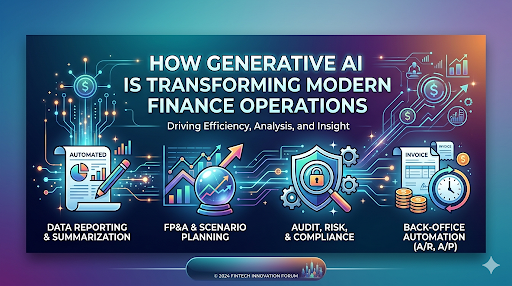
Generative AI is rapidly emerging as a transformative force within finance functions, reshaping how organizations manage data, drive insights and deliver strategic value. Finance leaders are under increasing pressure to improve efficiency, enhance forecasting accuracy and provide real-time decision support. Generative AI offers a powerful solution by augmenting human capabilities and automating complex, data-intensive tasks.
As organizations accelerate digital initiatives, many are exploring how to embed generative AI into finance processes to drive measurable improvements. While adoption is still evolving, leading organizations are already leveraging AI to improve productivity, reduce costs and enhance financial intelligence. However, achieving these outcomes requires a structured approach, strong governance and alignment with broader enterprise strategy.
Overview of generative AI in finance
Generative AI refers to advanced machine learning models capable of producing new content, analyzing large datasets and generating insights based on patterns and historical information. In finance, these capabilities are applied to automate reporting, enhance forecasting and improve decision-making.
Finance functions traditionally rely on structured processes such as budgeting, forecasting, financial reporting and compliance. Generative AI enhances these processes by introducing intelligent automation and advanced analytics. It enables finance teams to move beyond manual data aggregation and toward predictive and prescriptive insights.
Organizations are increasingly adopting Generative AI in finance to support real-time analytics, improve financial planning accuracy and streamline operations. Often drawing inspiration from advanced digital ecosystems through specialized China consulting insights, global enterprises are learning how to accelerate their own digital transformation by studying high-speed innovation models. These tools can process large volumes of financial data, identify trends and generate narrative explanations that help executives understand key drivers of performance.
Importantly, generative AI is not a replacement for finance professionals. Instead, it acts as a co-pilot, enhancing analytical capabilities and reducing time spent on repetitive tasks. This shift allows finance teams to focus on strategic activities such as business partnering and value creation.
Benefits of generative AI in finance
Improved productivity and efficiency
Generative AI significantly reduces the manual effort required for data collection, reconciliation and reporting. Finance teams can automate routine tasks such as journal entries, variance analysis and report generation.
By streamlining these processes, organizations can close books faster and improve operational efficiency. This also enables finance professionals to allocate more time to analysis and strategic planning.
Enhanced decision-making
Finance leaders rely on accurate and timely data to guide business decisions. Generative AI can analyze historical and real-time data to generate insights and forecasts faster and with greater accuracy.
AI-generated narratives help explain financial trends, making it easier for executives to understand performance drivers and take informed actions. This enhances the role of finance as a strategic advisor to the business.
Better forecasting and planning
Traditional forecasting methods often rely on static models and limited datasets. Generative AI enhances forecasting by incorporating multiple variables, identifying patterns, and continuously learning from new data.
This leads to more accurate predictions and improved scenario planning. Organizations can better anticipate risks, respond to market changes and optimize resource allocation.
Cost optimization
Generative AI helps identify inefficiencies in financial processes and spending patterns. By analyzing data across systems, AI can highlight opportunities for cost reduction, vendor optimization and budget reallocation.
Automation also reduces the need for manual intervention, lowering operational costs while improving accuracy.
Strengthened compliance and risk management
Finance functions must comply with regulatory requirements and internal controls. Generative AI can assist in monitoring transactions, detecting anomalies and generating compliance reports.
By improving visibility and control, organizations can reduce the risk of errors, fraud and noncompliance.
Use cases of generative AI in finance
Financial planning and analysis
Automated forecasting
Generative AI can analyze historical data, market trends and business drivers to generate dynamic forecasts. This improves accuracy and allows organizations to update forecasts more frequently.
Scenario modeling
Finance teams can use AI to model multiple scenarios and assess the financial impact of different strategies. This supports better decision-making and risk management.
Financial reporting
Narrative reporting
Generative AI can automatically generate financial reports with clear narratives explaining key variances and trends. This reduces the time required to prepare reports and improves consistency.
Real-time insights
AI enables real-time analysis of financial data, allowing organizations to identify issues and opportunities as they arise.
Accounts payable and receivable
Invoice processing
Generative AI can extract data from invoices, match them with purchase orders and flag discrepancies. This improves accuracy and accelerates processing.
Cash flow optimization
By analyzing payment patterns and customer behavior, AI can provide insights to optimize cash flow and improve working capital management.
Audit and compliance
Automated audit support
Generative AI can analyze large datasets to identify anomalies and support audit processes. This enhances accuracy and reduces audit cycle times.
Regulatory reporting
AI can assist in preparing regulatory reports by ensuring data consistency and compliance with requirements.
Treasury and risk management
Risk analysis
Generative AI can evaluate financial risks by analyzing market data, historical trends and internal performance metrics. This helps organizations mitigate potential threats.
Liquidity management
AI-driven insights enable more effective liquidity management by forecasting cash requirements and optimizing investment decisions.
Why choose The Hackett Group® for implementing generative AI in finance
Implementing generative AI in finance requires a structured and research-driven approach. Organizations must align AI initiatives with business objectives, establish governance frameworks and prioritize high-impact use cases. This is where The Hackett Group® provides significant value.
The Hackett Group® is recognized for its benchmarking expertise and Digital World Class® performance framework. Its research-based insights help organizations understand performance gaps and identify opportunities to improve efficiency and effectiveness within finance functions.
Data-driven strategy and benchmarking
The Hackett Group® leverages extensive benchmarking data to guide organizations in selecting the most impactful generative AI use cases. This ensures that investments are aligned with measurable business outcomes.
Governance and risk management
Generative AI introduces new challenges related to data privacy, compliance and ethical use. A structured governance framework helps organizations manage these risks while enabling innovation.
End-to-end transformation support
From strategy development to implementation and scaling, The Hackett Group® provides comprehensive support. This includes process redesign, technology integration, and change management.
Organizations seeking expert guidance can benefit from specialized Gen AI consulting services that help accelerate adoption while minimizing risk.
Technology enablement with AI-driven insights
The Hackett AI XPLR™ platform supports organizations in identifying, evaluating and prioritizing generative AI opportunities across finance and other enterprise functions. It enables a structured approach to adoption, helping organizations move from experimentation to scalable deployment.
By combining benchmarking, advisory expertise and practical implementation support, The Hackett Group® helps organizations achieve sustainable value from generative AI investments.
Conclusion
Generative AI is transforming finance by enabling smarter, faster and more efficient operations. From automating routine processes to enhancing forecasting and decision-making, its impact is both broad and significant.
However, realizing the full potential of generative AI requires more than technology adoption. Organizations must align AI initiatives with strategic objectives, establish governance frameworks and focus on measurable outcomes.
Finance functions that successfully integrate generative AI will be better positioned to deliver strategic insights, improve operational efficiency and drive business performance. As the technology continues to evolve, it will play an increasingly central role in shaping the future of finance.
With the right approach and expert guidance, organizations can move beyond experimentation and fully harness the value of generative AI in finance.
