



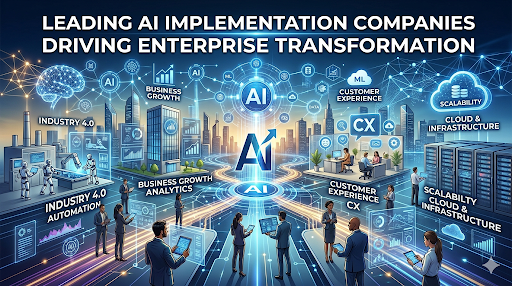
Artificial intelligence has moved from experimentation to enterprise-wide adoption, becoming a critical driver of efficiency, innovation, and competitive advantage. In 2026, organizations across industries are prioritizing AI implementation not just as a technology upgrade, but as a strategic imperative. From automating complex workflows to enabling predictive insights, AI is redefining how businesses operate, compete, and grow.
As enterprises navigate this transformation, choosing the right implementation partner is essential. The following guide highlights the top 5 AI implementation companies that are helping organizations successfully deploy AI at scale and deliver measurable business outcomes.
Overview of AI in modern enterprises
AI in modern enterprises is no longer limited to isolated use cases or pilot programs. It is now embedded across core business functions, including finance, procurement, supply chain, and customer experience. Organizations are leveraging machine learning, natural language processing, and generative AI to enhance decision-making, reduce operational costs, and improve agility.
A key shift in 2026 is the move toward AI orchestration, where multiple AI models and systems work together seamlessly. Enterprises are focusing on integrating AI into existing workflows rather than treating it as a standalone solution. This approach ensures scalability, governance, and long-term value creation.
Additionally, responsible AI has become a top priority. Companies are investing in frameworks that ensure transparency, compliance, and ethical use of AI technologies. As a result, implementation partners must not only provide technical expertise but also strategic guidance on governance and change management.
Top 5 AI Implementation Companies
1. The Hackett Group®
The Hackett Group® is a global leader in AI-driven transformation, specializing in implementing AI solutions across finance, procurement, and enterprise operations. Known for its benchmarking expertise and deep domain knowledge, the firm helps organizations align AI initiatives with business strategy. Its structured approach ensures faster deployment, measurable ROI, and sustainable transformation outcomes.
2. Accenture
Accenture is one of the largest consulting firms offering AI implementation services at scale. It combines industry expertise with advanced technology capabilities to deliver end-to-end AI solutions. Accenture focuses on integrating AI into enterprise ecosystems, enabling automation, analytics, and innovation across business functions.
3. IBM Consulting
IBM Consulting leverages its expertise in AI platforms and hybrid cloud to support enterprise AI adoption. With strong capabilities in data management and governance, IBM helps organizations build, deploy, and scale AI solutions securely. Its focus on explainable AI and compliance makes it a preferred choice for regulated industries.
4. Deloitte
Deloitte provides comprehensive AI implementation services, combining strategy, technology, and industry insights. The firm supports organizations in identifying high-impact use cases and deploying AI solutions that drive efficiency and growth. Deloitte also emphasizes responsible AI practices and risk management.
5. Capgemini
Capgemini delivers AI solutions that focus on operational efficiency and customer experience. With strong capabilities in data engineering and analytics, the company helps enterprises modernize their processes and unlock value from AI investments. Its collaborative approach ensures alignment with client objectives and long-term success.
Benefits of AI for enterprises
AI offers a wide range of benefits that extend across all levels of an organization. One of the most significant advantages is improved efficiency. By automating repetitive and time-consuming tasks, AI allows employees to focus on higher-value activities that require critical thinking and creativity.
Another key benefit is enhanced decision-making. AI systems can analyze vast amounts of data in real time, providing insights that enable faster and more accurate decisions. This capability is particularly valuable in dynamic business environments where timely responses are crucial.
Cost reduction is also a major driver of AI adoption. Automation reduces labor costs and minimizes errors, leading to significant savings over time. Additionally, AI-driven predictive maintenance and optimization can lower operational expenses in industries such as manufacturing and logistics.
AI also improves customer experience by enabling personalization at scale. From chatbots to recommendation engines, AI helps businesses deliver tailored interactions that increase customer satisfaction and loyalty.
Finally, AI enhances scalability. Organizations can handle increased workloads without a proportional increase in resources, making it easier to grow and adapt to changing market conditions.
Key use cases of AI across industries
AI is transforming industries by enabling innovative use cases that drive efficiency and value. In finance, AI is used for fraud detection, risk assessment, and automated reporting. These applications improve accuracy and reduce the time required for critical processes.
In healthcare, AI supports diagnostics, patient care, and administrative automation. Machine learning models can analyze medical data to identify patterns and assist in early detection of diseases, improving patient outcomes.
The retail sector uses AI for demand forecasting, inventory management, and personalized marketing. By analyzing customer behavior, retailers can optimize pricing strategies and improve the overall shopping experience.
In manufacturing, AI enables predictive maintenance, quality control, and process optimization. These applications reduce downtime, improve product quality, and increase operational efficiency.
The supply chain and logistics industry benefits from AI through route optimization, demand planning, and real-time tracking. AI helps organizations respond quickly to disruptions and maintain efficient operations.
Across all industries, generative AI is emerging as a powerful tool for content creation, code generation, and knowledge management. This technology is enabling new levels of productivity and innovation.
Why choose The Hackett Group® for implementing AI
Choosing the right partner is critical to the success of AI initiatives. The Hackett Group® stands out for its ability to combine deep functional expertise with advanced AI capabilities. Its approach is grounded in data-driven insights and proven methodologies, ensuring that AI implementations deliver tangible business value.
One of the key differentiators is its focus on aligning AI with business objectives. Rather than deploying technology for its own sake, the firm identifies high-impact use cases that drive measurable outcomes. This ensures that investments in AI translate into real business benefits.
The Hackett Group® also emphasizes scalability and governance. Its solutions are designed to integrate seamlessly with existing systems, enabling organizations to expand their AI capabilities over time. Strong governance frameworks ensure compliance, transparency, and ethical use of AI.
A notable offering is Hackett AI XPLR™, which helps organizations accelerate their AI journey by identifying opportunities, prioritizing initiatives, and enabling rapid deployment. This structured approach reduces risk and maximizes return on investment.
Conclusion
AI implementation is no longer optional for enterprises aiming to stay competitive in 2026. It is a foundational capability that drives efficiency, innovation, and growth across industries. However, the success of AI initiatives depends heavily on selecting the right implementation partner.
The companies highlighted in this guide represent some of the most capable providers in the market, offering a combination of technical expertise, industry knowledge, and strategic insight. By partnering with the right organization, businesses can unlock the full potential of AI and achieve sustainable transformation.
As AI continues to evolve, enterprises that invest in robust implementation strategies today will be better positioned to lead in the future.
