



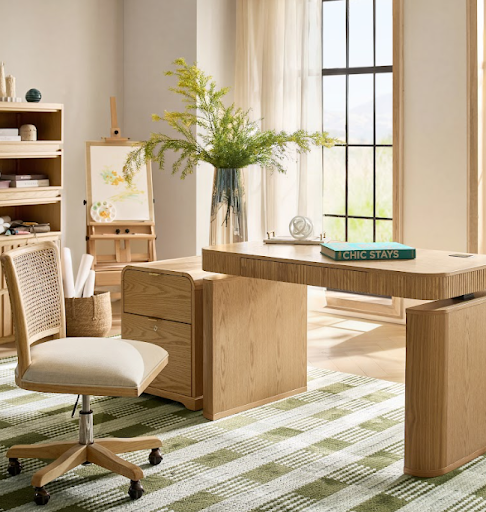
In a culture that values calm, continuity, and understatement, workplace furniture is finally learning to soften
The Problem With the Standing Desk Aesthetic
There is a particular kind of object that arrives in a room and immediately begins an argument with everything already in it. You know the type. The brushed-aluminium exercise bike in the corner of the spare bedroom. The black cable trunking running along a plaster cornice. The ergonomic keyboard tray, powder-coated in corporate grey, bolted beneath an antique writing desk.
The first generation of standing desks — those angular, adjustable, aluminium-framed workstations that began appearing in home offices around 2015 — were this kind of object. They were designed for a specific environment: the open-plan tech office, the standing-desk-as-status-symbol co-working space, the loft conversion where concrete floors and exposed ductwork made the industrial aesthetic feel intentional. They solved an ergonomic problem with considerable conviction. And they created, in the process, an aesthetic problem that nobody in the product category seemed particularly bothered about.
In a British home with cornicing and a cast-iron fireplace and floors that have had a hundred years to acquire their particular patina, a motorised aluminium workstation is not a neutral addition. It is a visual argument happening in the middle of a room. It says: office. It says: temporary. It says: this object does not belong here and we both know it.
What British Interiors Value
The British domestic interior has its own visual language, and it is not a language that translates easily into a spec sheet. It is the language of warmth over coldness, of aged materials over new ones, of objects that have been chosen rather than selected. It is the quality that makes a room with mismatched inherited furniture feel more resolved than a room where everything was purchased from the same catalogue on the same afternoon.
British interiors tend to value continuity. The sense that objects have lived in a room long enough to have earned their place. The warmth of timber that has been touched by light for decades. The weight of a room that has been arranged and rearranged until it has arrived at something that feels, if not perfect, then settled. Calm. A standing desk home UK buyers would actually want to live with — one that fits this visual grammar rather than contradicting it — requires a fundamentally different design philosophy from anything the category had previously produced.
This is the interiors language the standing desk had not yet learned to speak. Until, with some recent products, it began to.
The Furniture-First Philosophy
What would a standing desk look like if it began with the domestic interior and worked backwards? If the first question asked in its design process was not ‘how do we optimise the height adjustment mechanism?’ but ‘what does the room need from this object?’
The answer, it turns out, involves several specific design decisions that depart significantly from the category norm. A surface in solid wood rather than laminate — because real timber has the tonal variation and tactile quality that reads as furniture rather than equipment, and because in morning light, against wooden floorboards, it belongs to the room in a way that no vinyl-wrapped MDF surface ever quite manages. Clean square edges rather than the sharp industrial corners that most standing desks default to — because clean square edges are the language of things made to be lived with, not installed and endured.
A warm-toned base in a muted, domestic colour rather than the standard black or silver that announces its office origins from across the room. These are the considered material choices of a desk designed to belong to a home, not to a workplace temporarily relocated into one. The Julia standing desk from Hulala Home is the most complete expression of this philosophy currently available in the UK market: a motorised, height-adjustable workstation that reads, in a period British room, as furniture that was chosen rather than equipment that was tolerated.
The Morning Before the Screen Comes On
There is a moment in the morning — before the laptop is opened, before the first meeting of the day, before the inbox becomes a to-do list — when a room is most honestly itself. It is the moment when you see the objects in it as objects rather than as functions. The lamp is a lamp, not a light source. The desk is a desk, not a workstation.
In that moment, in a room with the Julia, something specific happens. The wood surface catches the morning light — flat, diffuse, the particular grey-gold of a north-facing British room at eight in the morning — and it looks right. Not beautiful in an aspirational, magazine-spread sense. Right in a quieter, more durable sense. The sense that this object was made for this material context. That someone thought about what it would look like in this light, in this room, next to these things.
The motor is silent. The surface is still. The room is doing what a room should do before the working day begins: offering a quality of stillness that makes the working hours that follow feel slightly more chosen, slightly more intentional.
This is not a health claim. It is not a productivity claim. It is a design claim, and it is the one the standing desk category has been slowest to make — because it requires thinking about the room at 7am rather than only about the body at 11am. The two things are, in the end, not as separate as the ergonomics industry has tended to assume.
What This Means for WFH Space Design
Five years after the mass migration of knowledge work into British homes, we are at a cultural inflection point. The first phase — improvised, reactive, making do — is over. The home office has become a permanent domestic room, and permanent rooms deserve to be designed.
The furniture in them deserves to be designed too. Not in the sense of being expensive, or bespoke, or the product of a named designer’s signature vision. But in the sense of having been thought about from the room’s perspective as well as the body’s. Of having been made with awareness that it will be looked at for as many hours as it will be worked at.
The standing desk that finally belongs in the British home is not the one that optimises most aggressively for ergonomic performance. It is the one that has learned, at last, to speak the language of the room it is going into. To contribute to the quality of stillness a well-considered interior offers, rather than to interrupt it.
That desk exists now. It took longer than it should have. But it is here.
