



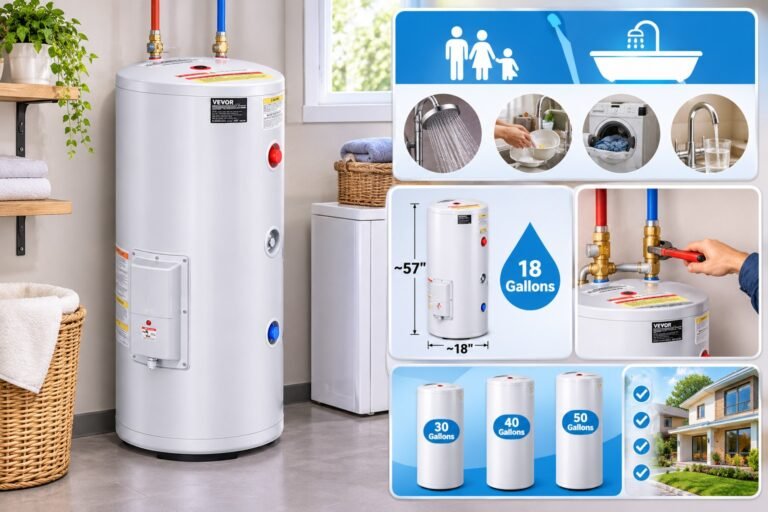
Choosing the right water heater is not simply a matter of finding a tank that fits into an available space. It should also provide enough hot water for everyday activities without taking up unnecessary room or consuming more energy than needed. An 18-gallon electric water heater can be a practical option for smaller households, guest bathrooms, compact apartments, offices, or individual rooms where hot water demand is relatively low.
However, an 18-gallon tank is not suitable for every household. Its performance depends on how many people use hot water, how frequently different fixtures operate, the heater’s recovery rate, and the temperature of the incoming water. Understanding these factors before choosing a unit can help prevent problems such as running out of hot water during a shower or waiting too long for the tank to reheat.
Understanding How an 18-Gallon Electric Water Heater Works
An electric storage water heater uses heating elements inside an insulated tank to heat and store water. When someone opens a hot-water tap, heated water flows out of the tank while cold water enters to replace it. The heating elements then work to bring the incoming water back to the selected temperature.
An 18-gallon model stores a relatively small amount of hot water compared with standard household tanks. This makes it useful where demand is limited or where the heater can be installed close to the point of use. For example, a small unit serving a separate bathroom may reduce the distance water travels through pipes before reaching the tap.
It is important to understand that the tank’s advertised capacity does not necessarily equal the amount of hot water available at the tap. When hot water mixes with cold water at a faucet or shower, the usable volume can be greater than the tank’s stored volume. The actual amount depends on the storage temperature, incoming water temperature, and desired outlet temperature.
How to Choose the Best 18-Gallon Water Heater for Your Home
The best model is one that matches your household’s normal usage rather than simply having the lowest price or smallest dimensions. Consider the following factors before making a decision.
1. Evaluate Your Daily Hot-Water Requirements
Start by identifying which fixtures the water heater will serve. A unit supplying a small bathroom with a basin and occasional shower has different requirements from one expected to provide hot water for a kitchen, laundry area, and bathroom at the same time.
Think about how many people will use the water, how often showers take place, and whether several activities happen close together. A single occupant with moderate hot-water needs may find an 18-gallon tank adequate for selected applications. A couple may also find it useful in a secondary bathroom or as a point-of-use heater.
For a family that regularly uses multiple showers, washing machines, or kitchen fixtures simultaneously, a larger tank may be more appropriate. Choosing too little storage can lead to frequent periods without enough hot water.
2. Check the Heating Power and Recovery Rate
Tank capacity is only one part of a water heater’s performance. The recovery rate describes how quickly the heating system can raise the temperature of incoming cold water after hot water has been used.
Two heaters with the same storage capacity may perform differently because their heating elements have different power ratings. A model with a higher-rated element may recover more quickly, provided the electrical supply and installation are suitable for it.
Check the manufacturer’s specifications for wattage, voltage, recovery rate, and recommended circuit requirements. Do not assume that every 18-gallon heater has the same heating performance. These details are especially important if the unit will serve a shower or another fixture with regular demand.
3. Consider Available Installation Space
Compact water heaters are often selected because a full-size tank will not fit comfortably in the available location. Before purchasing, measure the height, width, and depth of the installation area.
Allow additional room for water connections, electrical access, servicing, and the manufacturer’s required clearances. Check the position of the inlet and outlet connections as well. A heater may appear to fit on paper but become difficult to install if the pipework is positioned differently from the existing connections.
Also consider the floor or mounting surface. A filled water heater is considerably heavier than an empty one, so the installation area must safely support the combined weight of the appliance and water.
4. Compare Insulation, Controls, and Safety Features
Good tank insulation helps reduce heat loss while stored water is waiting to be used. This can help limit unnecessary reheating and improve everyday operating efficiency.
Temperature controls are another useful feature. They allow users to select an appropriate setting according to household needs and the manufacturer’s instructions. A temperature and pressure relief valve is an essential safety component because it helps protect the tank from excessive pressure and temperature.
Look at the warranty, tank construction, heating element material, drain valve, and availability of replacement parts. These details can make a difference to long-term ownership, especially when the heater will be used regularly.
What Are the Main Differences Between 18-Gallon Water Heaters and Other Sizes?
Choosing between different tank sizes requires a realistic understanding of household demand. A smaller tank usually takes up less space, while a larger tank provides more stored hot water for periods of heavier use.
The following comparison gives a general idea of how different capacities may suit various applications. Actual suitability depends on the model’s recovery rate, first-hour delivery, insulation, and usage conditions.
| Tank capacity | Typical application | Main consideration |
| 10–15 gallons | Small sinks, compact spaces, limited point-of-use demand | Very limited stored hot water |
| 18 gallons | Small households, guest bathrooms, secondary fixtures | Suitable for moderate or restricted demand |
| 30 gallons | Smaller households with more regular hot-water use | Greater storage than compact models |
| 40 gallons | Many small to medium households | Better suited to multiple daily activities |
| 50 gallons | Larger households or higher demand | More stored hot water but requires more space |
An 18-gallon heater is generally easier to accommodate in a compact utility area than a 40- or 50-gallon model. It may also be a sensible choice when hot water is needed close to a particular fixture rather than throughout a large property.
A 30-gallon tank offers a middle ground for households that need more storage but do not have space or demand for a much larger unit. A 40- or 50-gallon heater may be a better option when several people need hot water throughout the day.
These comparisons should be treated as starting points rather than fixed household rules. A tank’s first-hour rating and recovery performance can be just as important as its nominal size.
Understanding Electric Tank Water Heaters and Their Applications
Different electric tank water heaters are designed for different installation conditions and household requirements. Some are compact point-of-use units, while others are intended to supply hot water to several fixtures across a home.
Point-of-use heaters are particularly useful when a bathroom, workshop, or kitchen is located far from the main water heater. Instead of waiting for hot water to travel through a long pipe, a smaller unit installed nearby can supply that area directly. This arrangement may also reduce the amount of water wasted while waiting for the tap to warm up.
An 18-gallon tank can be considered for applications such as:
- A guest bathroom that is not used continuously.
- A small apartment with limited hot-water demand.
- A separate washroom in a home or office.
- A workshop sink where hot water is needed occasionally.
- A secondary hot-water source for a distant fixture.
Before using a compact tank as the main household heater, check whether its storage and recovery performance can meet the busiest periods of demand. A small tank may work well for one fixture but struggle when several fixtures operate together.
Installation Tips for an 18-Gallon Electric Water Heater
Correct installation is essential for safe operation, reliable heating, and a longer service life. Although compact heaters may be easier to position than larger models, they still require suitable plumbing, electrical connections, and safety arrangements.
Choose a Suitable Location
Install the heater in a dry, accessible area that meets the manufacturer’s requirements. A location close to the fixtures it serves can help reduce heat loss through long hot-water pipes.
Avoid placing the unit where it may be exposed to freezing temperatures, excessive moisture, or physical damage. If the heater is installed in a cupboard or enclosed space, make sure there is enough room for inspection and future maintenance.
Prepare the Plumbing Connections
Before connecting the heater, identify the cold-water inlet and hot-water outlet. Follow the labels on the unit and the installation instructions rather than assuming that connection positions are identical across different models.
Use compatible fittings and suitable pipe materials. The connections should be secure and properly sealed to prevent leaks. A shut-off valve on the cold-water supply is useful because it allows the heater to be isolated when maintenance or repairs are required.
The temperature and pressure relief valve must be installed according to the manufacturer’s instructions and applicable plumbing requirements. Its discharge pipe should be correctly routed to a suitable location and must not be blocked or capped.
Check the Electrical Supply
Electric water heaters require a power supply that matches their rated voltage, wattage, and current requirements. Check the product label and wiring diagram before connecting the appliance.
Do not assume that an existing socket or circuit is suitable simply because another appliance used it previously. Depending on the model, a dedicated circuit, appropriate breaker, grounding, and correctly sized wiring may be required.
Electrical installation should be carried out by a qualified electrician in accordance with local regulations. Never modify the heater’s wiring or use an extension cord unless the manufacturer specifically permits it.
Fill the Tank Before Switching on the Power
One of the most important installation precautions is to fill the tank completely before energising the heating elements. Open the cold-water supply and a hot-water tap to allow trapped air to escape. Once water flows steadily from the hot tap, the tank is generally full.
Only then should the electrical supply be switched on, following the manufacturer’s instructions. Turning on an electric storage heater while the tank is empty can damage the heating element.
After installation, inspect the connections for leaks and check that the temperature controls and safety components operate as intended. If anything appears unusual, stop using the heater and have it inspected by a qualified professional.
Maintenance Tips to Keep a Small Water Heater Working Properly
Regular maintenance can help preserve performance and identify minor problems before they become expensive repairs. Start by checking the manufacturer’s maintenance schedule, since procedures can differ between models.
Inspect the plumbing connections periodically for signs of leakage, corrosion, or moisture. Keep the area around the heater clear so that air can circulate where required and technicians can access the unit.
Sediment may collect inside a storage tank over time, particularly where the water supply contains minerals. Depending on the model and local water conditions, periodic flushing may help remove accumulated deposits. The temperature and pressure relief valve should also be inspected according to the manufacturer’s guidance.
If the water becomes unusually hot, takes longer to heat, or changes temperature unexpectedly, the thermostat, heating element, or other components may need attention. Avoid opening electrical compartments or attempting repairs unless you have the necessary qualifications.
Common Mistakes to Avoid When Selecting an 18-Gallon Heater
One common mistake is choosing a heater based only on its physical size. A compact tank may fit perfectly into a small space but still fail to provide enough hot water for the intended application.
Another mistake is overlooking recovery rate. If a household uses most of the stored hot water in a short period, the heater’s ability to reheat incoming water becomes important. Buyers should also avoid assuming that a higher wattage automatically makes a unit suitable for an existing electrical circuit.
Ignoring installation clearances, plumbing connections, warranty conditions, and safety requirements can create problems later. It is worth comparing the complete specifications rather than relying on the product title alone.
Making the Right Choice for Your Household
An 18-gallon electric water heater can be a convenient solution when hot-water demand is modest, available space is limited, or a separate fixture needs its own supply. It is particularly useful for point-of-use applications where a large household tank would be unnecessary. However, homes with several occupants or frequent simultaneous hot-water use may benefit from a larger storage capacity.
Before making a final decision, compare the tank dimensions, heating power, recovery rate, warranty, electrical requirements, and installation instructions. Understanding electric water heater capacity in relation to actual daily usage is the best way to avoid choosing a unit that is either too small or unnecessarily large.
For additional options, compare the available models in VEVOR’s electric tank water heaters collection. Review each product’s specifications carefully and select a model that matches your space, plumbing arrangement, electrical supply, and household hot-water requirements.
The capacity guidance and installation considerations above are supported by manufacturer specifications and sizing information, along with technical guidance on storage water heaters and safety.
