



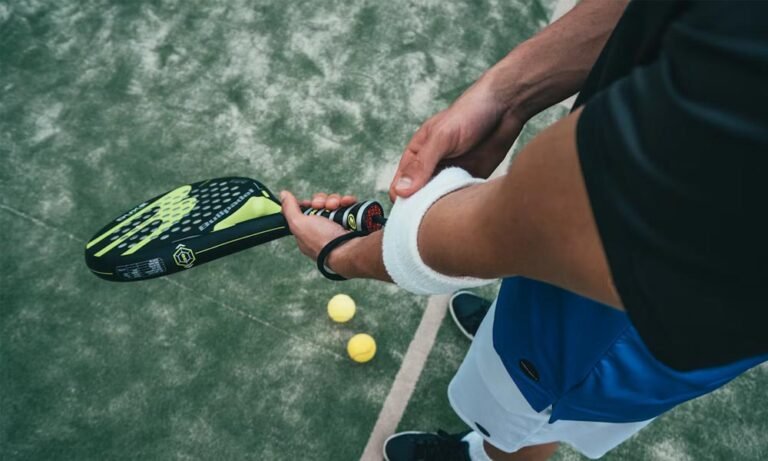
So you’ve heard friends raving about padel, seen the glass courts popping up near your gym, and you’re thinking about finally giving it a try. Good call. Padel for beginners is one of the friendliest ways to get into a racket sport, because the rules are simple, the court is small and the rallies come quickly. You don’t need to be sporty. You don’t need expensive gear. You just need to know a few basics before you step on court.
This guide keeps things easy and covers everything a first-timer actually needs.
What Makes Padel Different From Tennis
People often describe padel as “tennis in a box”, and that’s not far off. It’s played on a court about a third the size of a tennis court, surrounded by glass walls at each end and wire mesh along the sides. Nearly every game is doubles, so there are four players on court.
The racket looks a bit like a thick, oversized table tennis bat. It has no strings. Instead it has a solid face with small holes drilled through it, and it’s shorter than a tennis racket, which makes it much easier to control.
The ball looks almost identical to a tennis ball but has slightly less pressure, so it bounces a little lower and slower.
The big difference is the walls. In padel, the ball is allowed to bounce on the floor and then hit the glass, and you can still play it. That single rule changes everything. It gives you more time, keeps rallies going and makes the game feel fun even when you’re not very good yet.
Padel for Beginners: The Rules You Need to Know
You could read a full rulebook, but honestly, most new players only need a handful of points to get going. Here are the essentials:
- Scoring is the same as tennis. Points go 15, 30, 40, game. Six games wins a set, and matches are usually best of three sets.
- Serves are underarm. You bounce the ball behind the service line and hit it at or below waist height, diagonally into your opponent’s service box.
- The serve must bounce in the box first. It can then hit the back glass, but if it hits the side mesh before bouncing, it’s a fault.
- The ball can only bounce once on your side. After that bounce it can hit any wall, and you can still return it.
- You can’t hit the walls directly. Your shot has to land on the floor of your opponents’ side before touching any glass or mesh.
- You can play the ball off your own walls. Hitting it against your own back glass to send it over the net is allowed, though it’s an advanced trick.
That’s genuinely enough to play your first match. The rest you’ll pick up as you go.
If you’d like a little more detail before your first booking, there are plenty of handy beginner padel guides online that explain the rules, the court layout and even how to find a venue near you. LiveForPadel is a good place to start, as it’s written for UK players and keeps things in plain English. It’s also useful for checking where your nearest courts are, since new ones open all the time.
What to Wear and What to Bring
Here’s some good news. You don’t need much at all.
Most padel clubs hire out rackets for a small fee, and balls are often included with your court booking. So for your first few games, the only things you really need are comfortable sports clothes, a water bottle and the right shoes.
Shoes are the one thing worth thinking about. Padel courts are usually covered in artificial grass with sand on top, and normal running trainers can slip on it. Tennis shoes, especially ones made for clay courts, grip much better. Specialist padel shoes are even better, but you don’t need them on day one.
Should You Buy Your Own Racket Straight Away?
Probably not. Try a few hire rackets first and notice what feels comfortable. Beginner rackets tend to be round in shape, a bit lighter and softer, which makes it easier to hit the ball cleanly. Once you’ve played five or six times, you’ll have a much better idea of what suits you.
Your First Game: What to Expect
Nerves are normal. Everyone on court was a beginner once, and padel players are a famously friendly bunch.
Start with a gentle warm-up. Rally the ball back and forth at the net, then from the back of the court. Don’t worry about winning points yet. Just get used to the bounce off the glass, because it takes a few goes before it feels natural.
Most beginners make the same few mistakes. They hit the ball too hard. They chase the ball instead of letting it come off the back wall. And they forget about their partner. Try to move together as a pair, like two people joined by a rope. If your partner goes to the net, you go too. If they drop back, you drop back.
Being at the net is where most points are won in padel. Once you feel a little more confident, try to get forward after you serve or after a good return.
And smile. Seriously. Padel is meant to be fun, and the laughter is half the point.
How to Keep Improving After Day One
Once you’re hooked (and most people are), the quickest way to get better is simply to play often with people at a similar level. A few easy ways to do that:
Join a social session at your local club. Many venues run mixed evenings where you swap partners every few games, which is great for meeting new players.
Book a group lesson. Even one hour with a coach can fix bad habits early, especially your grip and your serve.
Watch a little professional padel online. You’ll pick up loads just by seeing how the best players use the walls and stay patient.
Most importantly, don’t rush it. Padel rewards smart, steady play far more than big hitting, so your game will keep improving the more you get on court.
Ready to Book Your First Court?
Padel is one of those rare sports that’s easy to start and hard to put down. The rules fit on a postcard, the kit is cheap or free to hire, and you’ll be enjoying proper rallies within your very first hour. That’s why padel for beginners is such a popular search right now, and why so many people who never thought of themselves as sporty are now playing every week.
Grab three friends, find a court nearby and give it a go. There’s a good chance you’ll be booking your next game before you’ve even left the club.
