



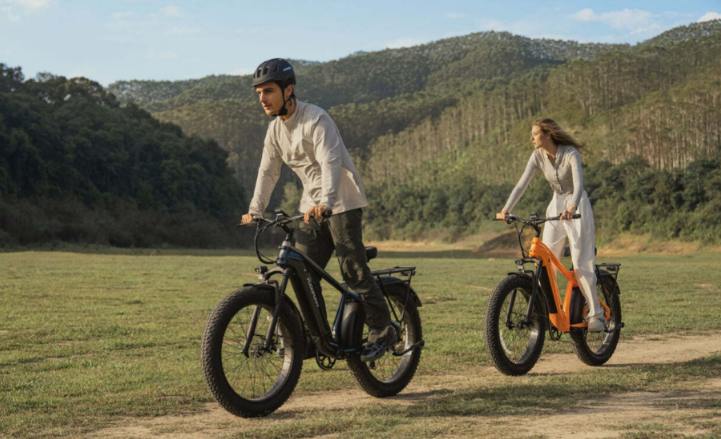
Yes. As an e-bike becomes faster and heavier, brakes, tires, suspension, and overall bike stability matter more. A powerful motor may help a bike accelerate or maintain speed, but the rest of the bike still has to slow it down, keep the tires connected to the road, and remain manageable when the surface becomes uneven.
That is why riders comparing the fastest ebike options should look beyond motor power and top speed. Performance works as a system. More speed is most useful when the brakes, tires, suspension, battery, and frame are suited to the way the bike will actually be ridden.
Why Do Brakes Matter More on a Faster E-Bike?
Brakes have to manage both speed and weight.
Many e-bikes are heavier than conventional bicycles because they carry a motor and battery. Add a rider, luggage, or outdoor gear and there is even more mass to control.
At higher speeds, riders also need more space and time to react to a corner, traffic, loose gravel, or an unexpected obstacle. Strong braking does not mean riders should stop abruptly. The more important benefit is predictable control.
Hydraulic disc brakes are common on higher-performance e-bikes because they can provide consistent braking with relatively light lever pressure. Rotor size, brake condition, tire grip, rider technique, and surface conditions still matter.
A fast e-bike with weak or poorly maintained brakes is an unbalanced setup, regardless of how powerful the motor is.
Do Faster E-Bikes Need Wider Tires?
Not always. Tire choice should match the surface.
A narrow tire can work well on smooth pavement, while wider tires may provide more stability on gravel, broken roads, dirt, and other uneven surfaces.
For riders regularly moving between paved streets and outdoor routes, a fat tire electric bike can make sense because the larger contact area can provide a more planted feel on loose or changing ground.
But wider is not automatically better. Fat tires add weight and rolling resistance, and tire pressure still affects grip and handling.
The important question is not simply how wide the tire is, but whether its size and tread suit the roads and trails the bike will actually encounter.
Does Suspension Become More Important at Higher Speeds?
Suspension becomes more useful when speed and rough surfaces appear together.
A small pothole or patch of broken pavement feels very different at a slow pace than it does when approached more quickly. Suspension can reduce some of the impact reaching the rider and help the bike stay settled over uneven ground.
For everyday roads and moderate trails, front suspension may be enough. Full suspension becomes more relevant when riders regularly encounter repeated rocks, roots, deep ruts, or significantly rougher terrain.
That does not mean every faster e-bike needs full suspension.
A commuter riding smooth city streets may gain little from the extra weight and complexity. The surface still determines what equipment is useful.
Is More Motor Power the Same as Better Performance?
No. Motor output is only one part of e-bike performance.
A stronger motor may help with acceleration or climbing, but it does not improve braking or tire grip. It also cannot make an unsuitable suspension setup comfortable on rough terrain.
Battery capacity matters as well. Riding at higher assistance levels can increase energy use, so riders interested in greater performance should also consider how speed affects the range they need for the complete trip.
This is why comparing e-bikes by one number can be misleading.
Motor output, battery, brakes, tires, suspension, weight, and terrain all affect how the bike behaves once it leaves the specification sheet.
What Does a Balanced Faster E-Bike Setup Look Like?
Puckipuppy’s Beagle 2 provides a useful example of how moderate higher-speed capability can be supported by equipment designed for everyday and mixed-surface riding.
The Beagle 2 uses a 750W rated motor with 960W peak output. Puckipuppy lists throttle operation at up to 20 mph and pedal assistance at up to 28 mph. Its removable 48V 15Ah battery has a manufacturer-listed range of 40–60 miles.
Rather than relying on speed alone, the bike pairs that motor with 180mm hydraulic disc brakes, 26 × 4-inch fat tires, and a 110mm adjustable front suspension fork. It also has a 400-pound maximum load capacity.
Those features make more sense when the bike’s intended use is considered. Puckipuppy positions the Beagle 2 for weekday commuting, errands, gravel roads, and occasional permitted forest-trail access rather than highly technical mountain riding.
That also explains how it can fit riders searching for an electric bike for hunting without turning it into a dedicated extreme off-road machine. For scouting routes, camp roads, gravel, and lighter forest access, fat tires, front suspension, hydraulic brakes, and up to 60 miles of stated range can be more relevant than simply adding more top speed.
There is a trade-off: the Beagle 2 weighs 77.6 pounds. Riders who transport an e-bike frequently should consider rack capacity and how manageable the bike will be when it needs to be moved without motor assistance.
Does Bike Weight Affect Handling at Higher Speeds?
Yes, but weight does not have a simple good-or-bad effect.
A heavier bike may feel planted on some surfaces, but the additional mass also has to be accelerated, slowed, turned, lifted, and transported.
Cargo adds another variable. Once racks, bags, or outdoor equipment are loaded, weight distribution can change steering and braking feel.
That is why riders should test an e-bike with the approximate load they expect to carry rather than judging handling only during an unloaded test ride.
Should Top Speed Decide Which E-Bike to Buy?
Usually not.
Top speed tells riders what the motor system may be capable of under certain conditions. It does not tell them how the bike will feel on gravel, how confidently it brakes on a descent, or how comfortable it remains on broken pavement.
A better comparison looks at the complete setup:
- braking for controlled slowing;
- tires matched to the riding surface;
- suspension suited to road or trail conditions;
- enough battery for realistic riding distance;
- manageable bike and cargo weight.
This gives a much clearer picture of real-world performance than motor power alone.
What About E-Bike Speed Rules?
Riders should also check local rules before using higher-powered or higher-speed e-bikes.
For example, in Great Britain, an e-bike treated as an electrically assisted pedal cycle must have a continuous-rated motor output no higher than 250W and electrical assistance must be cut off at 15.5 mph. Bikes outside those limits are treated differently under road-traffic law.
The Beagle 2 is a US-spec model rated at 750W with pedal assistance up to 28 mph, so UK readers should not assume it qualifies as a standard EAPC for normal public-road and cycle-path use.
Faster Only Works When the Rest of the Bike Keeps Up
A faster e-bike does not simply need a bigger motor. As speed and weight increase, braking, traction, suspension, and control become more important too.
For smooth urban riding, that may mean good hydraulic brakes and road-appropriate tires. For gravel or mixed outdoor routes, wider tires and suspension may become more useful.
The goal is balance. A well-matched e-bike should be able to accelerate, absorb rough surfaces, maintain traction, and slow down with the same level of confidence.
