



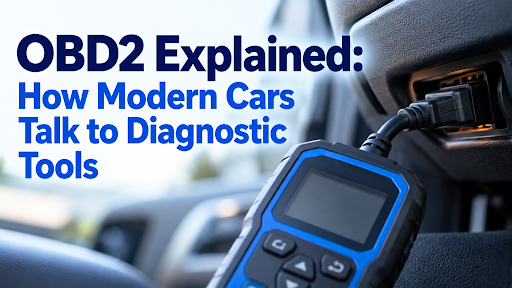
If you’ve ever seen a mechanic connect a small device to a port under your car’s dashboard and then, within seconds, tell you precisely what is wrong, then you’ve witnessed OBD2 at work. It looks a bit like magic when you’re on the outside of it, but it’s actually one of the more elegant pieces of standardisation in the entire motor industry, and it’s worth understanding, if only because it explains why so much of modern car ownership now revolves around a small plastic port you’ve probably never noticed.
What Does OBD2 Actually Stand For?
as an Engine Control Unit (ECU), that keeps track of dozens of sensors throughout the engine, transmission and emissions systems, and alerts you if something is outside of normal parameters.
In Europe, you’ll sometimes see the term EOBD (European On-Board Diagnostics) instead. It’s basically the same technical specification used for cars sold in the rest of the EU and UK, but with a couple of regional variations in which emissions are measured. In the context of normal use, OBD2 and EOBD are equivalent in function and share the same physical connector, hence are often used interchangeably.
Why Does a Standard Like This Even Exist?
Prior to OBD2, each manufacturer had their own unique diagnostic system, connector, and sometimes even their own special tool that could only be used by their dealers. If your car had a fault, you needed that manufacturer’s specific equipment to find out what it was, which meant independent garages were often working half-blind.
OBD2 has changed this, by mandating that all manufacturers make the same fundamental diagnostic data available via the same physical connector on the vehicle, and in the same basic language. It became mandatory across the EU and UK for new petrol cars from January 2001, and for diesel cars from January 2004. This is why the system is the same, regardless of whether you are driving a twenty-year-old hatchback or a car that rolled off the production line last year – it is the same underlying standard, but applied to more and more sophisticated cars.
The push behind the standard was as much about emissions as it was about convenience for drivers and garages. Regulators wanted a reliable way to confirm that a car’s emissions control systems were actually working as intended throughout its life, not just when it left the factory, and OBD2 gave them a consistent, checkable method of doing that across every make and model on the road. It’s also why many of the fault codes you’ll encounter are associated with emissions-related components such as oxygen sensors, catalytic converter, and evaporative systems: It was these systems that were always part and parcel of the job, never an afterthought.
Where Is the OBD2 Port, and What Does It Look Like?
The connector is a 16-pin socket, specifically located within about two feet of the steering wheel and is therefore just below the dashboard on the driver’s side, often behind a small removable panel. It’s a standard shape and size across every make and model, which is precisely the point: any OBD2-compliant scan tool will physically plug into any OBD2-compliant car.
What Actually Happens When You Plug a Scanner In?
When a scan tool is plugged in, it begins to communicate with the ECU (and in many new vehicles, other control modules) via one of a few standardised communications protocols, the most prevalent being CAN, or Controller Area Network. That’s because CAN is an efficient protocol for all the electronic systems in a vehicle to share data on a single pair of wires – a trait that makes it the dominant protocol in the industry, not just in cars.
Through that connection, the scanner can pull two broad categories of information.
Diagnostic Trouble Codes (DTCs)
These are the actual fault codes, made up of a letter followed by four digits. The letter indicates which system the fault is related to: P – powertrain (Engine & Transmission), B – body, C – chassis, U – Network-related. A code like P0442, for instance, immediately tells anyone who knows the standard that it’s a powertrain fault, specifically a small leak in the evaporative emissions system, without a single word of guesswork.
Live Data (Parameter IDs, or PIDs)
In addition to fault codes that are stored, OBD2 also provides real-time data like engine temperature, fuel trim, oxygen sensor readings, and RPM. This is how a technician can monitor a sensor’s performance in real time instead of just a stored code, particularly when dealing with intermittent faults that are not a simple error.
Why This Matters for Ordinary Drivers, Not Just Mechanics
The genuinely useful part of all this, from a driver’s perspective, is that OBD2 isn’t locked away behind dealer-only equipment. It’s a standardised code, so any scan tool, whether designed for the average driver versus a professional workshop, is able to read the same fault code a garage would.
That’s why a decent iCarsoft OBD2 scanner UK drivers use at home can tell you precisely what triggered a warning light, rather than leaving you to book a garage visit purely to find out what’s wrong before any actual repair work even starts. It won’t replace a mechanic’s diagnosis for anything complex, but it turns “the check engine light is on” into “it’s a fault with the oxygen sensor,” which is a considerably more useful starting point.
A Few Things OBD2 Doesn’t Do
It’s important to be honest about the scope here as there is some misunderstanding about OBD2.
It Won’t Tell You Exactly Which Part to Replace
A fault code identifies the system or component that is sending the fault, not necessarily the specific part that has failed. A code indicating a reference to an oxygen sensor could simply indicate that the sensor has failed, or that there is a problem upstream of the sensor. Reading the code is the first step, not the final diagnosis.
It Doesn’t Cover Absolutely Everything
Manufacturer-specific codes exist alongside the generic ones, and some deeper functions, like certain advanced calibrations or manufacturer-locked settings, sit outside what a standard consumer-level scanner can access.
None of that makes the system less useful. It just means a fault code is the start of the diagnostic process, not the end of it.
Common Questions About OBD2
Is OBD2 Exactly the Same on Every Car?
The core standard is the same across every OBD2-compliant vehicle, meaning the connector, the basic fault code structure, and the generic PIDs all work identically. What differs is the additional manufacturer-specific codes and functions that are added atop. While a generic scanner will always scan the standard codes, some brand specific functions such as certain code calibrations or advanced bi-directional tests may require a scanner with the proper software for that particular brand.
Do Electric and Hybrid Cars Have OBD2?
Yes, because they still have the standard 16-pin connector and still receive the same types of fault code for the same systems as that covered by the standard, such as ABS, airbags, and body electronics. The high voltage battery and drive system, though, become a bit trickier, because makers typically maintain proprietary diagnostic information for these, and do not share it via generic OBD2 PIDs.
Can Plugging In a Scanner Drain the Battery?
Not under normal use. The scan tool draws a little bit of power from the OBD2 port when it is plugged in, just as any other accessory does, and codes and live data will not substantially drain a healthy battery for a few minutes. The exception is if the car’s battery is already weak, and the device is permanently connected and left plugged into the car for long periods of time (such as some tracking dongles).
Does Reading a Code Cost Anything?
Once you have a scan tool, reading a stored fault code is free, because the data is in the ECU’s memory waiting to be retrieved. Some garages may require a diagnostic fee, which is usually for the technician’s time in interpreting the code and in narrowing down the real cause of the problem (not necessarily for the scanner).
The Bottom Line
OBD2 is the quiet piece of standardisation that makes modern car ownership considerably less mysterious than it used to be. It is why a warning light does not require an anxious wait for an appointment to the garage to discover what is wrong, or why independent garages and confident DIYers can diagnose faults that a generation ago would have required a visit to a dealership of the manufacturer. Whatever you end up doing with the information, understanding what’s actually happening when you plug that scanner in makes the whole process feel a lot less like guesswork, and a lot more like simply reading what your car has been trying to tell you all along.
