



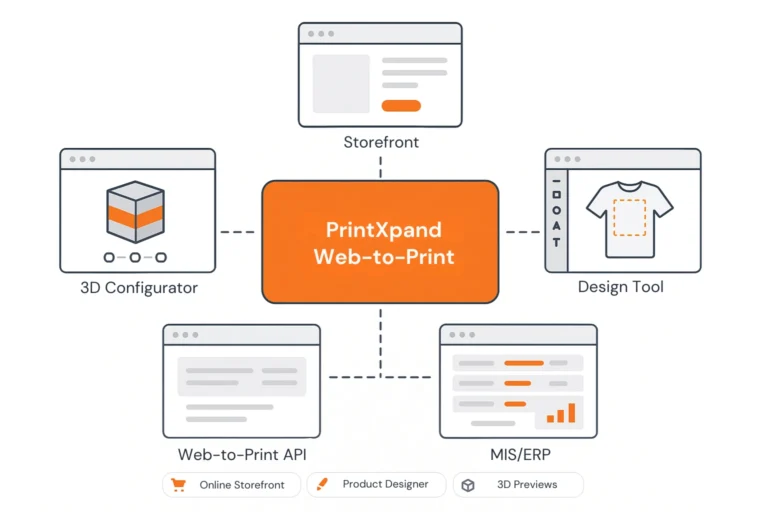
The web-to-print software market has matured significantly over the past decade. What started as a niche category serving large commercial printers has expanded into a broad technology segment covering everything from local print shops to multi-location retail print chains and direct-to-consumer eCommerce brands. With that expansion has come a much larger number of platforms competing for the same buyer attention, and a much harder decision for print businesses trying to figure out which one to actually build their operations on.
PrintXpand is one name that frequently appears in that search process. It is a capable platform with a reasonable feature set. But it is not the only contender, and for many print businesses in the United States, it may not be the best fit either. If you are looking for alternatives to PrintXpand software, this article covers 9 of the strongest competitors currently operating in the market, along with a technical breakdown of what each one actually does well.
What Separates a Good Web-to-Print Platform from a Great One?
Before listing the top web-to-print platforms available today, it helps to understand what technical criteria actually matter when choosing one. The surface-level features, such as an online design tool and a shopping cart, are table stakes at this point. Every platform on this list has those. The real differentiators are found deeper:
- Architecture: Is the platform SaaS-based, on-premise, or headless/API-first? This determines how much control your dev team has and how easily it connects to your existing stack.
- Variable Data Printing (VDP) depth: Can the platform handle high-volume personalized print runs with merged data fields, conditional logic, and database-driven templates? Or is personalization limited to simple text swaps?
- Print MIS integration: Does the platform connect natively with your print management information system, or does it require custom middleware to bridge the gap?
- Prepress automation: Does the platform handle file preflight, color profile conversion, bleed and safe-zone checks, and print-ready PDF generation automatically?
- Multi-storefront support: Can a single admin manage dozens of separately branded storefronts for different clients or business units?
- Pricing model and scalability: Is pricing transaction-based, subscription-based, or licensed? How does cost scale as order volume grows?
- B2B portal capabilities: Does the platform support corporate accounts with approval workflows, budget controls, user role hierarchies, and department-level ordering?
With those criteria in mind, here are 9 of the best web-to-print softwares and top web-to-print platforms worth evaluating as alternatives to PrintXpand software in 2026.
1. DesignNBuy (with DesignO)
Best For: Print businesses that need a complete B2B and B2C web-to-print platform with native support for packaging, wide-format, and promotional products.
DesignNBuy has built a reputation as one of the more technically complete platforms in the market, particularly for businesses that need to go beyond standard commercial print into packaging, apparel, and wide-format production.
One of its standout components is DesignO, an AI-first, API-driven online product design tool that can be embedded into existing eCommerce stores without rebuilding the storefront from scratch. DesignO supports live 2D and 3D product previews, print-ready file output with proper CMYK and color profile handling, and plug-and-play integration with Shopify, WooCommerce, Magento, and BigCommerce.
Key Technical Features:
- 3D product preview engine for realistic pre-production visualization
- Variable Data Printing (VDP) support for database-driven personalized bulk orders
- AI-powered design assistance built into the product configurator
- Mobile-responsive design tool experience with device-agnostic rendering
- Job sheet generation and end-to-end production workflow management
- Native support for packaging, apparel, wide-format, and promotional product categories
- REST API access for third-party integrations and headless deployments
- DesignO integration for embedding an AI-first design engine into any existing eCommerce storefront without platform migration
For US print businesses that find PrintXpand lacking in packaging or wide-format depth, DesignNBuy is among the strongest direct alternatives to PrintXpand software currently available. Its combination of a full storefront platform and an embeddable design module gives it unusual flexibility for businesses at different stages of technical maturity.
2. MarketDirect StoreFront (by eProductivity Software)
Best For: Mid-size to large commercial printers that need a proven, enterprise-grade web-to-print eCommerce platform with deep MIS connectivity.
MarketDirect StoreFront by eProductivity Software (ePS) is widely regarded as one of the most established enterprise web-to-print solutions in the US market. It is built to scale from single-location commercial printers processing hundreds of orders per year all the way to retail print chains with over 1,500 locations. The platform offers both cloud-based SaaS deployment and on-premise self-hosted options, giving IT teams real flexibility in how they manage infrastructure.
Key Technical Features:
- Modular architecture with flexible licensing, allowing businesses to enable only the components they need
- Deep native integration with ePS MIS products including ePS Pace and PrintSmith Vision
- SmartMatrix module for managing complex product variants and SKU families without manual duplication
- AutoEngage module for automated customer marketing campaigns triggered by order behavior
- Picsart connector for access to 20-plus AI-powered design tools and thousands of content templates
- Multi-storefront support with per-site branding, product sets, and user access controls
- Full B2B portal functionality including cost center management, approval workflows, and budget controls
- Integration with FedEx, UPS, Google Analytics, PayPal, and Authorize.Net out of the box
- Real-time order tracking and Google Analytics monitoring from the admin panel
MarketDirect StoreFront is one of the top web-to-print platforms for businesses that have already made an investment in ePS MIS products and want a storefront that connects to production without needing custom integration work. It is a particularly strong alternative to PrintXpand software for enterprise print operations.
3. Zakeke
Best For: eCommerce brands and print-on-demand businesses that need live 2D, 3D, and AR product customization as a plug-in to their existing store.
Zakeke is a cloud-based product customization and 3D Digital Asset Management platform. It sits in a slightly different category from most web-to-print software, as it is primarily a visual product configurator rather than a full print management platform. However, for businesses where the customer-facing design experience is the primary bottleneck, Zakeke is one of the most technically advanced options available.
Key Technical Features:
- Live 2D, 3D, and Augmented Reality (AR) product visualization in the browser
- Product customization for text, images, logos, colors, and patterns
- 3D Digital Asset Management for managing product models and visual assets
- Direct integration with Shopify, WooCommerce, Magento, BigCommerce, and PrestaShop
- Print-ready file output with proper bleed, resolution, and color profile handling
- No-code setup for basic product configurations, with API access for advanced use cases
- Support for apparel, promotional products, labels, signage, and custom merchandise
Zakeke is not a replacement for a full web-to-print platform if you also need order management, production routing, and MIS connectivity. But as a front-end customization layer added to an existing eCommerce store, it is one of the best web-to-print softwares in its specific category.
4. Propago
Best For: Commercial printers that serve enterprise and marketing clients and need a marketing asset management portal with print fulfillment built in.
Propago is a cloud-based supply chain and marketing asset management platform built specifically to support commercial printers serving large enterprise customers. It handles pre-approved templates, print-ready files, variable data files, direct mail products, promotional items, apparel, and digital assets from a single backend. The platform is designed around the idea that the biggest challenge enterprise print buyers face is not ordering. It is controlling brand, budget, and inventory across a distributed organization.
Key Technical Features:
- Marketing Asset Management (MAM) portal with brand control and access permissions
- Budget and cost center controls at the department, user, and product level
- Support for pre-approved templates, variable data files, and print-ready uploads
- Inventory management with pick-list generation and real-time stock visibility
- Direct mail product support including mailing list attachment and USPS workflows
- Promotional products, apparel, and digital file fulfillment alongside print
- Modern, intuitive front end with a supply chain management backend designed for high-volume operations
Propago fills a gap that most alternatives to PrintXpand software do not address: the enterprise marketing supply chain. If your print business serves corporate clients who manage distributed marketing programs across dozens of locations, Propago is one of the top web-to-print platforms built specifically for that use case.
5. PrintNow
Best For: Print businesses that need to build and manage multiple branded online print stores from a single unified admin platform.
PrintNow is a web-to-print platform built around a Unified Admin model, meaning all stores, products, users, and orders are managed from one central interface. With over 3,300 stores deployed across 14 countries, it has a track record in multi-store print eCommerce. The platform includes an HTML5 web-to-print editor for in-browser product personalization and focuses heavily on integration with tools that print businesses and their customers already use daily.
Key Technical Features:
- Unified Admin platform for building and managing multiple print stores from one dashboard
- HTML5 online design editor for in-browser product personalization
- App marketplace within the Unified Admin for extending platform functionality
- Scalable infrastructure designed to handle traffic, content, and volume growth without reliability issues
- Enterprise-grade security and compliance features with reliable cloud hosting
- Collaborative site building for teams working across multiple store deployments
- Integration with daily business tools via connected app ecosystem
PrintNow is a solid mid-market web-to-print alternative for businesses managing a growing number of client storefronts. Its emphasis on the admin experience makes it a practical pick for operations teams that spend significant time managing store configurations rather than just order fulfillment.
6. OnPrintShop
Best For: Print businesses of all sizes looking for a deeply developed, award-winning web-to-print platform with strong automation and B2B portal features.
OnPrintShop is one of the most recognized names when US print businesses search for the best web-to-print softwares. With over 18 years of active development, more than 2,000 print service providers on the platform, and a dual Pinnacle Award 2026 win for both AI technology and product innovation, it has a strong track record. It is also one of the most common platforms that comes up alongside PrintXpand in direct comparison searches, making it both a competitor to PrintXpand and an alternative worth evaluating in its own right.
Key Technical Features:
- Advanced multi-page online designer with support for complex product configurations
- Automated prepress workflows with preflight checks and print-ready file generation
- B2B corporate ordering portal with user role management and multi-level approval workflows
- No-code personalization engine for building product templates without technical expertise
- AI-assisted design generation integrated into the product configurator
- Multi-storefront management from a single admin instance
- Native integration with US-market shipping carriers and payment gateways
- Print MIS connectivity for end-to-end production tracking
OnPrintShop deserves serious consideration as one of the top web-to-print platforms available in 2026. Buyers who shortlist PrintXpand will almost always encounter OnPrintShop in the same research cycle. Both are strong products. The key technical differences come down to prepress automation depth and the maturity of the B2B portal feature set, where OnPrintShop has a longer development history.
7. Coreprint (by Vpress)
Best For: Print businesses running multiple client storefronts that also need a built-in Digital Asset Manager without paying for a separate DAM subscription.
Coreprint is the flagship product of Vpress, a global web-to-print company with over 20 years of experience in the market. It gives print businesses a multi-tenant storefront architecture, where each client or business unit can have a fully branded ordering portal managed from one central admin. The platform includes Variable Data Printing, a Dynamic Editor for in-browser customization, and a free Digital Asset Manager, which is a technically significant inclusion given that DAM tools normally require a separate subscription.
Key Technical Features:
- Multi-tenant storefront architecture for managing multiple fully branded client portals
- Built-in Digital Asset Manager (DAM) with user-level access control at no extra cost
- VDP engine for high-volume personalized and variable print jobs
- Dynamic Editor for in-browser product customization by end users
- 24/7 ordering with quoting, artwork upload, and artwork approval workflows
- Integration with print MIS and ERP/CRM systems
- Multimedia marketing campaign support alongside standard print ordering
Among the alternatives to PrintXpand software on this list, Coreprint is the one most focused on the print service provider that manages brand assets on behalf of clients. The free DAM removes a meaningful cost from the technology stack for businesses that would otherwise need a standalone asset management tool.
8. Customer’s Canvas (by Aurigma)
Best For: Development teams and software vendors that need a headless, API-driven product personalization engine to embed in their own platform or eCommerce store.
Customer’s Canvas by Aurigma is technically the most developer-oriented product on this list. It is not a storefront. It is a white-label, embeddable online design engine. It is used by some of the largest print platforms in the world as the personalization and design layer inside their own products, which tells you something about the quality of its rendering and output.
Key Technical Features:
- WYSIWYG in-browser design editor that can be embedded into any web application via JavaScript SDK
- Server-side PDF rendering engine with CMYK conversion and ICC color profile management
- Support for bleed, safe zone, crop marks, and print-ready file generation
- Multi-page product templates with conditional logic and dynamic content rules
- REST API for full programmatic control of design sessions, templates, and output files
- Plugin architecture for extending editor capabilities without modifying core code
- Support for business cards, labels, apparel, posters, wall decor, and packaging
Customer’s Canvas is the right choice when the technical requirement is a best-in-class design engine that you want to own and control, rather than a vendor-managed storefront. If your team has development resources and you want to avoid being locked into a single platform’s UX decisions, this is one of the best web-to-print softwares for that specific need.
9. Pressero (by Aleyant)
Best For: US-based commercial printers that want a cloud-native web-to-print storefront tightly connected to a print MIS without managing two separate vendor relationships.
Pressero is built by Aleyant, a US company founded in 2005 with a strong footprint in the North American print market. The platform is cloud-based, requires no on-premise installation, and is designed around a business rules engine that routes jobs and applies pricing based on product type, customer account, or order configuration. Its tightest differentiator is the native integration with Aleyant’s own print MIS product, ePS Printstream, which allows orders to flow directly into production scheduling without manual re-entry.
Key Technical Features:
- Cloud-native SaaS architecture with no on-premise software or server maintenance required
- Business rules engine for automated job routing based on product, customer, or order attributes
- Dynamic pricing engine with substrate, quantity, and turnaround-based pricing rules
- Native integration with ePS Printstream MIS for automated order-to-production flow
- Custom domain storefronts configurable per client account
- Mobile-responsive storefront rendering with full device compatibility
- JDF/JMF output for integration with compatible production equipment and workflow systems
Pressero is one of the top web-to-print platforms for US print shops that are already using or considering ePS MIS products. The native connectivity between storefront and production removes a significant amount of integration complexity that other alternatives to PrintXpand software still require custom development to solve.
How to Pick the Right Platform from This List
The best web-to-print softwares are not universally better than each other. They are better for specific business profiles. Here is a direct framework for narrowing the list:
- You need a full B2B and B2C platform with packaging and wide-format support: DesignNBuy
- You serve enterprise corporate clients with distributed marketing programs: Propago
- You need enterprise scale with deep MIS integration and modular architecture: MarketDirect StoreFront
- You want a storefront and MIS from the same US-based vendor: Pressero
- You need a multi-client storefront platform with a free DAM included: Coreprint
- You need an embeddable API-first design engine to power your own platform: Customer’s Canvas
- You need live 2D, 3D, and AR product customization for an eCommerce store: Zakeke
- You are managing multiple print stores from a single admin and need scalable infrastructure: PrintNow
- You need a proven, deeply developed platform with a long track record and strong B2B portal tools: OnPrintShop
Final Thoughts
The top web-to-print platforms in 2026 cover a wide range of technical architectures, pricing models, and target use cases. PrintXpand is one option in a field of strong alternatives. Whether you are a commercial printer building a B2B portal, a print-on-demand business connecting to eCommerce, or a software vendor looking for an embeddable design engine, there is a more purpose-built platform on this list for your situation.
When evaluating alternatives to PrintXpand software, avoid making the decision based on feature lists alone. Request sandbox access. Test the product configurator against your actual print product catalog. Review the API documentation if integration is a priority. Ask vendors specifically about their VDP capabilities, prepress automation, and how order data flows into production. Those questions will surface the real differences between platforms far faster than any comparison chart.
The best web-to-print softwares earn that title by fitting the operational reality of the business using them, not by having the longest feature list on a product page.
