



Abstract
English literature A level coursework is a 2,500-3,000- word independent critical study worth 20% of the final grade. This guide covers text selection, Assessment Objectives, structure, and referencing for a distinction-level essay.
Key Takeaways
- A level English literature coursework (NEA) is an independent critical study worth 20% of the final A level grade, requiring 2,500-3,000 words of comparative analysis.
- Text pairings should differ in genre or form, span different time periods (usually one pre-1900 text), and offer sufficient thematic and critical complexity.
- Top-brand essays integrate all five Assessment Objectives (AO1-AO5) within each paragraph rather than addressing them separately.
- A coherent, thematic structure, rather than two isolated single-text halves, is the clearest marker of a Band 5 essay.
- Common pitfalls include plot summary, unbalanced word counts between texts, and “context dumpling” rather than integrated historical analysis.
Starting English literature level coursework is a big step up from GCSEs. This non-exam assessment (NEA) is an independent critical study in A-level English, offering you freedom and challenge. This extended piece of academic writing is worth 20% of your overall score and requires sustained research, context, and critical thinking across a text length of 2500-3000 words.
From modern prose with A Level Shakespeare coursework and from examining form and meter in A Level poetry coursework, this comprehensive guide offers you the skills and techniques you need to have a plan, structure an essay that addresses each Assessment Objective (AO), and achieve top-band marks. For students who want a second opinion at any stage of the process, coursework writing services from a trusted editorial service such as The Academic Papers UK can clarify whether a structure or argument is on the right track before submission.
Choosing Your Texts & Coursework Topics
Your most important choice in the A Level English Literature coursework will be your choice of texts. If the texts are too similar, you will exhaust your analytical contrast; if they are too different, you will seem to be comparing things that do not really need to be compared.
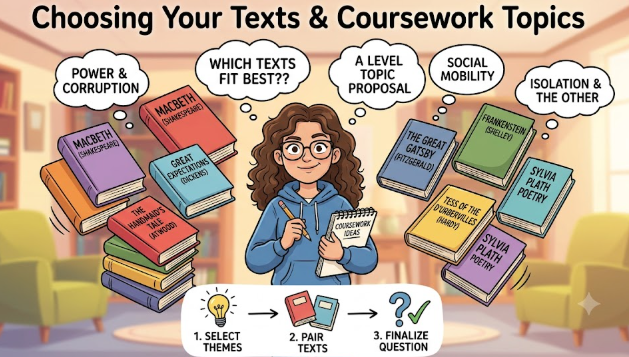
Entry requirements shared across the five exam boards (AQA, Edexcel, OCR, WJEC)
- Genre/Form Contrast: Most exam boards require students to study two texts of different genres (e.g. play and novel or prose and poetry).
- Time Period Requirements: Typically, one of the texts must be pre-1900, in line with board-specific historical range requirements.
- Significant Literary Value: Text should offer great thematic complexity, sophisticated storytelling devices, and a substantial body of existing critical scholarship to draw on.
High-Scoring Text Pairings & English Literature Coursework Topics
| Core Theme | Text 1: Primary Focus (Pre-1900) | Text 2: Comparative Focus (Post-1900) | Central Analytical Angle & Thesis Frame |
| Power, Tyranny, & Gender | Macbeth by William Shakespeare (Drama) | The Handmaid’s Tale by Margaret Atwood (Prose) | Thesis: Compares how autocratic regimes exploit traditional gender roles and domestic spaces to consolidate control and suppress political dissent. |
| The Transgressions of Desire | Tess of the d’Urbervilles by Thomas Hardy (Prose) | A Streetcar Named Desire by Tennessee Williams (Drama) | Thesis: Examines how Victorian agrarian society and mid-20th-century industrial America punish female sexuality and enforce rigid moral double standards. |
| Isolation & Psychological Decay | Frankenstein by Mary Shelley (Prose) | Selected Poems by Sylvia Plath (Poetry) | Thesis: Explores the psychological consequences of societal rejection, domestic confinement, and the destructive impulse toward creation. |
| Class Disillusionment & Identity | Great Expectations by Charles Dickens (Prose) | The Great Gatsby by F. Scott Fitzgerald (Prose) | Thesis: Investigates the moral degradation associated with rapid social mobility and the tragic pursuit of an idealised upper-class identity. |
| Madness & Domestic Confinement | The Yellow Wallpaper by Charlotte Perkins Gilman (Prose) | The Duchess of Malfi by John Webster (Drama) | Thesis: Analysis of spatial imprisonment and “madness” as both a weapon of patriarchal control and a subversively desperate act of female agency. |
| Colonial Power & The “Other” | Othello by William Shakespeare (Drama) | Heart of Darkness by Joseph Conrad (Prose) | Thesis: Investigates how Western institutions construct “otherness” to justify racial exploitation, while exposing the moral fragility of the coloniser. |
| Rebellion Against Social Order | Jane Eyre by Charlotte Brontë (Prose) | Top Girls by Caryl Churchill (Drama) | Thesis: Evaluates the sacrifices women must make to achieve independence within patriarchal economic systems across the 19th and 20th centuries. |
| The Illusion of Innocence | Songs of Innocence and of Experience by William Blake (Poetry) | Lord of the Flies by William Golding (Prose) | Thesis: Explores the inherent corruption of human nature when stripped of societal constraints, contrasting Romantic idealism with post-WWII cynicism. |
Deciphering the Assessment Objectives (AOs)
Top-scoring candidates do not simply ‘tick’ off Assessment Objectives 1, 2, 3 and 4 in turn. Rather, they naturally integrate AO1 through AO5 in almost every paragraph.
Breakdown of the Objectives:
- AO1 (Articulate Informed Arguments): Communicate in a formal, objective and academic style. Demonstrate control of literary vocabulary (such as free indirect discourse, synecdoche, hubris, anaphora and caesura).
- AO2 (Analyse Form, Structure, & Language): Attend to micro-level detail. When quoting what a character says, do not only capture the words; consider how the writer creates the scene through sentence structure, rhythm, stage directions, or imagery.
- AO3 Context is not a history lesson that is inserted as an unrelated paragraph. It needs to describe why the text was written or read and is required to be written in a particular way. How does the writer’s use of Victorian gender norms, Cold War fears or Jacobean religious attitudes shed light on his/her work?
- AO4 (Comparative analysis) Ensure that both texts are analysed and treated equally. Engage in comparative transitions throughout the essay, using words such as conversely, similarly, in a parallel fashion and whereas.
- AO5 (Alternative Interpretations): Respond to challenging interpretations. Refer to published literary scholars or use formal critical approaches (Marxism, Feminism, Post Colonialism, Psychoanalysis) to show that literature is not a single, monolithic text, but may be read in several ways, all of which may be legitimate.
Designing a Top-Band A Level English Literature Coursework Structure
Creating a successful English literature coursework structure involves developing a coherent and continuous argument with a dialogue between both texts. Instead of dividing your essay into two halves, which weakens high-level comparative writing, a Band 5 essay incorporates close language analysis, historical context, and critical lenses throughout 2500+ words.
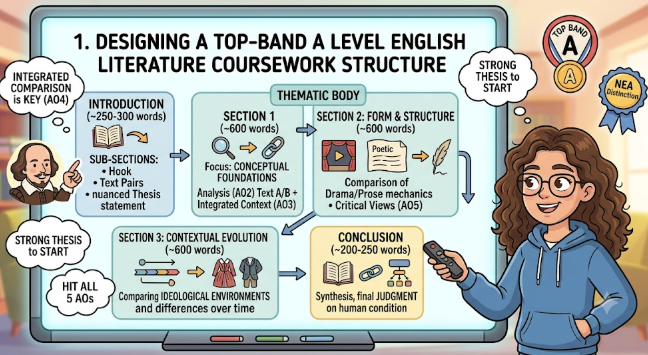
Your paper should start with a well-focused Introduction (250-300 words) that introduces your thematic hook or main idea, introduces the primary texts and their genres and time period, and presents a nuanced and clear thesis about the core comparison you are making. The core of your work is Comparative Body Paragraphs (3-4 substantial segments, 500-600 words per), in which you will compare sub-themes from multiple books instead of individual books.
- Section 1, you create the conceptual framework of your theme, drawing some quotes from Text A before you move directly to Text B to compare and contrast how the writer(s) in Text B develop these concepts by using micro-level language and/or structural features.
- Section 2 is on structure and form: how the stagecraft of a playwright or the metre of a poem differs from the narrative voice of a novelist; and how the decisions made in both disciplines, as well as in writing, have been influenced by historical and social considerations.
- Section 3, where you are asked to draw a sharp contrast between the two periods of time, and between the two authors, to demonstrate how they come to different conclusions.
- Section 4, your analysis culminates in critical theories (Feminist, Marxist, Post-colonial, etc.) competing with each other, and you compare your own interpretation of the texts to that of contemporary readers.
Finally, your Conclusion (200-250 words) should synthesise your findings, not simply repeating them, closing with what both works collectively reveal about literature, power, and the human condition.
Writing Top-Band Analysis: Anatomy of a High-Scoring Paragraph
For Band 5 (top marks), your English Literature coursework analysis should integrate and develop all five AOs coherently. The following example demonstrates this integration in practice.
Comparative paragraph – Exemplar Band 5
Spatial confinement in both Gilman and Webster is a physical manifestation of patriarchal control, though each writer expresses this through techniques suited to the different demands of prose and drama. The Yellow Wallpaper is a first-person narrative that uses broken sentences to represent the narrator’s mental breakdown within the confines of the hereditary estate. The “wallpaper that smoulders” and its “barred windows” are extended metaphors evoking the “rest cure” (19th-century psychiatric treatment for women to accept their domestic fate passively) (AO2, AO3).
In contrast, in The Duchess of Malfi, Webster uses the physical space of the stage to externalise how the Duchess is locked up in her own palace (AO4). Ferdinand’s confinement of the Duchess in darkness, in Act IV, Scene 1, deprives her of theatrical show, as Jacobean fears of female autonomy (AO3). Rebellious women have often been described as “monsters or angels” in patriarchal literature, which is “localised” in enclosures, as Sandra Gilbert describes them (AO5). But, as Gilman’s voice goes into manic regression (crawling across the floor, refusing to be seen as proper, in a Victorian sense), the Duchess is granted a lasting tragic agency by Webster. Such choice of monosyllabic phrasing and present-tense assertion, “I am Duchess of Malfi still” (IV.1), challenges her physical confinement (AO2), and is an example of the ideological resistance she makes against her confinement, which is ultimately undermined by Gilman’s prose realist structure (AO1, AO4).
Referencing, Citations, and Building Your Bibliography
A Level English Literature coursework bibliography entries should follow your exam board’s required referencing convention — most commonly MHRA (footnotes with a bibliography) or Harvard, depending on centre preference; check your specification before you begin drafting, as examiners mark referencing consistency as part of AO1.
- In-text quotations from your primary texts should be referenced by act/scene/line (drama), chapter (prose), or line number (poetry) — for example, (IV.1) or (Ch. 12).
- Secondary criticism (scholarly articles, critical essays, published interpretations) should be cited in full in a separate bibliography, distinct from your primary text references.
- Avoid unreliable sources such as unverified study-guide websites or anonymous blog summaries; examiners can distinguish genuine critical engagement from recycled study-notes paraphrasing.
- A short, well-chosen bibliography of four to six genuine critical sources is more credible than a long list padded with unverifiable or tangential references.
Common Pitfalls to Avoid in A Level Coursework
Even top students can fall into habits that cost valuable marks. The four most common are:
- Plot Summary / Narrating the Story: Avoid re-telling the plot. Assume your examiner is already familiar with the texts thoroughly. All quotes should be connected to an analytical argument and not just a retelling of the story.
- The “Context Dump”: Do not begin paragraphs with lengthy author or historical descriptions. Only use context in ways that help to clarify a particular word, motif, or character action.
- Word Count Imbalance: Try not to use 20% of the page for the other text and 80% for your favorite text. Compare both texts, making them equal partners.
- Understanding the Purpose of Form: Know that a play is a piece of writing meant to be performed on stage, a poem is built from the use of rhythm and line breaks, and prose is written using narrative voice and pacing. Always discuss form in the terms specific to each text’s genre.
Whether you are unsure about the organisation of your secondary research, your close reading of your primary one, or the structure of your essay, feedback from a tutor, or an A Level English coursework help service can help identify where a good essay could become an extraordinary one. Independent editorial review, for instance through a legitimate research and coursework writing services platform, can also be useful for checking referencing accuracy and argument coherence before submission, provided the final analytical work remains the student’s own.
Conclusion
For A Level English Literature coursework, the key is developing an overall argumentative essay that integrates all five Assessment Objectives. You make your essay more than a summary of a text by choosing appropriate dynamic text pairs, conducting careful close readings, and exploring historical contexts and critical theories. Planning is essential; referencing is important, and a disciplined, independent critical voice is the true guide. With a clear roadmap and attention to detail, a draft can become a top band, distinction-level assignment.
FAQs
How do you choose a topic for A Level English Literature coursework?
Identify two texts that are thematically similar and are different in time or genre from the one required in the exam board specification. State your topic as an analytical question that investigates a universal theme (gender, isolation, class, etc.) that is in depth enough to support close reading and critical discussion of the text.
How do you structure A Level English Literature coursework?
Create your essay (2,500-3,000 words) using comparative and thematic body paragraphs, not separate analysis of each text. Have a clear thesis statement in the introduction, develop sections on thematic or structural similarities and differences, and summarise at the end what both texts have in common.
How do you compare literary texts in A Level coursework?
Keep a connected conversation between both texts within the same paragraphs, comparing and contrasting the authors’ methods of form and technique in creating meaning, as opposed to plot. Employ specific comparative transitions to emphasise similarities and/or differences, while noting the significance of the shifts due to different historical periods and literary genres.
What assessment objectives are used for English Literature NEA?
All of the coursework is examined against the following criteria: AO1 Academic argument and terminology, AO2 Close analysis of language, structure and form, AO3 Historical and social context, AO4 Comparative connections, AO5 Alternative interpretations and critical views. Top band essays incorporate all 5 objectives in each part of the study.
References
- Tevdovska, E.S., 2016. Literature in ELT Setting: Students⿿ Attitudes and Preferences Towards Literary Texts. Procedia-Social and Behavioral Sciences, 232, pp.161-169.
- SAADI, T., 2025. Integrating dialogic literary argumentation and metacognitive strategies as a means for enhancing EFL literature education in Algeria (Doctoral dissertation, Soraya HAMANE/Mohammed KHELADI).
- Bhatti, A.M. and Bashir, A., 2025. NARRATIVE STRUCTURE AND LANGUAGE USE IN SHORT STORIES OF INTERMEDIATE ENGLISH TEXTBOOK 1: A STUDY OF CEFR-COMPLIANT FEATURES. Journal of Applied Linguistics and TESOL (JALT), 8(4), pp.25-37.
- Eaglestone, R., 2000. Doing English: A Guide for Literature Students. London: Routledge.
- Gilbert, S.M. and Gubar, S., 1979. The Madwoman in the Attic: The Woman Writer and the Nineteenth-Century Literary Imagination. New Haven: Yale University Press.
- AQA, 2023. A-level English Literature B (7717) Specification. Manchester: AQA
