



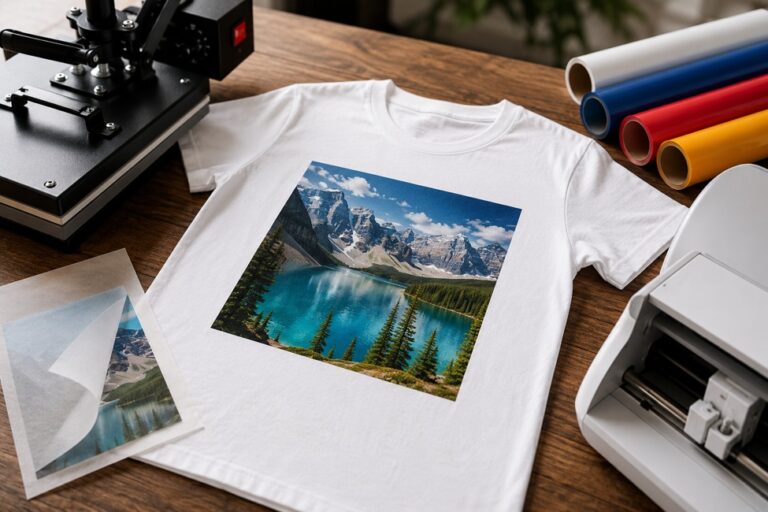
There are at least seven distinct ways to get a picture onto a shirt, and the right one depends entirely on what you’re trying to achieve. A single personalised gift needs a different approach than a run of 200 event shirts. A photographic image has different requirements than a bold two-colour logo. Polyester performance wear behaves differently under heat than 100% cotton jersey.
The gap between a print that looks sharp for years and one that starts cracking after a dozen washes usually comes down to one decision made at the start: choosing the right method for the job. This guide walks through every meaningful option, with honest assessments of what each one handles well and where each one falls short.
Whether you’re making one shirt at home tonight or figuring out how to put a picture on a shirt at scale for a brand or business, the method overview and step-by-step guidance here covers what you need to know.
Before You Choose a Method: Three Questions Worth Answering
The choice of printing method follows logically from three decisions that should come first.
How many shirts do you need?
Single shirts and small personal batches suit DIY methods or digital professional printing (DTG, DTF) where there are no minimum quantities. Larger runs of 50 or more units shift the economics toward screen printing, where setup costs spread across more units and the per-shirt price drops significantly. Choosing a method that suits your quantity saves money and is particularly important when ordering cheapest custom shirts for events, teams, or promotions.. Choosing a method that suits your quantity saves money and avoids the frustration of paying setup costs for a small order that didn’t need them.
What does the image actually look like?
Photographic images with gradients, fine detail, and many colours perform best with DTG, DTF, or sublimation printing. Bold, flat-colour designs and simple text are where screen printing excels. Vinyl cutting handles geometric shapes and text cleanly. Understanding which category your image falls into eliminates methods that would struggle with it before you commit to anything.
What fabric is the shirt?
Cotton and cotton-blend shirts work well with most methods: DTG, DTF, iron-on transfers, and screen printing all perform reliably on cotton. Polyester is the natural fabric for dye sublimation, which permanently bonds ink with synthetic fibres. Synthetic and performance fabrics can be tricky for methods that rely on heat bonding with cotton fibres. Checking the fabric composition on the garment label before choosing a method avoids a mismatch that no amount of technique can fix.
“The most common mistake in custom shirt printing is choosing the method you’ve heard of rather than the method that suits the job. Five minutes of upfront thinking about image type, fabric, and quantity saves hours of frustration.”
Method Comparison: Quick Reference
| Method | Best Image Type | Fabric | Durability | Cost Per Shirt | Skill Level |
| Iron-on Transfer | Photos, full colour | Cotton, blends | Low (20-30 washes) | $1-5 DIY | Beginner |
| Heat Transfer Vinyl | Bold text, logos | Any | High | $3-8 DIY | Beginner-Inter. |
| DTG Printing | Photos, complex art | Cotton (best) | High | $8-20 pro | None (pro handles) |
| DTF Printing | Photos, complex art | Any fabric | High | $6-15 pro | None (pro handles) |
| Screen Printing | Simple, bold graphics | Most fabrics | Very High | Low at bulk | Advanced |
| Dye Sublimation | Full-colour, all-over | Polyester only | Very High | $8-18 pro | None (pro handles) |
| Print-on-Demand | Any design type | Cotton, blends | High | No upfront cost | Beginner |
Method 1: Iron-on Transfer Paper (Home DIY)
Iron-on transfer is the most accessible way to put a picture on a shirt at home, requiring only an inkjet printer, transfer paper, and a household iron or basic heat press. The process involves printing your image onto specialised transfer paper, then using heat to bond the design to the fabric.
Step-by-step process
- Prepare your image at 300 DPI and the intended print size. For light-fabric transfer paper, mirror the image horizontally before printing so it reads correctly once transferred. If you are preparing the artwork for standard paper printing before transferring it to a shirt, knowing the a4 size in inches (8.27 × 11.69 inches) can help you set up the document at the correct dimensions.
- Select the correct transfer paper for your shirt colour. Light-fabric paper is used on white and pale shirts. Dark-fabric paper, which does not require mirroring, is used on coloured and dark garments.
- Print at the highest quality setting on your inkjet printer. Allow the print to dry fully before handling.
- Pre-heat the shirt with your iron or heat press to remove moisture and wrinkles from the print area. A flat, firm surface works better than an ironing board for even pressure.
- Position the transfer face-down on the shirt and apply firm, even pressure with your iron set to maximum heat without steam. Work in small circular motions, covering every part of the design for the time specified by the transfer paper instructions, typically 30 to 60 seconds.
- Allow the transfer to cool completely before peeling the backing paper away. Peeling while warm risks lifting parts of the design.
Iron-on transfers produce acceptable results for personal projects, especially on light-coloured cotton shirts. The durability ceiling is the main limitation: most iron-on transfers begin showing cracking and fading after 20 to 30 washes, regardless of care. For anything that will be worn and washed regularly over a long period, a more durable method is worth the additional investment.
Method 2: Heat Transfer Vinyl (HTV)
Heat transfer vinyl is the step up from iron-on paper for home production. Instead of printing an image onto paper, you cut the design from coloured vinyl sheets using a cutting machine such as a Cricut or Silhouette, weed out the negative space around the design, and press the remaining vinyl onto the shirt with a heat press.
The output has a clean, slightly raised finish with sharp edges and strong colour saturation. Because vinyl physically bonds with fabric fibres under heat and pressure, HTV is significantly more durable than iron-on paper transfers. Well-applied HTV on quality vinyl holds through regular washing for years rather than months.
The design constraint is important to understand: HTV is not suited to photographs or any image with gradients, complex shading, or fine detail. It works with flat, solid-colour designs, text, numbers, and geometric shapes. Each colour in a design requires a separate layer of vinyl cut and applied in sequence. Multi-colour designs are achievable but time-intensive.
Best for:
- Sports kit with names and numbers
- Text-heavy designs and slogans
- Bold logos and graphic shapes in a limited colour palette
- Batches of 5 to 30 shirts where screen printing setup costs aren’t justified
Method 3: DTG (Direct-to-Garment) Printing
DTG printing is the professional equivalent of inkjet printing applied directly to fabric. A specialised printer deposits water-based ink onto the garment surface, producing results that handle photographic images, complex illustrations, gradients, and multi-colour designs without the constraints of vinyl or screen printing.
For anyone asking how to get a high-quality photo onto a shirt, DTG is the most reliable professional answer for cotton garments. The ink bonds with the cotton fibres rather than sitting on top of the fabric, giving the print a soft hand feel and making it resistant to cracking or peeling with normal care.
In-house DTG equipment starts at around $10,000 for entry-level commercial machines. For most individuals, the practical route to DTG is through a print shop or print-on-demand platform that has invested in the equipment. The cost per shirt ranges from $8 to $20 for a single unit depending on design complexity and shirt type, with volume discounts available through most providers.
What DTG handles best:
- Full-colour photographs and photographic-quality artwork
- Complex illustrations with fine detail and gradient transitions
- Single-unit and small-batch orders where screen printing setup costs aren’t viable
- Designs requiring accurate colour reproduction
One practical note: DTG performs best on 100% cotton or high-cotton-content blends. Polyester and synthetic fabrics don’t absorb water-based inks well, which reduces colour vibrancy and print durability on non-cotton garments.
Method 4: DTF (Direct-to-Film) Printing
DTF printing has gained significant traction as a versatile alternative to both DTG and screen printing. The process prints artwork onto a special film, applies an adhesive powder, cures the film with heat, and then transfers the finished design onto the garment. The result is a high-quality print with the flexibility to work on virtually any fabric type.
The key advantage of DTF over DTG is fabric versatility. Where DTG is optimised for cotton, DTF transfers bond effectively with polyester, nylon, denim, leather, and blended fabrics. This makes it the preferred method for garments where DTG’s cotton preference becomes a limitation.
Print quality is comparable to DTG for most image types. Fine detail, gradients, and photographic images all transfer cleanly. The print has a slightly more tactile finish than DTG, which some buyers consider a premium characteristic and others find less natural. Durability is high with proper care.
DTF is most accessible through dedicated print shops and print-on-demand platforms that have invested in the equipment. For individual DIY users, DTF transfer sheets can be purchased pre-printed from specialist suppliers and applied at home with a basic heat press, making it a practical option for home production that doesn’t require owning the printing equipment.
Method 5: Screen Printing
Screen printing is the oldest and most established method in commercial apparel production, and it remains the benchmark for durability and colour vibrancy at scale. The process creates a separate mesh screen for each colour in the design and pushes ink through the screens onto the fabric in layers. Once cured with heat, screen-printed designs are exceptionally resistant to fading and cracking through heavy use and frequent washing.
The economics of screen printing depend entirely on quantity. Setup costs, which include creating screens for each colour, are fixed regardless of how many shirts you print. Spreading those costs across a larger run is what makes screen printing cost-effective. For a run of 100 shirts with a two-colour design, screen printing typically produces a lower per-unit cost than any digital method. For a single shirt, the setup cost makes it impractical.
Design constraints are real. Each additional colour adds a screen and increases setup cost. Designs with more than four or five colours become expensive to screen print. Photographic images require halftone simulation, which changes the visual character of the image. Screen printing is the right choice for bold, graphic designs in a limited colour palette at volume, not for photographic reproductions or complex multi-colour artwork in small quantities.
Method 6: Dye Sublimation
Dye sublimation produces the most seamless integration of image and fabric available in any printing method. Using heat to convert ink from a solid directly to a gas, the process bonds dye permanently with polyester fibres at a molecular level. The result is a print with no surface texture, no raised edges, and no risk of cracking or peeling because the design literally becomes part of the fabric.
All-over prints, edge-to-edge designs, photographic quality images, and gradient backgrounds are all achievable with sublimation in ways that other methods can’t replicate. Sportswear brands, cycling apparel companies, and fashion labels producing all-over graphic pieces rely on sublimation for this reason.
The absolute constraint is fabric. Sublimation only works on polyester and polyester-blend fabrics, and it produces the most vibrant results on white or very light base colours. On a dark polyester shirt, the dye is absorbed into the existing dark fibres and the colours lose their vibrancy almost entirely. For cotton shirts, sublimation is not a viable option.
Method 7: Print-on-Demand (The No-Equipment Route)
For anyone who wants professional-quality results without owning or operating printing equipment, print-on-demand is the most practical route. You upload your image to a platform, select a garment, position the design, and order. The platform prints using professional-grade DTG or DTF equipment and ships directly to you or, if you’re running a store, to your customer.
The practical advantages are significant. There is no minimum order quantity, which means you can order a single shirt to test how a design looks on an actual garment before committing to a larger run. There is no equipment investment, no consumables to manage, and no learning curve on operating machinery. The output quality matches what you’d receive from a professional print shop using the same methods.
For individuals making personalised gifts or one-off custom pieces, print-on-demand removes every barrier between having a design and having a finished shirt. For sellers building a custom apparel brand, it removes the inventory risk and fulfilment overhead that makes physical production operationally complex. The trade-off is per-unit cost, which is higher than bulk production methods at scale, but for low-volume and on-demand production this is a worthwhile exchange.
When print-on-demand makes the most sense:
- Single shirts and small batches where DIY quality isn’t sufficient
- Testing designs on physical garments before investing in a larger run
- Running an online store selling custom shirts without holding stock
- Situations where turnaround time and convenience matter more than per-unit cost
Preparing Your Image: What Determines Print Quality
The quality of the print starts with the quality of the image file, and no printing method can compensate for a poorly prepared source image.
Resolution
Images for print should be 300 DPI at the intended print size. A file that looks sharp on a phone screen at 72 DPI will print blurry and soft. If you’re working with a photograph, check that the original file is large enough to print at the intended size without upscaling. A 600 by 900 pixel photo produces a sharp print at roughly 2 by 3 inches at 300 DPI, not at 10 by 12 inches.
Background handling
For most printing methods, a PNG file with a transparent background is the correct format. A transparent background ensures only your intended design prints and no white box appears around the image on the finished shirt. JPEG files always have a solid background, which becomes a visible rectangle on the finished garment unless your design deliberately fills the entire print area.
Colour considerations for dark shirts
Printing on dark shirts requires specific preparation regardless of method. For DTG and DTF, a white underbase layer is printed first to create a surface for the colours to sit on, which slightly affects the hand feel of the finished print. For iron-on transfers, dark-fabric-specific paper is required. For screen printing, additional setup is needed to lay a white base before the colour layers. If your shirt is dark, confirm with your print provider that their process handles dark garments specifically, as not all do.
Image simplification for specific methods
Screen printing and HTV work best with simplified artwork. Complex gradients need to be replaced with solid colour fills. Fine details need to be reviewed at actual print size, as elements that look clear at full screen zoom often disappear at 3 to 4 inches wide. Running your image through a simplification pass before submitting to these methods produces cleaner results than submitting complex artwork and hoping the process handles it.
Caring for Printed Shirts: Making the Print Last
The durability of any print method is partly determined by care habits after purchase. A screen-printed shirt treated carelessly will deteriorate faster than a DTG-printed shirt handled well.
- Always wash printed shirts inside out. This reduces direct mechanical friction on the print surface during the wash cycle.
- Use cold water. Heat accelerates the breakdown of inks, dyes, and transfer adhesives regardless of print method.
- Avoid tumble drying where possible. Air drying eliminates the heat exposure that degrades prints over time. If using a dryer, low heat settings extend print life considerably.
- Do not iron directly over a print. If the shirt needs pressing, turn it inside out or place a cloth between the iron and the printed area.
- Avoid bleach and harsh detergents. Enzyme-based stain removers can degrade inks. Gentle, colour-safe detergents are safe for all print types.
Choosing the Right Method
The decision tree is simpler than the number of options makes it appear. For a single personalised shirt made at home, iron-on transfer or print-on-demand both work, with print-on-demand producing the more durable result. For bold designs on multiple shirts, HTV for small batches and screen printing at volume are the natural choices. For photographic images on cotton, DTG is the professional standard. For any fabric type with no restrictions, DTF handles the broadest range. For all-over designs on polyester, sublimation is the only method that delivers the result cleanly.
Run your requirements through those criteria and the right method surfaces quickly. Get the image file prepared correctly, confirm fabric compatibility, and the rest of the process follows from there.
