



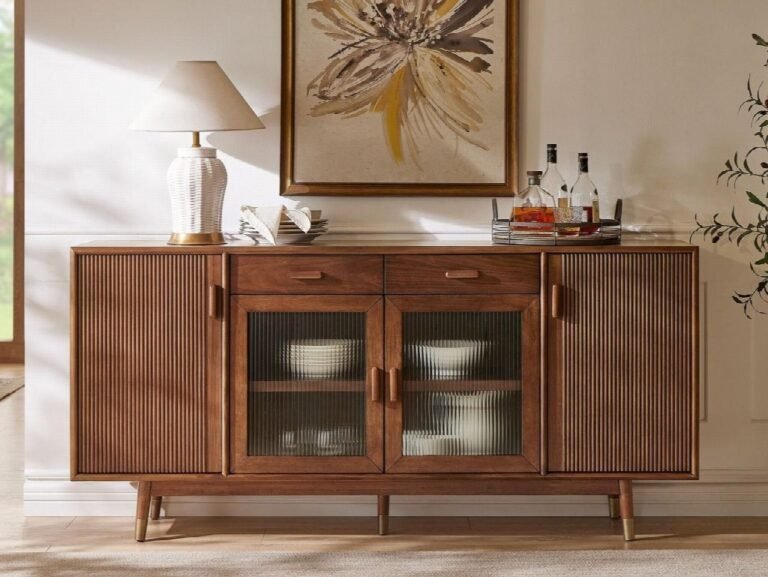
A sideboard is more than a place to store dishes. It can organize a dining room, provide practical storage in an entryway, or bring structure to an open-plan living space. Often used interchangeably with the term credenza, this low, wide cabinet combines concealed storage with a surface for displaying everyday objects and decorative accents.
Choosing the right sideboard requires more than finding a finish that matches your furniture. Its dimensions, interior configuration, materials, and placement all affect how well it works in a home. Understanding these details before buying can help you find a piece that looks appropriate and supports your daily routines.
1. Start With What You Need to Store
Think about the items the sideboard will hold before comparing designs. Dining rooms often need space for serving platters, table linens, glassware, and dinnerware. An entryway cabinet may be more useful with drawers for keys, mail, and smaller accessories. In a living room, enclosed compartments can keep books, games, chargers, and household supplies out of sight.
Make a short inventory of the belongings you plan to store, paying attention to their dimensions. Large serving plates may require wider compartments, while folded linens and smaller accessories are easier to organize in drawers.
A cabinet’s exterior dimensions do not tell the whole story. Interior shelf spacing, drawer depth, door openings, and partitions determine how much usable storage it actually provides. A wide sideboard with narrow compartments may be less practical than a slightly smaller cabinet with a better layout.
2. Measure the Space Before Choosing a Size
Measure the available wall width, floor depth, and surrounding walkways before selecting a sideboard. Painter’s tape can help mark the proposed footprint, making it easier to visualize how the furniture will fit.
Depth deserves particular attention. A cabinet that extends too far into a dining area can interfere with chair movement or make a walkway uncomfortable. Also check the clearance required for hinged doors and drawers to open fully.
Height affects both storage and appearance. A low sideboard can create a horizontal focal point beneath artwork or a mirror, while a taller cabinet may offer more vertical storage in a room with limited floor space. Neither is automatically better; the choice depends on ceiling height, nearby furniture, and the available wall area.
For a dining room, consider the distance between the sideboard and dining table. People should be able to sit down, pull out chairs, and move around without repeatedly bumping into the cabinet.
3. Compare Storage Layouts and Door Designs
The interior configuration should match the belongings you use most often.
Shelves work well for larger objects such as serving bowls, stacks of plates, and decorative pieces. Adjustable shelves are particularly useful because they accommodate items of different heights. Drawers are better suited to smaller essentials, including napkins, cutlery, placemats, and other accessories that benefit from separation.
Cabinets with a combination of drawers and enclosed shelves offer flexibility for households storing several types of belongings. When comparing different sideboard designs, look beyond exterior styling and consider how the available compartments support everyday storage needs.
Door construction also affects usability. Hinged doors provide a wide opening but need clearance in front of the cabinet. Sliding doors are useful in tighter spaces because they do not swing outward, although they typically expose only part of the interior at a time.
Pay attention to hardware as well. Handles should feel comfortable to use, and doors and drawers should operate smoothly. Small functional details can make a noticeable difference when a sideboard is opened several times a day.
4. Understand Materials and Finishes
The material influences a sideboard’s appearance, maintenance requirements, and overall construction.
Solid wood has natural grain variations that give each piece a distinctive appearance. Wood veneer uses a thin layer of real wood over a supporting substrate, allowing manufacturers to create wood-grain surfaces with different construction methods. Engineered wood is another common furniture material, often used in combination with veneers or decorative finishes.
Painted surfaces offer a more uniform appearance and can complement interiors with contrasting colors. Textured fronts, fluted details, and burl-inspired patterns add visual depth without requiring additional decorative accessories.
Before purchasing, review the manufacturer’s material description rather than relying on appearance alone. Two cabinets with similar wood tones may have very different underlying construction.
Maintenance matters too. Dark, smooth finishes may show fingerprints, while heavily textured surfaces can collect dust in their grooves. Natural wood and veneer finishes may have specific cleaning requirements. Choose a surface you can comfortably maintain as part of your regular household routine.
5. Match the Design to Your Interior
A sideboard should relate to the room without necessarily matching every other piece of furniture.
Wood tones introduce warmth and work naturally alongside dining tables, flooring, and woven accessories. If the finishes differ, look for a shared undertone or repeat a compatible color elsewhere in the room. This creates visual continuity without making the furniture look like a matching set.
For a mid-century modern interior, consider clean lines, tapered legs, warm wood tones, and understated hardware. Contemporary spaces may suit streamlined silhouettes, subtle textures, or more sculptural cabinet fronts. Traditional rooms can benefit from richer finishes and decorative detailing.
Visual balance is just as important as style. A sideboard with a bold geometric pattern or distinctive finish can become a focal point in a relatively simple room. If the space already contains dramatic artwork, patterned wallpaper, or an elaborate dining table, a more restrained cabinet may work better.
Hernest is a furniture and home decor brand with a collection of sideboards that shoppers can explore when comparing different cabinet styles, finishes, and designs. Looking across a range of options can help narrow the choice to a piece that suits both the room’s aesthetic and its storage requirements.
6. Consider Where the Sideboard Will Be Used
Although sideboards are traditionally associated with dining rooms, their practical design makes them useful in several areas of the home.
In a dining room, keep the cabinet close enough to the table for convenient access to serving dishes, glassware, and linens. Its surface can also serve as a temporary place for trays and refreshments when entertaining.
In an entryway, a sideboard can hold everyday essentials while providing a surface for a lamp, mirror, or small decorative arrangement. Check the depth carefully so it does not obstruct the main walking route.
In an open-plan living area, a long cabinet can visually define a dining zone without blocking sightlines. It can also provide additional storage along a wall that might otherwise remain unused.
A home office can benefit from a sideboard with enclosed compartments for paperwork, stationery, and equipment. In this setting, drawer organization and easy access may matter more than decorative details.
The best location is ultimately the one that makes frequently used belongings easier to reach without disrupting movement through the room.
7. Style the Surface and the Wall Above It
A sideboard’s top offers space for both practical and decorative objects. A table lamp, framed artwork, a vase, or a small group of accessories can make the arrangement feel intentional.
Vary the heights of decorative pieces rather than lining up several objects of similar size. Leave some open surface area as well, particularly if the cabinet doubles as a serving station.
The wall above the furniture deserves attention. A large painting, mirror, or coordinated pair of framed prints can establish a focal point. Consider the artwork’s width in relation to the cabinet below: a very small piece may look disconnected, while an oversized composition can overwhelm a narrow sideboard.
In an entryway, a strategically positioned mirror can help distribute available natural light. In a dining room, artwork can introduce color and texture without taking up valuable tabletop space.
Keep the arrangement flexible enough to accommodate everyday use. Decorative objects should not block doors, interfere with lighting cords, or make it difficult to place serving trays on the surface.
8. Check Maintenance, Stability, and Safety
A sideboard should be suitable for the demands of the household, not just its appearance.
Review the manufacturer’s care instructions to understand how to clean the finish and protect the surface from moisture, heat, and scratches. Use cleaning products appropriate for the specified material rather than assuming every cabinet can be maintained in the same way.
Check the recommended weight capacity before placing heavy objects inside or on top of the furniture. Distribute belongings appropriately and follow the manufacturer’s guidance for shelf loading and stability.
Anchoring is particularly important for taller storage furniture. Follow the supplied anti-tip instructions and use the appropriate wall attachment for the installation conditions. In homes with children, avoid placing tempting objects where they might encourage climbing, and keep heavier belongings in suitable lower compartments.
These precautions help ensure that the cabinet remains practical and stable during everyday use.
9. Choose a Sideboard That Fits Your Routine
The most suitable sideboard is not necessarily the largest or most decorative one. It is the piece whose dimensions, storage arrangement, and design make sense for the way your household uses the room.
Before ordering, confirm the overall measurements, usable interior space, material description, assembly requirements, door clearance, and care instructions. Check delivery access as well, especially if the furniture will need to pass through narrow hallways, staircases, or elevators.
For households that entertain frequently, convenient access to serving essentials may be the priority. In a busy family home, durable finishes, practical compartments, and reliable hardware may matter more than elaborate detailing.
A well-chosen sideboard brings together storage and style without making either feel like an afterthought. By evaluating how it will fit, what it will hold, and how it will be maintained, you can choose a piece that remains useful and visually appropriate long after it becomes part of the room.
