



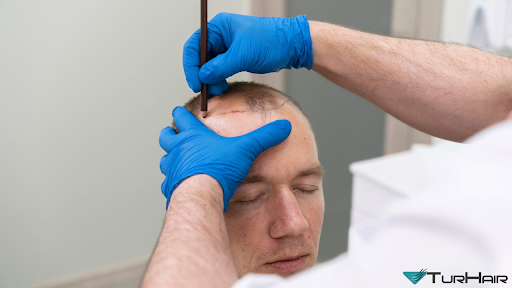
A hair transplant moves healthy follicles from the back and sides of the scalp into areas where hair has thinned. Surgeons in Istanbul carry out this operation every working day, and Turkey now draws patients from the United Kingdom, Germany and Spain. The reason is largely arithmetic. Published costs in Turkey typically run from EUR 2,500 to 8,000, while the same surgery commonly starts at EUR 8,000 in Western Europe.
Choosing a country is only the first of several decisions. You still need to know which technique fits your pattern of loss and how many grafts your case needs. The way a clinic is organized matters just as much. TURHAIR, a doctor led clinic in Zeytinburnu, Istanbul, treats only 1 to 2 patients per day.
What Does a Hair Transplant Actually Involve?
The procedure relocates your own follicles, so transplanted hair keeps the genetic characteristics of the donor zone. The surgeon extracts individual follicular units from the back and sides of the scalp. Those units are then placed into the thinning area at a matched angle and direction. Everything is completed in one day under local anesthesia.
Several distinct stages sit inside that single day, and each one influences how natural the result looks.
- Diagnosis of the hair loss pattern and assessment of donor capacity
- Hairline design based on your individual facial characteristics
- Graft extraction from the donor area
- Channel opening, which determines roughly 70 to 80 percent of the result
- Placement of the grafts into the prepared channels
Which Hair Transplant Techniques are Used in Istanbul?
Three techniques dominate current practice, and TURHAIR works with all of them. Follicular Unit Extraction (FUE) removes grafts one by one with a micro punch and leaves no linear scar. Direct Hair Implantation (DHI) uses a pen shaped implanter that opens the channel and places the graft in one movement. Sapphire FUE keeps the FUE extraction method but opens channels with sapphire tipped blades rather than steel.
No single method suits every patient. The right choice depends on your graft requirement, hair characteristics and the density you want in the recipient zone. Before booking a hair transplant turkey procedure, ask which technique the surgeon recommends for your case and why.
Dr. Mehmet Sıraç Demir has worked in hair transplantation and medical aesthetics since 2008. He is a member of the International Society of Hair Restoration Surgery (ISHRS). That background matters when the trade offs are explained during your consultation.
How the Istanbul Patient Journey Works from Start to Finish
Most international patients complete the whole trip in three to four days. The TURHAIR package covers the procedure, medication and aftercare, hotel for 2 to 3 nights, VIP airport transfers and translator support.
- Send photographs of your scalp for a remote assessment and a graft estimate
- Arrive in Istanbul and take the VIP airport transfer to your hotel
- Attend the face to face examination, blood tests and hairline design
- Undergo the one day operation under local anesthesia
- Return for the first wash and receive your medication and aftercare instructions
- Fly home after a stay of 2 to 3 nights
What Should You Expect During Recovery and Growth?
Growth is slow and staged, which surprises many first time patients. Transplanted hairs typically shed during the first weeks before the follicles enter a new growth cycle. That shedding is expected and is not a sign of failure. Results vary by patient, so judge the outcome at the end of the timeline.
The recovery pattern TURHAIR describes breaks into four broad stages.
| Stage | What Typically Happens |
|---|---|
| Days 1 to 7 | Mild redness and scabbing in the recipient area |
| Month 3 to 4 | First visible growth begins |
| Months 6 to 9 | Significant improvement in density |
| Months 12 to 18 | The final result becomes clear |
What Separates a Doctor Led Clinic from a High Volume One?
The difference is who performs the critical stages and how many patients share the surgeon’s attention that day. In a doctor led model, the surgeon personally handles diagnosis, hairline design, channel opening, donor planning and surgical supervision. In a high volume model, technicians may carry more of that workload while the doctor moves between rooms.
TURHAIR limits treatment to 1 to 2 patients per day for exactly this reason. Its published ratings stand at 4.9 out of 5 on Google and 4.96 out of 5 on ProvenExpert.
- Consultation and diagnosis carried out by the surgeon rather than a coordinator
- Hairline drawn around individual facial proportions instead of a template
- Conservative donor area management that guards against overharvesting
- Continuity of contact through the full 12 to 18 month growth period
What Else Can be Planned Alongside the Procedure?
The same surgical principles apply beyond the scalp. TURHAIR also performs beard and mustache transplant, eyebrow transplant and PRP therapy. The clinic carries out repair surgery for transplants performed elsewhere. Patients considering revision generally wait at least 12 months after their previous procedure.
Whatever the plan looks like, treat the consultation as the real decision point. An individual assessment of your donor area and loss pattern tells you more than any general overview.
Frequently Asked Questions
How Long Does a Hair Transplant Take from Start to Finish?
The surgery itself is completed in one day, typically taking several hours depending on the graft number. Most international patients stay 2 to 3 nights in Istanbul. That window covers the pre operative examination, the operation and the first wash. Your surgeon confirms the exact schedule after assessing your donor area and planned coverage.
Do I Need to Shave My Head Before the Procedure?
Shaving practice varies by technique and by case. Many Follicular Unit Extraction procedures use a fully shaved donor area, while Direct Hair Implantation can sometimes be planned with limited shaving. The decision depends on your graft number, hair length and the area being treated. Dr. Demir reviews this during the consultation, so raise it early.
When Can I Go Back to Normal Daily Life After Surgery?
Most patients plan roughly a week away from visible social contact. Days 1 to 7 usually bring mild redness and scabbing in the recipient area, which settles gradually. Desk based work is often possible sooner, though heavy physical activity waits longer. Recovery varies by patient, so follow the aftercare plan your clinic provides.
Is One Session Usually Enough to Reach the Final Result?
It depends on the extent of your loss. Mild cases commonly need 1,500 to 2,500 grafts, which often fits into one session. Severe patterns of 3,500 to 5,000 or more grafts may be staged across two procedures to protect the donor area. Your surgeon estimates this after examining your scalp.
