



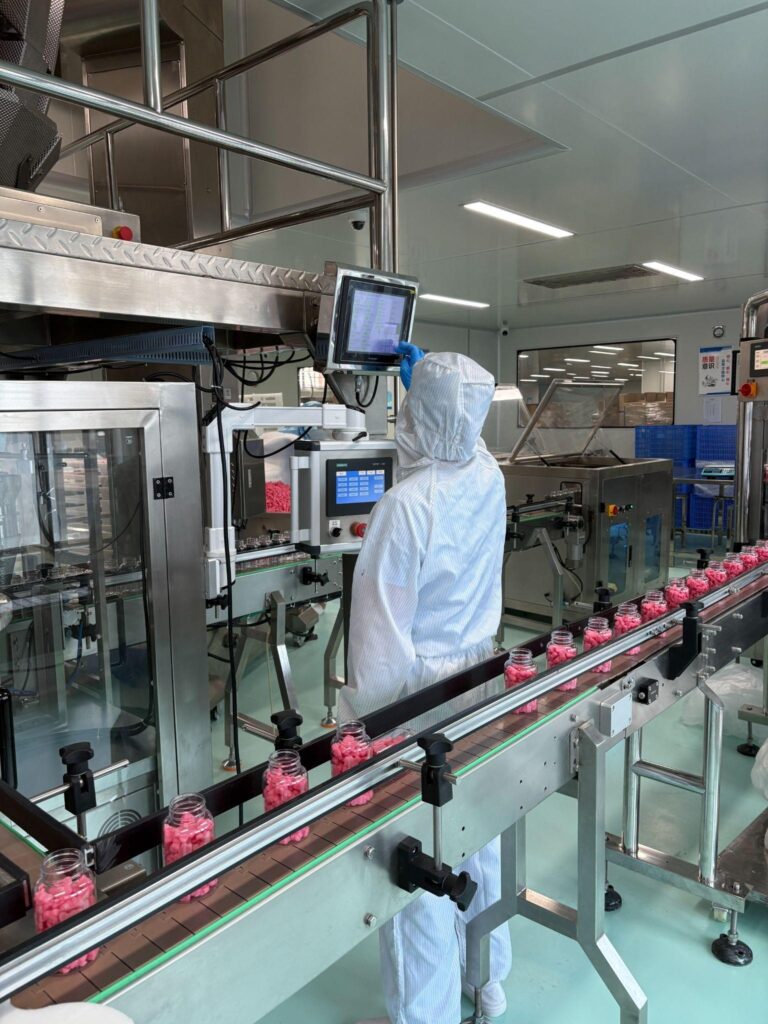
How can independent website entrepreneurs find dietary supplement manufacturers? Choosing a manufacturer is essentially a risk screening process.
- Certification and qualifications are the bottom
- Raw material transparency is a moat
- Ownership of formula intellectual property is a matter of life and
- MOQ and capacity to expand production determine how far you can
Finding the right factory is the foundation of a brand; finding the wrong one means the journey ends as soon as it goes online.
It’s not that the factories are unreliable, but rather that they haven’t fully grasped how complex the process of “finding a factory” truly is. Supplements aren’t like clothing or footwear; changing suppliers might only result in the loss of one batch of goods. However, if your fish oil contains excessive levels of heavy metals, or if the ingredient list doesn’t match the actual composition, you could face product removal, account suspension, and even serious legal risks.
This article is aimed at entrepreneurs who are currently building or preparing to build an independent website—you may be transitioning from Amazon, or you may want to start with an independent website. Regardless of your path, you must be thorough in selecting your manufacturers.
First, figure out what kind of factory you’re looking for
Many people initially confuse “private label OEM” with “OEM factory,” but the differences are significant. They can be broadly categorized into three types:
Advice for independent website entrepreneurs: If you have a limited budget and are unsure about market response in the early stages, start with white-label or low-MOQ private-label products for testing. Once successful, switch to custom formulas to lock in your intellectual property and formula exclusivity. The ideal partner is a factory that allows you to go through both paths—start with white-label and seamlessly switch to custom formulas once your brand is established, without having to find a new supplier.
| Model | Features | Suitable Stage |
| White Label | Ready-made formulas available for direct private
labeling—low cost and short turnaround time |
Rapid product testing and market validation |
| Private Label | Customized based on the factory’s standard formula, offering a degree of differentiation | Possessing a certain sales volume and seeking to build barriers |
| OEM/ODM | Fully customized formula; IP rights belong to the brand owner | Mature brand, pursuing differentiation |
Six essential dimensions to check when looking for a factory
Certification: This is the minimum requirement, not a bonus.
For independent websites targeting the European and American markets, cGMP (Current Good Manufacturing Practice) certification is the bare minimum; without it, it’s a direct pass.
But cGMP alone is not enough. Truly reliable factories often also hold the following certifications:
- NSF International or NPA/UL: Third-party audits guarantee product purity and
- ISO 22000 / FSSC 22000: Food Safety Management System
- Halal / Kosher: This is essential if your target audience includes Muslim or Jewish
- Organic / Non-GMO: Targeting health-conscious consumers
These certifications aren’t just posted for you to see; you can directly check and verify them on the official website of the corresponding certification body. Don’t just look at the certificates issued by the factory itself.
Raw material traceability and testing transparency
Many entrepreneurs don’t realize how important this is.
Your questions are: Does each batch of raw materials have a CoA (test report)? Does the factory conduct third-party component testing? Where are the raw materials sourced from, and how are suppliers selected?
Reliable factories won’t be vague about these issues. They should be able to provide a complete raw material traceability chain and issue test reports for each batch of products. If a factory refuses to let you review these documents or is very resistant to facility visits, that’s a red flag—leave immediately.
In short: Transparency is your brand’s moat.
MOQ (Minimum Order Quantity) and Production expansion capacity
For independent website entrepreneurs, a low MOQ is a necessity – you can’t just put hundreds of thousands of dollars worth of inventory on the ground right away.
However, when choosing a factory, you can’t just look at whether the MOQ is low or not. You also need to ask clearly: If my product becomes a hit, can you quickly increase production?
Ideally, the factory should be MOQ-friendly and have the capacity for large-scale production. Otherwise, even if you find a small factory that’s willing to accept orders starting at 500 bottles, they won’t be able to keep up once your order volume increases. You’ll then have to switch suppliers and go through the whole process of formula confirmation, sampling, and testing again, which is extremely
time-consuming.
Product form coverage
Have you ever considered that your consumers might not like swallowing capsules?
The supplement market has expanded from traditional capsules, tablets, and powders to include functional gummies, ready-to-drink liquids, dietary snack bars, lozenges, and more.
If you intend to enter the functional food industry, or plan to expand your product line in the future, it’s best to find a factory that can produce multiple dosage forms from the outset. Switching to a new factory means rebuilding trust and processes, which is costly.
Turnkey’s one-stop service capabilities
A factory that can cover the entire chain from formula development to raw material procurement, production, packaging and labeling, and compliance auditing is extremely valuable to independent website entrepreneurs—you only need to manage one partner instead of coordinating five or six suppliers.
This model is very practical for independent website entrepreneurs with limited resources. You don’t need to deal with five or six suppliers yourself; you only need to manage one partner, which greatly reduces communication costs and the probability of errors.
When choosing a factory, you can ask: Do you provide FDA-compliant label review? Do you have packaging design templates or assistance? Do you have warehousing and shipping solutions?
Communication, responsiveness, and willingness to cooperate in the long term
This may sound like a soft point, but it is actually very important.
You need a dedicated person to liaise with your factory, instead of someone who doesn’t know whom to contact every time you send an email and takes three days to reply. If problems arise during production (delays, raw material shortages, quality inspection anomalies), can you proactively inform us immediately?
The relationship with a factory is essentially a long-term partnership. It’s better to spend more time finding a partner who is willing to grow with you than to find a factory that treats you like a small customer and treats you perfunctorily.
Common pitfalls
Pitfall 1: The other party’s offer is abnormally low
The raw material costs for supplements have market prices. If a factory quotes a price 30% or more lower than the market price, you should carefully consider where they are saving costs—is it on the purity of the raw materials? Are they skipping certain tests? Or are there labor issues?
Pitfall 2: Exaggerated delivery time promises
A custom-made liquid supplement typically takes 10-14 weeks from formula confirmation to shipment. If a factory claims it can be done in 2 weeks, either they are not referring to a custom-made product, or they have skipped stability testing and quality control.
Pitfall 3: Ambiguous ownership of formula IP
This is extremely important! Make sure the contract clearly states that you own the exclusive rights to the formula, and that the factory cannot sell the same formula to other buyers. Otherwise, the product you painstakingly created could be an exact copy from your competitors tomorrow.
Pitfall 4: Only looking at the factory’s official website and exhibition materials
Visit the factory in person, or at least have a third-party auditing firm audit it for you. The factory’s certifications can be verified on official platforms; don’t just trust the documents the factory shows you.
These are the things to consider when choosing a factory
The above are all from a general industry perspective, but there are some unique considerations when building an independent website that many people have overlooked:
The storytelling potential of a product: Independent websites sell more than just products; they sell stories and trust. Can the factory provide clinical data to endorse the ingredients? Are there any patented raw materials available?
ESG/Sustainability: Overseas consumers (especially in Europe and America) are increasingly concerned about a brand’s sustainability stance. Does your OEM manufacturer use renewable energy? Is the packaging biodegradable? This isn’t just PR rhetoric; it’s a real factor affecting independent website conversion rates.
Compliance requirements for different markets: The US market is governed by FDA 21 CFR Part 111; the EU market has its own Food Supplement Directive; and the Canadian market requires Health Canada NPN registration. It’s essential to verify whether the manufacturer has experience or qualifications to handle compliance in your target market.
Is the sampling process smooth? Do not place any formal orders before receiving samples. A reliable factory should have a clear and efficient sampling process and be willing to conduct multiple rounds of iterative adjustments before final delivery.
Quick decision checklist
Go through this list before finalizing the supplement manufacturer:
- cGMP certification has been verified on the official
- Samples received and quality assessment completed
- CoAs for at least one batch of products have been
- Both the MOQ and the capacity expansion cap have been
- Formula exclusivity is included in the contract
- Compliance qualifications in the target market have been
- There is a dedicated project contact
- Turnkey’s service scope has been clearly
Conclusion
Finding a dietary supplement manufacturer is essentially a risk screening process. You’re weeding out factories that might cut corners without your knowledge or shirk responsibility when problems arise, leaving you with a partner who can grow alongside your brand.
Don’t compromise on quality just to rush into a launch, and don’t neglect qualifications and transparency just because of a low price. Consumers are buying health; losing their trust is more costly than any product recall.
