



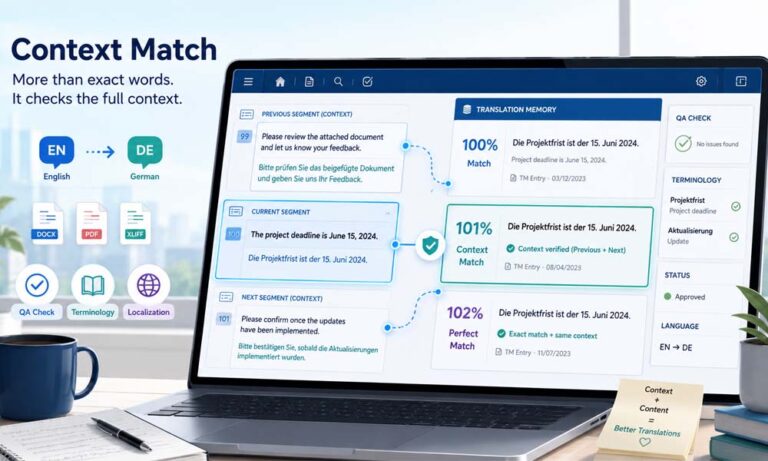
Have you ever opened your CAT tool, looked at a segment, and seen 101% match on the screen? It feels strange at first. Most people think 100% should already mean perfect. So when the tool shows something higher, it can feel confusing.
This is a very common question in translation work. Many translators, editors, and project managers stop and wonder the same thing. They ask, “How can anything be more than 100%?” The answer is simple once you understand how context match works.
In 2026, translation tools are smarter, faster, and more helpful than ever. But they still depend on clear rules. One of the most useful rules is the one behind context match. It helps people work faster, avoid mistakes, and trust their old translations more.
In this article, we will explain everything in a very easy way. We will look at what context match means, how it is different from a 100% match, why it matters, and how it helps in real projects. By the end, the idea will feel simple, clear, and useful.
What Is Context Match?
Let’s start with the main idea. A context match means the text is exactly the same, and the situation around that text is also the same. It is not only about matching words. It is about matching the full setting in which those words appear.
Think of it like seeing the same sentence in two different places. The sentence may look identical, but the meaning may not be the same. A normal match only says, “These words match.” A context match says, “These words match, and they are being used in the same way too.”
That is why context match is often seen as more reliable. It gives you more confidence. It tells you that the old translation is not just similar on the surface. It also fits the same location, flow, and meaning.
Many CAT tools show this as 101% match. Some tools also use names like ICE match, which means In-Context Exact match. The number looks odd at first, but it makes sense. The tool is saying this match is stronger than a normal exact match because it checked more than just the text.
What Does 100% Match Mean?
Now let’s look at the other side. A 100% match means the source segment is exactly the same as a segment already saved in the Translation Memory. Every word is the same. Every character matches. On the surface, it looks perfect.
And to be fair, a 100% match is very useful. It saves time. It gives translators a ready-made result. In many cases, it is correct and works well. That is why Translation Memory is such a big part of CAT tool work. It helps people avoid doing the same work again and again.
But here is the important part. A 100% match only checks the segment itself. It does not always check the meaning around it. It does not always ask what came before. It does not always check if the sentence is still in the same type of place, like a title, a table, or a list.
So yes, the words are the same. But that does not always mean the meaning is fully safe. This is where many people get confused. They see 100% and think the work is done. But in real translation projects, the same sentence can mean different things in different places.
Context Match vs 100% Match
This is the part that matters most. When people compare context match vs 100% match, they are really asking one simple question: which one is safer to trust?
The answer is usually context match. A 100% match only proves that the words are identical. A context match proves that the words are identical and the nearby setting also matches. That extra check makes a very big difference.
Imagine someone gives you the sentence, “Open the file.” In one document, it may mean opening a digital document on a computer. In another, it may mean opening a cabinet file in an office. The words are the same. But the real meaning may depend on what comes before, what comes after, and what kind of document you are working on.
This is why context match vs 100% match is not just a technical question. It is a quality question. It affects how much review is needed. It affects how much confidence you have. And it affects how quickly you can move through a project without worrying about hidden meaning problems.
That is also why people say 101% match is better than 100%. It is not because the words are “more exact.” It is because the tool checked more than one thing. It checked the words and the setting around them.
Why Context Match Is Better Than 100%
So why is context match better than 100% in many cases? The biggest reason is trust. When the tool verifies the context, you do not have to guess as much. The segment feels safer because the system has already checked the conditions around it.
This matters a lot in real work. Translation projects are often large. They may have software strings, manuals, website pages, legal files, product updates, or support articles. In those projects, the same small sentence can appear many times. But not every use means the same thing. A plain 100% match can miss that problem. A context match is more likely to catch it.
There is also a time benefit. When translators see a strong context match, they often need less time to review it. They do not have to stop and double-check as much. That can help the whole project move faster. It can also reduce stress, especially when deadlines are tight.
Project managers like this too. If a file has many context match segments, planning becomes easier. Review effort becomes lighter. Quality risk becomes lower. This is one reason why 101% matches are often treated differently in pricing and workflow rules.
How Context Match Works
At first, context match sounds complex. But the basic logic is actually simple. The tool checks a few conditions before it decides that a segment deserves that extra level of trust.
The first condition is very easy. The current segment must match an old segment exactly. This part is the same as a normal 100% match. If the words are not identical, then it is not a context match.
The second condition is that the segment before it usually must also match. This helps the tool understand the flow. If the previous sentence is the same, there is a stronger chance that the current sentence is being used in the same way. This is one of the key ideas behind context match.
The third condition often has to do with structure. The tool may check whether the segment is still in the same kind of place. For example, maybe it was in a heading before. Or maybe it was inside a table cell. If the structure has changed, the tool may no longer treat it as a true context match.
So the idea is not magic. The tool is simply asking a few extra questions. Is the segment the same? Is the nearby segment the same? Is the structure the same? If the answer is yes, then the match becomes stronger and safer.
How CAT Tools Check Context Match
CAT tools do not only save translated sentences. They also save useful details around those sentences. This is what makes context match possible. When you confirm a segment, the tool can store the segment along with information about its position or its nearby segment.
Later, when you open a new file, the tool looks through the Translation Memory and compares the new content with what was saved before. If it finds the same sentence, that is already helpful. But if it also finds the same previous segment and the same structure, it may return a context match instead of a simple 100% match.
This is why people sometimes call it a “digital fingerprint.” The tool is not only remembering the sentence. It is also remembering something about where that sentence lived before. That extra memory makes reuse much smarter.
Different CAT tools may name this feature in different ways. Some may show 101% match. Some may use terms like ICE match. Some tools may apply slightly different rules. But the main idea stays very close: the words match, and the surrounding conditions match too.
That is important to remember. Not every tool uses the exact same labels. So when writing about context match, it is smart to explain the idea clearly without acting like every CAT tool works in one identical way.
Simple Examples of Context Match
Examples make this much easier to understand. Let’s use the word “Run.” On its own, it looks very simple. But what does it mean? It could mean running with your legs. It could mean starting a software program. It could even mean managing something, like “run a business.”
Now imagine that your Translation Memory already has the word “Run” saved from a software manual. In that old file, the sentence before it was something like, “To start the program, click here and then…” In that case, “Run” clearly means starting software.
But now imagine you are translating a fitness guide. The new segment also says “Run.” If the tool only sees the same word, it may show a 100% match. But the meaning is now very different. In this case, the translator still needs to stop and think.
This is where context match becomes helpful. If the previous segment and structure are also the same as the old software manual, the tool can be much more confident that “Run” still means starting the program. If the surrounding text is different, it may not offer that stronger match level.
Another easy example is the sentence “Check the light.” In one file, it may be about a car’s headlight. In another, it may be about a light setting on a device. The exact words are the same. But the real message changes depending on the full context. That is why context match is more useful than a plain exact match.
When people first hear about context match, they sometimes think it is just a fancy number. But it is really a safety signal. It is the tool’s way of saying, “I checked more than the words.” And in translation work, that extra check can save a lot of time and prevent a lot of mistakes.
Context Match and Perfect Match
Now let’s move to another term that often appears in CAT tools: Perfect Match. This is where many people get confused. They see context match and Perfect Match and think they are exactly the same. But they are not.
A context match usually comes from Translation Memory. The tool checks the current segment, the segment before it, and often the structure around it. If all of that lines up, it gives you that stronger match level. That is why context match feels safer than a normal 100% match.
A Perfect Match often works in a different way. Instead of only looking at Translation Memory, it compares the current file with an older bilingual file or an earlier translated version. This is very useful when a client sends a new version of the same manual, contract, or help file. If large parts of the file have not changed, the tool can mark them as Perfect Match.
Think of it like updating a user guide. Maybe the client changed only two pages in a 100-page file. A Perfect Match helps the tool find all the parts that stayed exactly the same from the old file to the new one. That way, the translator does not waste time checking the same content again and again.
So here is the simple difference. Context match usually checks strong reuse inside the Translation Memory with context. Perfect Match usually checks strong reuse between old and new file versions. Both are helpful. Both save time. But they are used in slightly different ways.
Why Context Match Helps Quality
Quality is one of the biggest reasons why context match matters so much. When the tool checks more than just the words, the chance of using the wrong meaning becomes lower. That makes the translation feel safer from the start.
This is very helpful in projects with repeated content. Think about software menus, product guides, website pages, or support articles. The same sentence may appear many times. If the tool confirms a context match, the translator can trust that the old translation fits this same situation too.
Consistency is another big benefit. Clients do not just want correct translations. They also want the same ideas translated the same way across the full project. A strong context match helps keep terms, style, and sentence choices more stable from one file to another.
There is also a review benefit. Reviewers do not have to spend as much time questioning every exact match. They can focus more on new words, fuzzy matches, and risky sections. That makes the full QA process cleaner and faster.
Still, it is smart to stay realistic. A context match is high-confidence, but it is not magic. If the old translation in the memory was wrong, the match can still bring that old mistake back. So it is safer than a plain 100% match, but it should not be treated like a miracle.
Context Match and Translation Pricing
Now let’s talk about money, because this is a very real part of translation work. In many projects, not every segment is paid at the same rate. New words often get the full rate. Fuzzy matches get a reduced rate. Exact matches get a lower rate too. Then context match may get the lowest rate of all.
Why does this happen? The reason is simple. A context match usually needs very little work. If the tool has already confirmed the text and the context, the translator may only need a quick look. That is much less work than translating from scratch.
This is why many agencies and clients place context match in a very low payment band. In some workflows, it may be paid at a tiny rate. In some cases, it may even be treated as no-charge content. The idea is that the reuse value is so high that the human effort is very low.
Of course, pricing rules are not the same everywhere. Some clients use one grid. Others use another. Some treat 101% and 102% differently. Some tools and teams have their own rules. So when writing or talking about context match, it is best to explain that pricing depends on the project setup.
For project managers, this matters a lot. Good context match rates can lower the cost of a job. For translators, it matters too, because match analysis affects expected earnings, review time, and planning. That is why understanding match types is not just a technical skill. It is also a business skill.
How to Get More Context Match
By now, you may be wondering how to increase context match in real projects. The good news is that there are smart ways to improve your chances. It starts with keeping your Translation Memory clean and useful.
If your TM is full of old errors, messy segments, or bad formatting, it becomes harder to trust the matches. But if it is clean, clear, and well-managed, your context match results become much more helpful. This is one reason why TM maintenance is so important in professional work.
Another smart step is to keep document structure consistent. If one project uses the same templates, headings, lists, and table formats as the last one, the tool has a better chance of finding a real context match. Small structure changes can break strong matches even when the words stay the same.
Writing style matters too. If a company writes product pages one way this month and a completely different way next month, match rates may drop. But if the style stays steady, the CAT tool can reuse more content with confidence.
This is why many good teams use templates and style guides. They do not only make documents look nice. They also help the CAT tool do its job better. Over time, that can lead to more context match, faster work, and lower cost.
Common Mistakes About Context Match
One common mistake is thinking that a 100% match is always perfect. It sounds perfect, but as we already saw, it only confirms identical words. It does not always confirm identical meaning. That is why the difference between 100% and context match is so important.
Another mistake is trusting every high match too much. Some people see 101% and think there is nothing left to check. But what if the original translation in the memory had a typo? What if a term changed later in the project? A high-confidence match is helpful, but human eyes still matter.
A third mistake is ignoring structure. Many people focus only on the sentence and forget that layout can affect meaning too. A short text in a heading may need a different style than the same words inside a paragraph or a button. This is one reason structure checks are part of context match logic.
Some teams also make the mistake of never cleaning their Translation Memory. Over time, this can hurt trust in matches. If the TM is messy, even strong-looking matches may become risky. Good TM care is one of the easiest ways to make context match more useful.
So the smartest mindset is balance. Trust the tool, but do not stop thinking. Use context match as a strong signal, not as a reason to switch your brain off.
The Future of Context Match
In 2026, translation technology is moving very fast. AI tools are improving all the time. They can understand tone better, suggest wording faster, and help translators work in smarter ways. So where does context match fit into this future?
Right now, context match in CAT tools is still mostly rule-based. The tool checks exact things, like the same segment, the same previous segment, and the same structure. That is one reason it is trusted in pricing and workflow systems. The rules are clear, stable, and easy to explain.
AI works differently. It tries to understand meaning, not just exact patterns. For example, AI may notice that two sentences mean nearly the same thing even if the wording is different. That is powerful, but it is not the same as a standard context match used in a billing report.
In the future, these two worlds may work together more closely. Rule-based context match can keep things safe and structured. AI can help with smarter suggestions and deeper meaning checks. That mix could make CAT tools even more useful for translators and project managers.
But for now, the key point is simple. When you see context match in a real workflow, it usually means a strict, rule-based check. That is why it remains such an important part of modern translation work.
Conclusion
So, what is the big lesson here? A higher match number does not just mean “more same words.” It usually means more verified reuse. That is the real reason context match matters so much.
A plain 100% match can still be helpful. It saves time and gives a strong starting point. But context match goes one step further. It checks the nearby setup too. That extra step makes it more dependable in many real translation situations.
This is why so many professionals say that 101% match is better than 100%. It is not about chasing bigger numbers. It is about getting more confidence, better quality, and less wasted review time. That helps translators work faster and helps teams manage projects more smoothly.
If you understand context match, you already have an advantage. You can read analysis reports more clearly. You can price jobs more wisely. And you can make better decisions during translation and review. In a busy 2026 workflow, that kind of clarity is a real strength.
So the next time your CAT tool shows 101% match, you will not feel confused. You will know exactly what it means. And you will know why it can be more valuable than a simple 100% match.
You may also read: Growth Enterprises Market: A Simple Guide for Fast-Growing Businesses
