



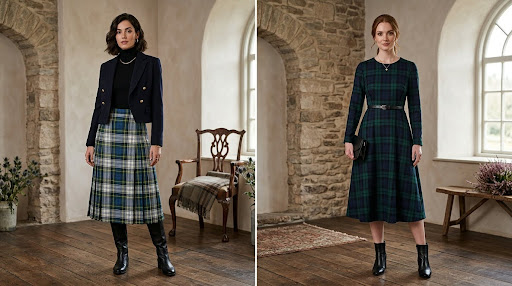
Women’s Highland wear has expanded significantly in the past decade. Where once the only options for women attending Scottish events were a sash worn over standard dress, the modern market now offers genuine tartan-construction women’s clothing — pieces designed specifically for female wearers rather than adapted from men’s kilt patterns.
Two of the most popular options dominate the choice: the tartan plaid skirt and the tartan plaid dress. Both work at Scottish-themed events. Both come in similar tartan options. Both can be styled across formal and casual contexts. But they’re fundamentally different garments with different strengths, and choosing the right one for your wardrobe matters more than most first-time buyers realize.
Here’s the honest 2026 buyer’s guide for women’s Highland wear comparing these two essential pieces — including which one to buy first, how each performs at different events, and what to look for in quality construction.
What Each Piece Actually Is
The category distinction matters because the construction is fundamentally different.
Tartan plaid skirt:
A skirt made from tartan-patterned fabric, ranging from mini-length (above the knee) to maxi-length (ankle or floor). The construction can be:
- Traditional kilted skirt (pleated, with kilt-style construction borrowed from men’s kilts)
- A-line skirt (fitted at the waist, flaring outward)
- Mini pleated skirt (modern fashion-forward style)
- Wrap-style skirt (overlapping front panel like men’s kilts)
The skirt is worn with separate top wear — blouse, sweater, jacket — providing the upper-body styling. This separation allows for significant outfit variation across occasions.
Tartan plaid dress:
A complete one-piece garment in tartan fabric, typically with:
- Fitted waist or empire waistline
- A-line or fit-and-flare skirt section
- Sleeves ranging from sleeveless to long-sleeved
- Various neckline options (V-neck, scoop, boat neck)
- Knee-length to mid-calf hem most commonly
The dress is a complete outfit on its own, requiring only accessories and outerwear to complete the look.
The fundamental difference: the skirt is half an outfit; the dress is a complete outfit. Each has implications for versatility, styling complexity, and value.
How Each Reads at Different Events
The visual presence differs significantly.
Tartan plaid skirt at events:
A tartan plaid skirt with appropriate top reads as “thoughtfully styled with Scottish heritage.” The wearer has assembled an outfit that incorporates tartan as one element rather than committing the entire outfit to it. This signals fashion-forward styling rather than full Highland dress.
The skirt works particularly well when:
- The event has mixed dress codes (some guests in traditional, some in modern)
- The wearer wants to incorporate Scottish heritage without overwhelming presence
- The outfit needs flexibility (different tops for different occasions)
- The wearer attends multiple events where the same skirt can be styled differently
Tartan plaid dress at events:
A tartan plaid dress reads as “fully committed to Highland-themed dressing.” The complete tartan presentation signals dedicated participation in the Scottish heritage aesthetic.
The dress works particularly well when:
- The event is explicitly Scottish or Celtic-themed
- The wearer wants maximum visual impact
- The occasion is ceremonial (weddings, formal Scottish dinners)
- A complete coordinated look is preferred over outfit-building
The summary: skirts offer outfit versatility; dresses offer ceremonial completeness.
Versatility Compared
This is where the practical difference shows up most.
Tartan plaid skirt versatility:
A single quality tartan plaid skirt can be styled across:
- Formal events (white blouse, blazer, heels)
- Semi-formal events (cashmere sweater, tights, ankle boots)
- Casual events (graphic tee, denim jacket, sneakers)
- Office wear (silk blouse, structured cardigan)
- Date nights (fitted top, leather jacket, heels)
- Brunch and casual outings (chunky knit, scarf, boots)
One tartan plaid skirt can support 6-10 distinct outfit combinations across her wardrobe.
Tartan plaid dress versatility:
A tartan plaid dress reads similarly across most contexts, with limited variation:
- Layered with cardigan for casual
- Belted with structured jacket for formal
- Worn alone for warm-weather events
- Layered with tights and boots for cooler weather
The same dress typically supports 3-5 distinct styling variations.
For maximum wardrobe value per piece, the skirt wins decisively.
Price and Quality Tiers
Honest pricing for quality versions in 2026:
Tartan plaid skirt:
- Entry-level: $50-$90 (acceptable wool blends or quality cotton)
- Mid-range: $90-$180 (pure wool or wool blend, recognized tartan)
- Premium: $180-$350 (pure wool from Scottish mill, tailored construction)
Tartan plaid dress:
- Entry-level: $80-$140 (acceptable construction, basic tartan fabric)
- Mid-range: $140-$280 (quality fabric, tailored fit)
- Premium: $280-$500+ (designer construction, premium fabric)
The dress costs more at equivalent quality tiers because it’s a more complex garment with more fabric and more construction labor. The skirt typically delivers better cost-per-wear because it gets worn more often.
For first-time buyers, the mid-range price point is the sweet spot for either piece.
Construction Quality Indicators
Look for these in quality construction regardless of style:
Required for either:
- Pure wool or quality wool blend (avoid pure synthetic)
- Visible tartan pattern depth (woven, not printed)
- Tailored fit appropriate to women’s body shape
- Quality lining for comfort and structure
- Reinforced stress points
- Hem stitched cleanly
Specific to skirts:
- Quality waistband construction with proper closure (zipper, buckles, or hook-and-eye)
- Pleat work appropriate to the skirt style
- Hem properly weighted to maintain drape
- Length appropriate to your body proportions
Specific to dresses:
- Bodice tailoring that fits the upper body properly
- Waistline placement at the natural waist
- Sleeve length proportionate to overall garment length
- Skirt section length flattering to your height
- Appropriate stretch in sleeves for movement
Avoid for either:
- Pure synthetic fabrics marketed as wool alternatives
- One-size-fits-most sizing without specific measurements
- Tartan that’s printed rather than woven
- Construction that doesn’t provide internal structure
Where Each Belongs by Event Type
Formal Highland weddings:
- Skirt: With dress blouse and structured jacket — appropriate but slightly less ceremonial
- Dress: Fully appropriate, especially with shoulder sash for added heritage
- Winner: Dress for full ceremonial presence
Burns Night dinners:
- Skirt: With cashmere sweater or silk blouse — tasteful and traditional
- Dress: Fully appropriate but slightly more formal than typical
- Tie: Both work depending on the venue’s formality
Highland Games:
- Skirt: With casual top, comfortable for outdoor wear and walking
- Dress: Less practical for outdoor festival environment
- Winner: Skirt for outdoor practicality
Daily wear at office:
- Skirt: With blouse and blazer — completely appropriate office wear
- Dress: Often too formal for daily office use unless event-specific
- Winner: Skirt for everyday versatility
Casual brunches and outings:
- Skirt: With knit sweater or tee — easy and stylish
- Dress: Reads as overdressed for casual contexts
- Winner: Skirt for casual wear
Formal evening events:
- Skirt: With elegant blouse and jacket — appropriate
- Dress: With shoulder sash and accessories — fully appropriate ceremonial presence
- Tie: Both work; dress slightly more ceremonial
For overall versatility across the events most modern women attend, the skirt is dramatically more practical. For specific ceremonial occasions, the dress earns its place.
Which to Buy First
Buy the tartan plaid skirt first if:
- You attend Highland events occasionally rather than frequently
- You want maximum wardrobe versatility per dollar spent
- You’ll wear the piece across formal and casual contexts
- You already have separate top-wear (blouses, sweaters, blazers)
- You value year-round wardrobe utility over ceremonial impact
Buy the tartan plaid dress first if:
- You attend formal Scottish events frequently (weddings, Burns Nights)
- You want a complete heritage outfit without assembling pieces
- You prefer one-piece dressing over outfit building
- You’ll wear it primarily at ceremonial occasions
- Maximum ceremonial impact matters more than daily versatility
Buy both eventually if:
- You attend Highland events frequently across both ceremonial and casual contexts
- You want comprehensive women’s Highland wear coverage
- Budget allows the dual investment
For first-time buyers of women’s Highland wear, the skirt is the smarter starting purchase. It provides maximum value, scales across occasions, and integrates with existing wardrobe pieces in ways the dress can’t.
Frequently Asked Questions
Can I wear a tartan plaid skirt with men’s Highland accessories?
Yes, in a way. Women’s tartan sashes worn over the shoulder, kilt pins on the skirt’s outer panel, and other Highland accessories work appropriately with women’s tartan skirts.
Are tartan plaid dresses available in clan tartans?
Yes. Most major clan tartans are available in dress fabric for custom or semi-custom construction.
Can I wear either to a non-Scottish formal event?
The skirt translates more easily to non-Scottish formal events. The dress always reads as Highland-themed.
Which length is most flattering for the skirt — mini, midi, or maxi?
Most women find midi (knee to mid-calf) most universally flattering for tartan skirts.
Are tartan plaid dresses appropriate for non-Scottish wearers?
Yes, with respect. Universal tartans (Black Watch, Royal Stewart, Pride of Scotland) are open to anyone.
How do I clean a wool tartan skirt or dress?
Dry-clean only for most quality wool versions. Spot-clean small marks immediately. Both pieces should last 10+ years with proper care.
The tartan plaid skirt is the smarter first purchase for most modern women interested in Highland wear in 2026 — providing maximum wardrobe versatility, integrating with existing pieces, and earning its keep across daily wear and event use. The tartan plaid dress is the right purchase for women who specifically need a complete Highland-themed outfit for formal Scottish events. Choose based on the events on your actual calendar, and the buying decision becomes clear.
