



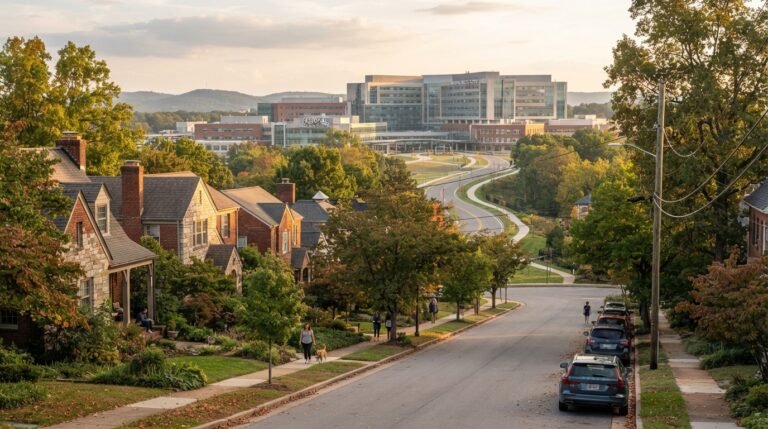
Living near a major regional medical hub offers incredible convenience. Whether you are a healthcare professional facing demanding shift schedules, a resident physician needing a short commute, or someone managing routine medical care, residing close to top-tier health centers brings peace of mind.
However, medical campuses are active 24 hours a day, 7 days a week. Emergency vehicles, supply deliveries, helipad traffic, and shift-change congestion can easily disrupt domestic tranquility. The challenge lies in finding a home that offers swift access to medical facilities while preserving the quiet, relaxing sanctuary you need to unwind.
1. Balancing Convenience and Tranquility Around Health Centers
Quick Answer: Finding a peaceful home near a medical campus requires evaluating micro-location factors, such as positioning your residence off primary emergency vehicle routes and selecting low-density residential pockets.
Proximity to health facilities ranks among the highest healthcare worker housing priorities. Nurses, surgeons, and emergency responders who work 12-hour shifts or take overnight call require fast commute times. Yet, continuous restorative sleep is vital for their performance and personal well-being.
Achieving a quiet living environment near a busy medical district is not about distance alone; it is about spatial orientation. Houses and townhome communities nestled just two or three blocks off primary arterial avenues often escape the majority of ambient traffic noise while retaining a sub-five-minute drive to hospital doors.
2. Navigating Emergency Routes and Traffic Corridors
Quick Answer: Map out hospital emergency access roads and ambulance transit routes before choosing a home, opting for neighborhoods situated along secondary residential streets or cul-de-sacs.
Ambulance routes follow predictable traffic patterns. Emergency vehicles stick to wide, high-speed arterial roads to reach hospital emergency bays efficiently.
When evaluating potential neighborhoods near a medical center:
- Identify Emergency Bay Access: Locate the hospital’s emergency department entrance and note which main avenues connect directly to local highways.
- Avoid Main Thoroughfare Frontage: Properties facing primary emergency routes will experience routine siren noise at all hours.
- Look for Natural Sound Buffers: Choose communities separated from main avenues by commercial buildings, dense tree lines, or neighborhood parks that absorb ambient road sound.
3. Key Architectural Features for Noise Control
Quick Answer: High-performance sound insulation—such as double-pane low-E windows, insulated exterior walls, solid-core doors, and multi-ply subfloors—effectively blocks low-frequency sirens and road noise.
When living near an active commercial or medical corridor, building quality plays a significant role in indoor comfort. Prioritizing acoustic soundproofing for rental homes transforms an ordinary living space into a serene retreat.
When touring prospective properties, check window seals and wall construction. Multi-family layouts featuring shared wall insulation or staggered staggered-stud construction minimize neighbor noise and exterior traffic hums.
4. Floor Plan Elements Built for Shift Workers and On-Call Staff
Quick Answer: Shift workers should choose floor plans with interior-facing bedrooms, attached private garages, and window orientations that accommodate blackout window treatments.
Medical professionals frequently work night shifts and sleep during peak daytime hours. Standard residential layouts with street-facing bedroom windows can make daytime rest difficult.
Look for floor plans that offer:
- Set-Back Bedrooms: Bedrooms positioned toward the back of the home or overlooking private courtyards remain quieter throughout the day.
- Attached Garages: Private attached garages permit quiet, secure departures for early morning rounds or late-night emergency calls without exposing you or your neighbors to cold weather and noise.
- Flexible Window Layouts: Recessed window frames make it easier to install blackout curtains or acoustic blinds to block out midday sunlight and neighborhood activity.
5. Strategic Regional Housing: Proximity Without the Commute Chaos
Quick Answer: Low-density townhome developments situated near regional healthcare hubs offer private garages, quiet neighborhood streets, and rapid hospital access.
Regional medical hubs across the country serve as major economic and healthcare anchors for surrounding communities. Balancing residential proximity to regional hospitals with quiet surroundings comes down to choosing the right neighborhood layout.
For healthcare staff, travelling medical specialists, or families seeking peaceful living near top-tier regional care, low-density multi-family housing provides the ideal solution. Selecting spacious townhomes for rent in Idaho Falls offers immediate access to major healthcare facilities like Eastern Idaho Regional Medical Center and Idaho Falls Community Hospital while providing attached garages, private entries, and peaceful suburban surrounding neighborhoods away from dense urban traffic.
6. Myth vs. Fact: Living Near Medical Centers
Clearing up common misconceptions helps homebuyers and renters choose the right location:
| Misconception | Residential Reality |
| “Living within a mile of a hospital means non-stop siren noise.” | Sirens are typically activated on major arterial highways, not quiet residential side streets two blocks away. |
| “High-density apartments near hospitals are the only rental option.” | Townhomes and boutique residential communities offer quieter, low-density living options close to health centers. |
| “Daytime sleeping is impossible near an active medical district.” | Modern acoustic insulation, set-back bedrooms, and window treatments make indoor spaces quiet at any hour. |
7. Medical District Housing Evaluation Checklist
Use this audit checklist when inspecting homes near healthcare facilities:
- [ ] Map Traffic Patterns: Is the property located off primary ambulance transport corridors?
- [ ] Window Inspection: Are windows double-paned with intact rubber seals around the frames?
- [ ] Bedroom Orientation: Does the primary bedroom face away from street traffic and parking areas?
- [ ] Garage Access: Is there a private attached garage for quiet, convenient vehicle access during shift changes?
- [ ] Neighborhood Density: Is the surrounding neighborhood composed of low-density homes rather than noisy commercial strip malls?
- [ ] Daytime Sound Test: Visit the property during afternoon hours to evaluate ambient sound levels inside the home.
Living close to a major medical center does not require sacrificing peace, quiet, and restful sleep. By understanding local traffic corridors, evaluating building acoustics, selecting thoughtful floor plans, and choosing low-density housing layouts, you can enjoy all the benefits of proximity to world-class healthcare within a peaceful home environment.
