



Many companies get calls all day. Customers want to know where their parcel is, staff want to check their leave, and a sales rep in another country needs a meeting booked before lunch.
For years, companies handled all this with call centres and long hold queues. AI voice agents offer another way.
Gartner expects agentic AI to soon resolve most common customer service issues without any human help and to bring down operating costs at the same time.
Daniel O’Sullivan, Senior Director & Analyst at Gartner, said: “Agentic AI has emerged as a game-changer for customer service, paving the way for autonomous and low-effort customer experiences.”
This article covers what these agents do, where they help most, and what a company should sort out before using one.
What Are AI Voice Agents in Enterprise Communication?
Self – Generated
AI voice agent is a software system that converses with clients or staff via the phone or another voice channel. It can provide information, respond to inquiries, and complete simple tasks.
Most of us have called a bank and been told to press one number for accounts and another for cards. If your problem did not fit any option, you were stuck. With a voice agent, the caller simply explains the problem in their own words.
Gartner predicts that 40% of enterprise apps will feature task-specific AI agents by the end of 2026, up from less than 5% in 2025.
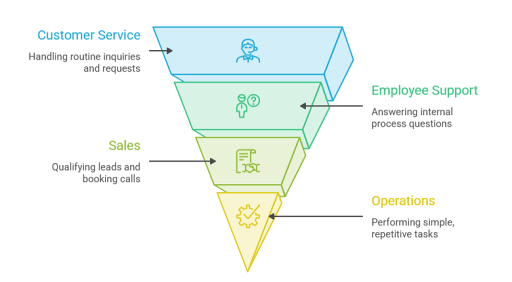
Companies mostly use voice agents in these areas:
- Customer service, for routine questions and service requests
- Employee support, for questions about internal processes
- Sales, to qualify leads and book follow-up calls
- Operations, for simple and repeated communications
Where AI Voice Generation Fits
Callers judge a voice agent by how it sounds. A robotic voice makes people impatient before the agent has even answered. Voice generation tools help fix this.
For example, Murf’s AI voice generator lets businesses produce clear and natural audio that sits well alongside a voice agent.
Teams often use it to create:
- Voiceovers for onboarding and training videos
- Recorded company announcements and team updates
- Audio guides that explain a product to customers
- Greetings and menu prompts for phone lines
A voice generator and a voice agent are not the same thing. A voice generator creates recorded speech while a voice agent holds a live conversation. A company that uses both can keep one familiar voice in its training videos, phone greeting, and live calls.
6 Ways AI Voice Agents Are Changing How Enterprises Communicate
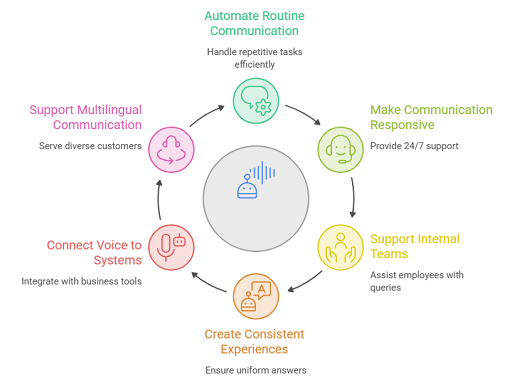
These are the main areas where voice agents are redefining how companies communicate.
-
Automating Routine Communication
Ask anyone who has worked on a support desk. Most calls repeat the same handful of questions. A voice agent can take these calls so staff do not have to.
Typical tasks include:
- Answering questions about store hours, products, and return rules
- Booking, moving, or confirming appointments
- Sharing account details that the company has approved
- Passing difficult calls to the right person or team
During a festive sale, an online store might get flooded with calls asking about delivery dates. The agent can take all of them at once. Meanwhile, the support team can deal with broken items and refund complaints, which need a person anyway.
-
Making Communication More Responsive
Customers call at night, on Sundays, and from a different time zone. Staff cannot cover every hour, but a voice agent can.
That makes a difference in a few ways:
- Simple requests get answered outside office hours
- Many calls run at the same time, so queues stay short
- Callers get information without waiting for a free employee
- People can ask out loud instead of typing or searching a website
Long hold times make people hang up, and some of them go straight to a competitor. A call that gets answered right away keeps that customer.
Bents Magazine explores how international phone numbers help businesses connect globally. A voice agent can answer those numbers in every region that a company serves.
-
Supporting Internal Teams
Employees ask routine questions too. They want to know about leave, laptop problems, or where an approval is stuck, and they often lose time searching for the answer.
An internal voice agent can help with:
- IT ticket status and fixes for common problems
- HR questions about leave, holidays, and policies
- Setting up or rescheduling meetings
- Updates on purchase orders and approvals
A field technician repairing a machine usually has both hands busy. Opening a portal on a phone is awkward at that moment. Asking a voice agent is much easier, and the answer comes back in a few seconds.
-
Providing Consistent Customer Experiences
Ask 10 employees the same policy question, and you may get a few different answers. People forget details or learn the rules from different sources. A voice agent answers from one approved source every time.
This helps companies:
- Give the same correct answer to every caller
- Follow the same steps for each type of request
- Keep the tone in line with the brand
- Send complex calls to the right employee
Customers notice when answers change from one call to the next. Steady answers build trust.
There is a catch. Prices, products, and policies change often. Someone has to keep the agent’s information current, or it will confidently repeat old details.
-
Connecting Voice With Business Systems
On its own, a voice agent can only share general information. Connected to company systems, it can do real work.
Common connections include:
- CRM platforms for customer history
- Help desk tools for ticket status
- Knowledge bases for approved answers
- Scheduling software for live availability
Let’s say a customer calls about a fault they reported last week. The agent looks up the CRM record, finds the open ticket, and reads out the latest update. For digital agencies supporting businesses with multiple online needs, white label SEO services can provide ongoing SEO support without requiring a dedicated in-house team.
-
Supporting Multilingual Communication
Generally, large companies serve customers who speak different languages. Hiring fluent staff for each one takes time and money.
Multilingual voice agents can:
- Speak with callers in their own language
- Adjust how they speak for local audiences
- Give people who find text difficult a voice option
- Support new markets without a new support team
Translation alone is not enough, though. Pronunciation, local terms, and tone all affect how a call feels. A phrase that sounds polite in one country can sound rude in another, so companies should test each language with local speakers.
What to Consider Before Adopting AI Voice Agents
A poorly planned rollout can annoy customers more than a hold queue ever did. Before going live, companies should think through the following:
- Accuracy, so the agent works from reliable and current information
- Integration with the systems teams already use
- Security for customer and employee data on every call
- Compliance with local rules on call recording, consent, and privacy
- Human escalation with clear points where a person takes over
- Regular reviews of call transcripts to improve the agent
Starting small usually works best. Choose one busy and predictable type of call, watch how the agent handles it for a few weeks, and expand once the results look good.
The Future of AI Voice Agents in Enterprise Communication
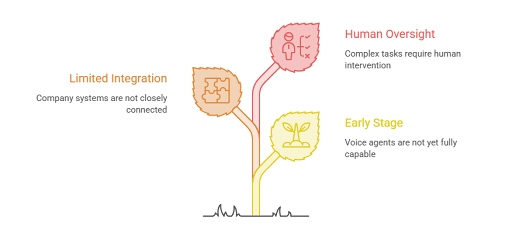
Voice agents are still at an early stage. As company systems connect more closely, the agents will handle more of the work around each call.
In the coming years, they are likely to:
- Link each call with the right customer and business data
- Give staff quick and hands-free access to information
- Finish simple tasks from start to end without help
- Handle calls across more languages and time zones
Today, an agent might tell a customer when a delivery will arrive. Soon, the same agent could change the delivery date, update the CRM, and send a confirmation message during one call. Agents are also getting better at spotting an upset caller and passing the call to a person earlier.
This ties into the wider move toward unified communication. Unified business communication brings different channels together. Voice agents can work alongside phone, chat, and team collaboration tools, so customers get the same experience wherever they reach out.
People will still handle the hard parts. Sensitive complaints, unusual cases, and decisions that need judgment should stay with trained staff.
Companies that get the most out of voice agents will use them to support their teams, not replace them.
Ensure Better Enterprise Communication With AI Voice Agents
AI voice agents are changing how companies run customer service, internal support, sales, and daily operations.
Key takeaways from this article:
- Voice agents take over repeat calls, so staff can focus on complex issues
- Customers and employees get answers at any hour with shorter queues
- Connections to CRM, help desk, and scheduling tools make agents far more useful
- One approved source keeps answers consistent on every call
- Clear handoff rules keep sensitive conversations with trained people
Turning on automation is just the beginning. Accurate data, safe systems, transparent procedures, and personnel prepared to take over are all necessary for positive outcomes.
Want to know how a voice agent fits into your company? Begin with a single high-volume call type, assess the outcomes, and expand from there. For more business technology insights, explore Bents Magazine.
