



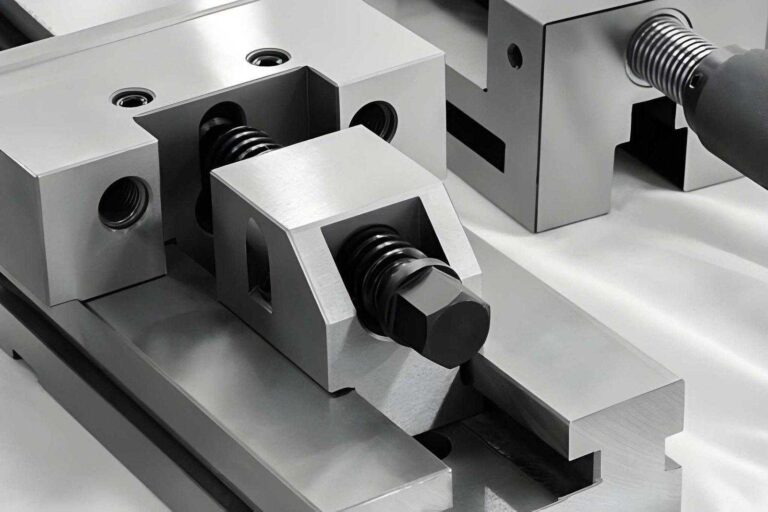
Accurate CNC machining depends on more than a correct program and a sharp cutting tool. The workpiece must also remain stable, properly aligned, and securely positioned throughout the entire machining process. If the material shifts, lifts, vibrates, or sits unevenly, even a well-programmed machine can produce inaccurate parts.
For beginners, workholding can sometimes feel less important than feeds, speeds, or tool selection. However, the way a part is held directly affects dimensional accuracy, surface finish, tool life, and operator safety. A reliable setup allows the machine to cut consistently without forcing the operator to make unnecessary offset adjustments.
The first useful workholding tool is a self centering vice. A self-centering design moves both jaws toward the middle as the vise closes, helping keep the workpiece positioned around a consistent center point.
This can be especially useful when machining multiple sides of a part or when repeating the same setup across several workpieces. Consistent centering reduces setup variation and can make it easier to establish dependable work offsets.
The second important tool is a set of parallels. Parallels are precision-ground strips placed inside a vise to raise the workpiece above the vise body. They provide a flat reference surface and create clearance for drills, end mills, or other cutting tools.
The third tool is a work stop. A stop gives each piece of material a repeatable loading position. The fourth is a set of soft jaws, which can be machined to match the shape of a specific component. The fifth is a collet system, which provides secure and even holding for smaller or round parts.
Together, these simple tools can help beginners create more stable setups and produce more consistent results.
Why Centered Workholding Creates More Consistent Results
Repeatability is one of the most important goals in CNC workholding. A setup should allow each new workpiece to sit in the same location and orientation as the previous one. When that happens, the machine can use the same work offsets and toolpaths with fewer adjustments.
Centered workholding is helpful because it keeps the part positioned around a predictable reference point. This is especially valuable when machining symmetrical parts or completing multiple operations that depend on a shared centerline.
However, a self-centering vise will only perform accurately when it is installed and maintained correctly. Before mounting the vise, the machine table and vise base should be cleaned thoroughly. Chips, burrs, or dried coolant beneath the vise can cause it to sit unevenly.
The vise should also be aligned according to the setup requirements. A dial indicator may be used to sweep a reference surface and check whether the vise is square or parallel with the machine axis. Beginners should make small adjustments and recheck the alignment before tightening all mounting hardware.
Parallels also play an important role in creating consistent setups. When a workpiece rests evenly on clean parallels, it is easier to control its height and alignment. If chips become trapped between the material and the parallels, the part may sit at an angle.
Operators should check that the workpiece is fully seated before machining. A soft mallet can sometimes be used to tap the material gently against the parallels while the vise is being tightened. The operator should then confirm that the parallels cannot move freely beneath the workpiece.
Work stops add another level of repeatability. A stop allows each new piece of stock to be placed against the same reference location. This reduces the need to measure and reposition every part manually.
Stops should be mounted securely and positioned where they will not interfere with tools, the spindle, or chip evacuation. They should also contact a reliable section of the material. If the end of the stock is rough or uneven, the stop may not provide a consistent reference.
Soft jaws are another beginner-friendly improvement. Standard hard jaws are useful for general work, but soft jaws can be machined to match the profile of a specific part. This creates more contact area and can improve stability.
Soft jaws are especially helpful for round, thin, or unusually shaped components. By supporting more of the workpiece, they can reduce distortion and movement. However, the jaw pocket must be machined accurately, and enough gripping pressure must be maintained to resist cutting forces.
The correct clamping pressure depends on the material and part shape. Too little pressure may allow the component to move, while excessive pressure can distort thin-walled parts. Beginners should avoid assuming that tighter is always better.
How Collets Help Hold Smaller Parts Securely
Collets are commonly used to hold round stock, small components, cutting tools, and parts that require even clamping around their outside diameter. Unlike a standard three-jaw chuck or vise, a collet applies pressure around a larger portion of the workpiece.
This even gripping action can reduce marking and improve concentricity. 5c collets are widely used in machining because they can hold a range of common stock sizes and are compatible with many fixtures, indexers, and lathe setups.
To use a collet correctly, the workpiece diameter must match the collet’s intended range. A collet should not be forced to hold material that is significantly larger or smaller than its rated size. Improper sizing can reduce contact, damage the collet, or allow the part to slip.
The collet and workpiece should also be clean. Chips or debris between the gripping surfaces can create runout and prevent the part from seating correctly. Operators should inspect the collet for wear, cracks, or damaged slots before use.
Part insertion depth is another important consideration. The material should have enough contact with the collet to remain stable during machining. Holding a long workpiece by a very short section can create vibration or allow the part to move under cutting pressure.
The amount of unsupported material should be minimized whenever possible. Long stock extending from the collet can deflect or chatter during cutting. A support, guide, or different workholding method may be needed for longer components.
Collets are especially useful when several identical parts must be loaded and unloaded. Once the setup is established, each workpiece can be positioned at a consistent depth using a stop. This makes production more repeatable and reduces loading time.
Regardless of the workholding method, inspection should be part of the setup process. Operators should confirm that the material is seated properly, the workholding device is aligned, and the first finished part matches the required dimensions.
Using reliable cnc measuring tools allows machinists to verify part size, runout, alignment, and feature location. Calipers may be used for quick checks, while micrometers, indicators, and bore gauges may be needed for tighter tolerances.
In conclusion, five simple workholding tools that can improve CNC accuracy are a self-centering vise, parallels, a work stop, soft jaws, and a collet system. Each tool helps control how the workpiece is positioned and secured during machining.
Centered workholding improves repeatability, while parallels and stops create reliable reference points. Soft jaws support unusual part shapes, and collets provide secure holding for smaller or round components.
By cleaning contact surfaces, selecting the correct gripping pressure, reducing unsupported material, and inspecting the first completed part, beginners can build more reliable CNC setups. Better workholding does not only improve accuracy. It also reduces setup time, prevents scrap, and creates a safer and more efficient machining process.
