



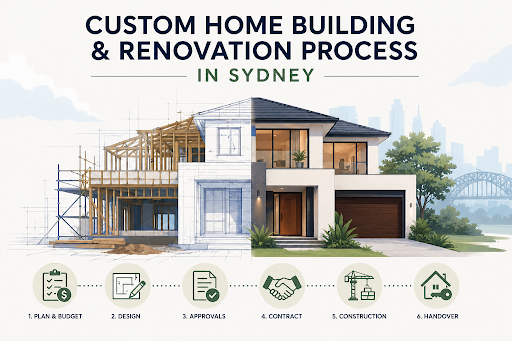
Most cost overruns and timeline blowouts on Sydney building projects trace back to the same root cause homeowners who started without fully understanding the process. They committed to a design before knowing what the council would approve. They signed a contract before understanding what was included. They started construction without locking in material selections, and trades ended up waiting.
Building timelines in Australia has become more structured and thorough. Between design development, surveys, engineering, council or certifier approvals, and the quoting process, it is common for the pre-construction phase alone to take several months.
Whether you are building a custom home from the ground up or renovating an existing property, the process in Sydney follows a clear sequence. Understanding each stage and what decisions need to be made at each point is what keeps projects on track and on budget.
Stage 1: Define the Scope and Set a Realistic Budget
Before you engage an architect, a designer, or a builder, you need clarity on two things: what you actually want to build, and what you can realistically afford to spend.
These two things need to be established together, not separately. Many homeowners spend months developing detailed plans only to discover their vision exceeds their budget at the point of quoting. Getting a rough cost indication from a builder early, even before the design is finalised, prevents that outcome.
For a custom home build in Sydney, construction costs typically range from $3,500 to $5,500 per square metre depending on specification level, site conditions, and finish quality. A 250sqm custom home at mid-range specification lands broadly between $875,000 and $1.375 million in construction costs, excluding land, design fees, council charges, and consultant costs.
For renovations, the scope definition matters just as much. Know upfront whether you are doing a cosmetic refresh, a full structural renovation, or a renovation with layout changes, because the cost difference between those three scopes is substantial, and the approval pathway is different for each.
What to establish at this stage:
- Approximate floor area and number of rooms for a new build
- Which parts of an existing property are being retained versus rebuilt for a renovation
- Target budget including a 15 to 20 percent contingency
- Desired completion timeline and any fixed deadlines driving that
Stage 2: Engage Your Design Team
Once scope and budget are broadly aligned, the next step is engaging the design professionals who will translate your brief into a set of drawings that can be approved and built from.
For a custom home build, this typically means a registered architect or building designer. For a renovation, it may be a building designer, draftsperson, or architect, depending on the complexity of the work.
Assembling your project team early, with a registered architect, town planner, and engineer working together from the start, helps avoid costly errors. A planner who understands the Greater Sydney Region Plan and how local council policies align with state environmental planning policy is particularly valuable in Sydney’s complex planning environment.
The design process moves through several stages:
Concept design: The initial sketch or 3D model that captures the overall layout, massing, and character of the project. This is where you align on the big picture before spending money on detailed documentation.
Design development: The concept is developed into a more detailed set of drawings that establishes the structural approach, materials, window positions, and key dimensions.
Construction documentation: The full set of drawings, specifications, and engineering details that the builder prices from and builds to. This documentation is also what gets submitted for council approval.
The design stage is where your input is most valuable and most cost-effective. Changes to a drawing cost nothing. Changes to a building cost a lot.
Stage 3: Navigate the Council Approval Process
Sydney’s planning system has multiple approval pathways, and choosing the right one for your project affects both your timeline and your design flexibility.
There are three main levels of building approval in NSW. Exempt development covers small works that do not need formal approval as long as specific size and boundary rules are met. A Complying Development Certificate (CDC) is the middle lane, faster than a full DA and suitable for straightforward projects that meet pre-determined standards in the National Construction Code and local planning controls. A full Development Application (DA) is required for more complex projects, heritage sites, unusual zoning, or significant environmental impact.
Fast-tracked complying development approvals can be issued in as little as 20 days, or 10 days for NSW Housing Pattern Book development. This makes the CDC pathway significantly faster than the full DA process, which can take anywhere from three months to well over a year depending on council, project complexity, and whether objections are raised.
The DA documentation must be thorough and accurate. Typical requirements include certified building plans drawn by a registered architect, a site analysis report, a Statement of Environmental Effects (SEE), shadow diagrams, a BASIX Certificate for residential projects, engineering approvals where required, and completed council forms.
BASIX, the Building Sustainability Index, is a NSW-specific requirement for all residential projects over $50,000. It sets minimum benchmarks for water efficiency and thermal performance. Your designer manages this, but it affects design decisions around insulation, glazing, and water fixtures from early in the process.
The most frequent causes of delay in the Sydney Development Application process include incomplete documentation, failure to address heritage restrictions, incorrect zoning compliance assessments, and underestimated environmental impact requirements. Early council engagement is the single most valuable thing an applicant can do.
A good builder will take the entire approval process off your plate. Working with an experienced Custom Home Builder Sydney means having a team that manages DA and CDC submissions, BASIX compliance, NatHERS ratings, and structural approvals, so you are not chasing council on your own while trying to make design decisions at the same time.
Stage 4: Tender, Select, and Contract Your Builder
Once design documentation is complete and the approval pathway is clear, you are ready to go to tender. This means sending your drawings and specifications to builders for formal pricing.
Get a minimum of three quotes, and make sure they are all priced on exactly the same documentation. A quote comparison only works if every builder has quoted the same scope.
When reviewing quotes, look beyond the bottom line. Understand what is and is not included site establishment costs, demolition if applicable, external works, council fees, and provisional sums for items not yet specified. A quote that looks cheaper often has more provisional sums, which means more price risk as the project progresses.
Transparency and detailed scopes remain essential in 2026. Clear budgeting from the start prevents unexpected surprises and gives you confidence that your vision aligns with your investment.
Your building contract in NSW should comply with NSW Fair Trading home building contract requirements. For residential projects over $20,000, a written contract is a legal requirement. The contract should set out the full scope of work, payment schedule, timeline, variation procedure, and what happens in the event of delays or disputes.
Construction cannot proceed without regulatory approval. Local councils enforce building codes that ensure structural safety, zoning compliance, and proper land use. Permit approval confirms that your design meets engineering and legal requirements. Skipping permits creates serious risks including legal penalties, construction delays, and forced structural modifications.
Stage 5: Pre-Construction and Site Preparation
Once contracts are signed and all approvals are in place, there is still important work to do before the first shovel goes in.
Before construction begins, a free site inspection assesses land conditions, soil, slope, orientation, and council requirements to provide an accurate, honest quote. This is a critical part of the home building process that many builders skip.
Pre-construction typically involves:
Soil testing: A geotechnical report determines the soil classification, which drives the foundation and footing design. In parts of Sydney, reactive clay soils require engineered footings that add cost if not identified early.
Demolition: If an existing structure is being removed, asbestos testing is mandatory for properties built before 1990. Asbestos-containing materials must be removed by a licensed removalist before any other demolition proceeds.
Service disconnections: Water, gas, and electrical connections to the existing structure need to be formally disconnected before demolition begins.
Material procurement: Locking in long lead-time items, such as structural steel, windows, joinery, and imported fixtures, before construction starts, prevents the supply delays that push timelines out mid-build.
Stage 6: Construction What Happens on Site and in What Order
A custom home build follows a defined construction sequence. Understanding this sequence helps you track progress and know when to be making decisions.
- Foundation and slab Excavation, formwork, steel reinforcement, and concrete pour. The slab is the foundation everything else sits on. Soil classification determines the engineering specification.
- Frame Timber or steel frame erected over the slab. Frame stage is when the floor plan becomes three-dimensional and the room layout is physically visible for the first time.
- Lock-up External cladding, roof, windows, and external doors installed. The building is weathertight. Mechanical, electrical, and plumbing rough-ins occur through this stage.
- Fit-out Internal linings, insulation, cabinetry, tiling, painting, and fixture installation. This is the most labour-intensive stage and where your selections — benchtops, tiles, tapware, flooring — come to life.
- Practical completion Final finishes, touch-ups, cleaning, and defect rectification. The builder walks through the project with you before handover. Any items that do not meet the contracted standard are documented and rectified before keys are handed over.
- Occupation Certificate Issued by the Principal Certifier confirming the building is suitable for occupation. Final inspection verifies structural safety, engineering confirms load paths work, and compliance checks every installed system. Without certification, occupancy is not legal.
The Renovation Process: How It Differs From a New Build
A home renovation in Sydney follows the same broad sequence design, approval, contract, construction but the context is different. You are working within an existing structure, which means surprises are more likely, the approval pathway depends heavily on what is being changed, and the management of the project requires tighter coordination between trades.
The most important renovation-specific considerations in Sydney are:
Structural assessment:
Before any walls come down, a structural engineer needs to confirm what is load-bearing and what is not. Removing a load-bearing wall without proper engineering is one of the most dangerous and expensive mistakes in residential renovation.
Heritage overlays:
A significant number of Sydney properties are in heritage conservation areas or are individually listed heritage items. Heritage restrictions in Sydney mean a full DA through the council assessment pathway is almost always required. This affects what you can change on the façade, roof, and in some cases, internal layout.
Apartment renovations:
Apartment and strata renovation in Sydney adds another layer of complexity. Before any structural, plumbing, or external work begins, strata by-laws require a formal by-law or renovation approval from the owners’ corporation. Work affecting common property structural walls, balconies, windows, and waterproofing requires owner corporation consent, and in many cases an indemnity agreement. For anyone navigating an Apartment Renovation Sydney, understanding what requires strata approval and what falls within your lot is the first step. Getting this wrong can result in work being ordered to be reversed at your cost.
Waterproofing compliance:
For any wet area renovation, waterproofing must comply with AS 3740 and be completed by a licensed waterproofer who issues a compliance certificate.
What Makes a Custom Build or Renovation in Sydney More Expensive Than Expected
Sydney is consistently one of Australia’s highest-cost building markets. Several factors drive that cost above what homeowners expect.
Labour costs: Sydney’s trades are in high demand across residential, commercial, and infrastructure sectors simultaneously. That demand keeps labour rates high and good subcontractors booked out weeks in advance.
Site conditions: Sydney’s topography means sloped blocks, rock excavation, and difficult access are common. Each of these adds cost that is not always visible until the geotechnical report is done or demolition begins.
Council and certification costs: DA fees, application fees, principal certifier fees, and occupation certificate costs are a real line item that many budgets underestimate.
Variations Selections transform plans into a real, tangible space, and at this stage final pricing is confirmed. Working with builders who prioritise transparency ensures costs are clearly explained and aligned with expectations before construction begins. Variations requested after contract signing changing a benchtop finish, adding a window, upgrading tapware all carry margin and delay risk. Locking in selections before the contract is signed is the single most effective way to control variation costs.
Frequently Asked Questions
How long does it take to build a custom home in Sydney? Most builds are completed within 6 to 12 months from approval, depending on design complexity and site conditions. The pre-construction phase design, approvals, tendering, and contracting typically adds another three to six months before construction starts.
Do I need a DA or CDC for my Sydney project? Complying development applies to a range of projects, including the construction of a new dwelling house, alterations and additions to a house, and home renovations. Fast-tracked complying development approvals can be issued in as little as 20 days. A full DA is required when the project does not meet CDC criteria. Heritage sites, certain zoning, and complex designs typically fall into this category.
Who is responsible for managing council approvals? A reputable builder handles all DA and CDC approvals as part of their service. You should not be chasing council on your own. Confirm this is included in the builder’s scope before signing.
What is BASIX and does my project need it? BASIX is a NSW requirement for all residential projects over $50,000. It sets minimum standards for water efficiency and thermal performance. Your designer manages the BASIX certificate, but it influences design decisions from early in the process.
Can I live in my home during a renovation? For minor cosmetic renovations, yes. For structural renovations, full gut renovations, or projects that affect the kitchen and bathroom simultaneously, most families find it impractical and prefer to move out for the duration. Factor temporary accommodation costs into your budget if the scope is significant.
What happens if my builder goes over time in Sydney? Your building contract should include a liquidated damages clause that specifies what compensation applies for delays caused by the builder. Check for this before signing. Some Sydney builders also offer deadline guarantees where they pay you a fixed daily amount for every day over the agreed completion date, which aligns the builder’s incentive directly with your timeline.
