



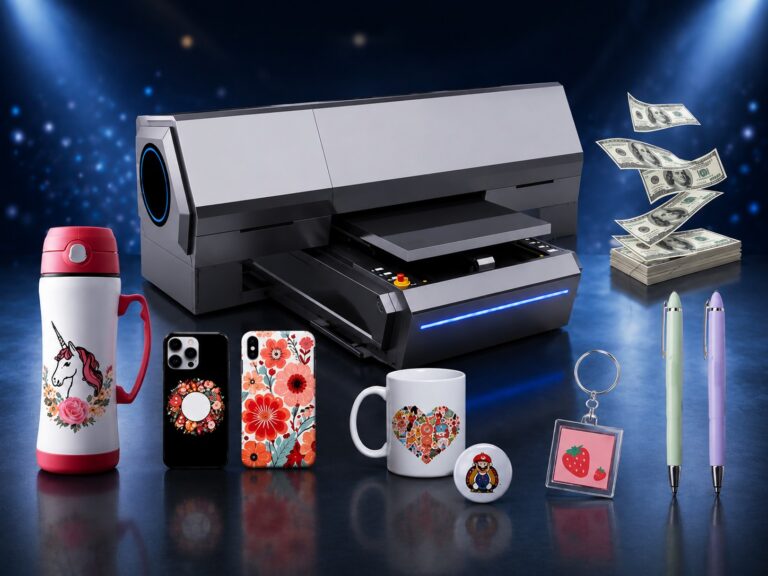
UV printing technology has opened up new possibilities for businesses that want to personalize products, create promotional materials, and produce short-run customized items. Among the available solutions, UV DTF printers and UV flatbed printers have become two popular choices. Although both use UV-curable inks, their workflows, applications, and ideal use cases are different.
Understanding these differences is important for businesses that are considering an investment in digital printing equipment. The right choice depends on the products being produced, the materials involved, production volume, available workspace, and the level of customization required.
What Is a UV DTF Printer?
A UV DTF printer uses a specialized transfer process. Instead of printing directly onto the final object, the design is printed onto a dedicated film. The printed layer is then transferred to the target surface.
One of the main advantages of this approach is flexibility. Because the design is prepared as a transfer, businesses can decorate objects with curved, irregular, or difficult-to-print surfaces that may not fit conveniently under a traditional flatbed printer.
UV DTF printing can be used for products such as bottles, tumblers, gift items, promotional products, phone cases, packaging, and various personalized objects. It is particularly attractive for businesses that handle customized products in different shapes and sizes.
Another advantage is the ability to prepare transfers in advance. Depending on the production workflow, businesses can produce designs before the final application stage, which can make order fulfillment more flexible.
What Is a UV Flatbed Printer?
A UV flatbed printer prints directly onto the surface of an object or substrate. The material is placed on a flat printing platform, and the printer applies UV-curable ink directly to the surface.
UV flatbed printers are commonly used for rigid materials such as acrylic, wood, glass, metal, PVC, foam board, and certain promotional products. Depending on the machine configuration, they can support a wide variety of substrates and product formats.
The direct-printing process can provide a strong connection between the printer and the final product. For businesses producing signs, panels, displays, boards, and other flat products, this workflow can be highly efficient.
UV DTF vs. UV Flatbed: Key Differences
Printing Method
The most obvious difference is the printing workflow.
UV DTF printing creates a design on a transfer film before applying it to the final object. UV flatbed printing applies the ink directly to the substrate.
This makes UV DTF particularly useful when the final product has an irregular shape or when direct printing is difficult.
Material and Product Compatibility
Both technologies can work with a broad range of materials, but their strengths are different.
UV flatbed printers are particularly suitable for flat or relatively stable substrates. They are often used for signs, panels, boards, decorative surfaces, and other rigid products.
UV DTF printing is more flexible when dealing with curved surfaces. Businesses can apply prepared transfers to products such as bottles, cups, cases, and other objects that may be challenging to position on a flatbed.
Production Workflow
A UV flatbed printer provides a relatively direct workflow: position the substrate, prepare the artwork, print, and cure the ink.
UV DTF involves additional steps because the design must first be printed onto transfer film before it is applied to the final product.
However, this extra step can provide greater flexibility. Businesses can potentially prepare transfers ahead of time and apply them when specific customer orders are received.
Product Customization
Both technologies can support customized production, but they are often used for different types of products.
UV flatbed printing works well for customized signs, plaques, displays, panels, and promotional materials. It can also be useful when businesses need to print directly onto large or rigid substrates.
UV DTF is particularly attractive for personalized consumer products. Businesses producing customized drinkware, gift items, packaging, and promotional merchandise may benefit from its ability to decorate curved and irregular surfaces.
Space and Equipment Considerations
Machine size and workspace requirements should also be considered before making an investment.
A flatbed printer requires sufficient space for the machine and for loading the substrates. The production environment must also accommodate the size and weight of the materials being printed.
UV DTF systems can offer a different workflow because the final products do not necessarily need to be placed directly inside the printer during the transfer stage. This may be useful for businesses handling many different product shapes.
Which Printer Should You Choose?
The best choice depends primarily on your business model.
A UV flatbed printer may be the better option if your business focuses on direct printing onto flat or rigid materials. Sign makers, promotional product manufacturers, packaging companies, and display producers may benefit from its direct-printing capabilities.
A UV DTF printer may be more suitable for businesses focused on product personalization and irregularly shaped objects. If you frequently receive orders for bottles, tumblers, phone cases, decorative products, or customized gifts, transfer-based printing can provide valuable flexibility.
Some businesses may eventually choose to use both technologies. A flatbed printer can handle direct printing onto rigid substrates, while UV DTF can provide an efficient solution for curved and difficult-to-print objects.
Consider More Than the Purchase Price
The initial machine price should not be the only factor in the decision. Businesses should consider ink consumption, film or transfer materials, maintenance, production speed, labor requirements, product waste, and expected order volume.
It is also important to think about future growth. A printer that meets today’s requirements may become limiting as product demand expands. Choosing equipment that supports the intended range of applications can help businesses avoid unnecessary upgrades.
When comparing different digital printing technologies, companies can explore equipment options from manufacturers such as DTF LINKO to better understand the available solutions and determine which configuration fits their production goals.
Final Thoughts
UV DTF printers and UV flatbed printers both offer valuable capabilities, but they are designed around different production workflows. UV flatbed printing is well suited to direct printing on flat and rigid substrates, while UV DTF provides greater flexibility for decorating curved, irregular, and customized products.
Rather than choosing a printer based solely on specifications or price, businesses should start with their target products and customers. By evaluating material compatibility, production volume, workspace, customization requirements, and long-term operating costs, companies can select the printing technology that best supports their business strategy.
