



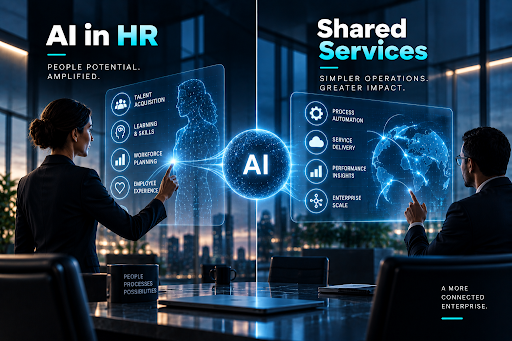
Human resources organizations are expected to improve workforce productivity, deliver better employee experiences and control operating costs while supporting increasingly complex workforce requirements. Shared Services have long helped HR achieve greater efficiency through process standardization and centralized service delivery. Now, AI in HR is creating opportunities to take this model further by automating knowledge-intensive work, improving employee self-service and enabling more intelligent HR operations.
The combination can help organizations move beyond traditional transaction processing toward more responsive and scalable workforce services. However, realizing this value requires strong workforce data, standardized processes, integrated technology and appropriate governance.
This article explores how AI in HR is changing Shared Services, the most valuable applications, business benefits and priorities organizations should consider when developing intelligent HR service operations.
What is AI in HR?
AI in HR refers to the application of artificial intelligence technologies across human resources processes, workforce services and decision support.
These capabilities can include machine learning, predictive analytics, generative AI, intelligent automation and AI agents. Organizations can apply them across recruiting, onboarding, employee support, learning, workforce planning and HR administration.
Unlike traditional automation, which generally follows predefined rules, AI can interpret information, identify patterns and support knowledge-intensive activities.
The objective is not simply to automate HR work but to improve how employees access services and how HR professionals allocate their time.
What are Shared Services in HR?
Shared Services consolidate common HR processes and administrative activities into centralized or coordinated service delivery structures.
The model can include employee data administration, onboarding support, benefits administration, HR case management, payroll coordination and employee inquiries.
By standardizing repeatable activities, Shared Services can reduce duplication and provide more consistent HR support across business units or locations.
As the model evolves, organizations increasingly expect these teams to provide digital self-service, workforce insights and more sophisticated support in addition to transactional processing.
Why AI matters for HR Shared Services
HR service organizations typically manage high volumes of employee inquiries, documents, cases and recurring administrative processes. This creates a strong foundation for intelligent automation.
Traditional workflow technologies can automate structured activities, but employees may still need HR professionals to interpret policies, search documentation or resolve more complex requests.
AI in HR can extend automation into these knowledge-intensive areas.
For example, generative AI can retrieve relevant policies, summarize employee cases and provide conversational answers to routine questions. This can reduce administrative demand while allowing specialists to focus on more complex workforce issues.
Core technologies enabling intelligent HR services
Several AI technologies can contribute to the evolution of Shared Services.
Generative AI
Generative AI can summarize HR cases, draft employee communications and provide conversational access to policies and workforce knowledge.
Machine learning
Machine learning can analyze workforce and service information to identify patterns, anomalies and trends.
Predictive analytics
Predictive analytics can help organizations anticipate service demand, workforce requirements and other potential changes.
Intelligent automation
Automation can execute repetitive activities such as workflow routing, approvals and employee record updates.
AI agents
AI agents can potentially coordinate multistep HR workflows across enterprise systems while escalating sensitive or consequential decisions to HR professionals.
Together, these capabilities expand AI in HR beyond individual tools toward more connected service operations.
Key applications of AI in HR Shared Services
Organizations can apply artificial intelligence across several HR service processes.
Employee self-service
Conversational AI can provide employees with information about benefits, leave, policies and common HR processes without requiring routine intervention from HR teams.
HR case management
AI can summarize employee requests, retrieve relevant information and route cases to the appropriate specialist.
Employee onboarding
AI-enabled workflows can help new employees navigate onboarding requirements, access organizational information and complete routine activities.
HR knowledge management
Generative AI can make policies, procedures and other HR documentation easier for employees and service professionals to search and understand.
Workforce administration
Intelligent automation can support employee record changes, documentation and routine administrative workflows.
Service reporting
AI can summarize service volumes, recurring employee issues and operational trends to help Shared Services leaders understand performance.
These applications can improve both HR productivity and employee service delivery.
Business benefits of AI-enabled Shared Services
When connected to clearly defined HR priorities, intelligent technologies can improve several dimensions of performance.
Greater HR productivity
AI can reduce time spent answering repetitive questions, searching for information and completing administrative work.
Faster employee support
Conversational self-service and intelligent case management can reduce response and resolution times.
More consistent service delivery
Standardized digital workflows can help organizations provide more consistent employee services across locations and business units.
Greater scalability
AI-enabled Shared Services can potentially manage increasing employee and service volumes without proportional growth in administrative resources.
Better employee experience
Simpler access to information and faster resolution of routine issues can reduce friction in important employee interactions.
How AI in HR changes the Shared Services operating model
The impact of artificial intelligence extends beyond individual task automation.
As technology handles more routine inquiries, information retrieval and administrative activities, HR professionals can spend greater capacity on exceptions, employee relations and more complex workforce needs.
This changes the skills required within Shared Services. Employees may need stronger capabilities in case management, analytics, AI oversight and problem-solving.
Organizations should therefore evaluate workforce design alongside technology implementation.
AI in HR should be considered an operating model change rather than simply another automation initiative.
The role of employee self-service
Employee self-service is one of the clearest opportunities for AI within Shared Services.
Traditional portals often require employees to navigate menus or search documentation manually. Conversational AI can provide a more intuitive interface.
An employee could ask a natural-language question and receive information based on approved organizational policies. If the issue requires specialist attention, the system could route the request to the appropriate HR team.
This approach can improve accessibility while reducing routine service demand.
However, organizations need strong knowledge governance to ensure employees receive current and reliable information.
Best practices for implementing AI in HR
Organizations can improve implementation outcomes by following several principles:
- Start with clearly defined HR service and workforce problems.
- Simplify and standardize processes before introducing advanced AI.
- Improve workforce data and HR knowledge quality.
- Prioritize use cases based on value, feasibility and risk.
- Integrate AI with existing HR platforms and Shared Services workflows.
- Establish strong employee privacy and cybersecurity controls.
- Maintain human accountability for sensitive workforce decisions.
- Prepare HR professionals for AI-enabled roles and processes.
- Measure improvements in productivity, service quality and employee experience.
- Expand AI capabilities only when they demonstrate sustainable value.
These practices help organizations scale AI without weakening the controls required for workforce processes.
Governance and employee privacy
Governance is particularly important because AI in HR can interact with sensitive employee information.
Organizations should define which workforce data AI systems can access and how that information can be used.
Role-based permissions should prevent employees or AI applications from accessing information beyond their authorized responsibilities.
Human oversight should remain central to consequential workforce decisions involving hiring, compensation, performance and employee relations.
Organizations should also monitor AI systems for accuracy, fairness and compliance with applicable requirements.
Common implementation challenges
Fragmented HR technology can make AI implementation difficult. Employee information may reside across core HR, payroll, benefits, recruiting and learning systems.
Knowledge quality is another challenge. Outdated policies or inconsistent documentation can result in unreliable AI-generated answers.
Organizations may also overestimate productivity benefits. Saving HR employees time does not automatically create financial value unless that capacity is redeployed or enables the organization to manage greater workloads.
Shared Services leaders therefore need clear plans for how AI-enabled capacity will translate into measurable business outcomes.
Measuring the value of AI-enabled HR services
AI should be evaluated through improvements in HR and Shared Services performance rather than technology usage alone.
Relevant measures can include cost per employee, HR productivity, case resolution time, employee self-service rates, process cycle time and employee satisfaction.
For example, an AI assistant should not be considered successful simply because employees use it frequently. Leaders should determine whether it reduces routine cases, improves resolution times and makes reliable HR information easier to access.
Establishing baseline performance before implementation allows organizations to measure these changes more effectively.
The future of AI in HR Shared Services
The next phase of AI in HR will increasingly involve AI agents capable of coordinating activities across workforce systems.
An agent could receive an employee request, retrieve relevant policy information, initiate an authorized workflow and escalate complex or sensitive cases to an HR professional.
Multiple agents may eventually coordinate activities across HR, payroll and other Shared Services processes.
As these capabilities mature, organizations will need to define clear decision rights and determine how much authority intelligent systems should receive.
Shared Services could increasingly evolve from centralized transaction processing toward intelligent workforce service orchestration.
Conclusion
AI in HR is creating opportunities for Shared Services to improve productivity, employee self-service and knowledge-intensive HR processes. Its value extends beyond automation when intelligent capabilities are integrated with standardized workflows, reliable workforce information and redesigned service models.
Organizations that combine AI with strong governance, integrated technology and appropriate human oversight will be better positioned to build scalable and responsive HR Shared Services.
The long-term opportunity is to create an intelligent HR service model that reduces administrative friction while allowing HR professionals to focus more capacity on workforce needs and enterprise performance.
