



Introduction
Printing on curved, irregular, or textured surfaces has always been a challenge for traditional printing methods. Flat screen printing and digital printing work well on flat objects, but many products, such as bottles, toys, electronic components, and sporting goods, have shapes that make direct printing difficult.
This is where pad printing comes in. It is a versatile printing process that has been trusted by manufacturers for decades because it can transfer detailed images onto almost any surface, no matter how uneven. In this article, we will explore what pad printing is, how it works, its components, its applications, and how to choose the right equipment for your production needs.
What Is a Pad Printing Machine and How Does It Work
A pad printing machine, also known as tampography, is a piece of equipment that transfers a two dimensional image onto a three dimensional object using a flexible silicone pad. Unlike screen printing, which presses ink directly through a mesh onto a surface, pad printing uses an indirect transfer method. This makes it especially suitable for objects with curved, concave, convex, or irregular shapes.
The machine is generally composed of three main parts, the silicone pad, the ink cup, and the printing plate, also called a cliché. The image to be printed is etched onto the cliché. During operation, the ink cup slides across the plate, filling the etched area with ink while scraping away the excess from the raised, blank surface. The silicone pad then presses down onto the etched image, picking up the ink due to the tackiness created as the ink’s solvent begins to evaporate. Once the pad lifts away from the plate, it moves over to the product and presses onto the substrate, releasing the image cleanly onto the surface.
This process happens quickly and repeatedly, which allows manufacturers to achieve consistent, high quality prints at scale. Because the silicone pad is elastic and can conform to different shapes, it can print on flat, round, oval, or textured surfaces without distorting the image, making it a highly flexible solution across many industries.
Types of Pad Printing Machines
Pad printing equipment generally falls into two broad categories, semi automatic and fully automatic machines.
Semi automatic pad printing machines are controlled by a microprocessor and are designed for simple, practical operation. Many of these machines use a sealed ink cup system, which reduces odor and ink evaporation compared to older open tray designs. They typically come in single color, two color, and six color configurations, giving businesses flexibility depending on their design complexity and production volume. These machines are commonly built from lightweight, durable alloy materials and often include independent X and Y axis adjustment for accurate pad positioning.
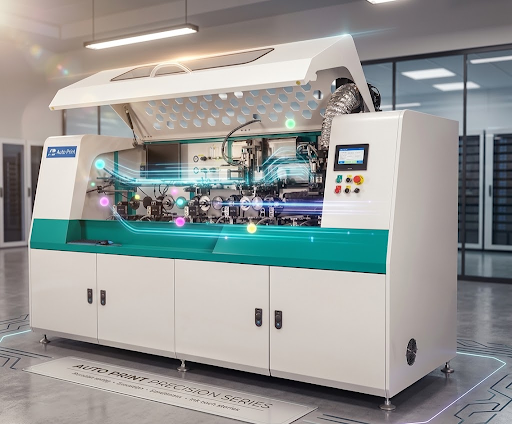
Fully automatic pad printing machines are intended for higher volume production and can integrate additional processes such as flame treating and UV curing into a single automated system. These machines are ideal for businesses that need consistent, high speed output, particularly when printing multiple colors on large batches of products.
The Pad Printing Process in Detail
Understanding the printing cycle helps explain why pad printing produces such reliable results. The process generally follows these steps.
First, the ink cup fills the etched image area on the printing plate with ink, ensuring the viscosity is right for even coverage. Next, the ink cup or open tray scrapes ink off the raised, non image sections of the plate, leaving ink only in the recessed etched area. As the solvent in the ink begins to evaporate, the surface ink becomes tackier than the ink beneath it. The silicone pad then presses down onto the etched image, and because of this tackiness, the ink transfers from the plate onto the pad.
When the pad lifts away from the plate, further evaporation makes the ink even easier to release. The pad then moves to the substrate and presses the image onto the product’s surface. Because the silicone pad is elastic, it can mold itself around curves and contours, ensuring even contact and preventing air pockets that could distort the printed image. Once the pad separates from the product, the cycle is complete and ready to repeat.
Applications of Pad Printing Machines
Pad printing is used across a wide range of industries because of its ability to print on complex shapes and small components. Common applications include electronic parts such as cables, connectors, IC chips, and SD cards, as well as buttons and keys found on calculators, keyboards, and telephones. Household appliances like irons, coffee pots, and televisions often rely on pad printing for branding and control panel markings.
The toy industry frequently uses pad printing for figurines, dolls, cars, and infant products such as pacifiers and rattles. Promotional and advertising items, including pens, lighters, key chains, and USB drives, are also commonly printed this way. Sporting goods manufacturers use pad printing on golf balls, shoes, and skateboard wheels, while the automotive sector applies it to indicators and press buttons. Even ceramics, glassware, and injection molded industrial parts benefit from this printing method, showing just how broad its range of use really is.
Choosing the Right Pad Printing Machine
Selecting the appropriate equipment depends on several factors, including the size of the product, the number of colors required, and the expected production volume. For single color printing on smaller quantities, semi automatic machines are often the most practical and cost effective option. These machines are available in various sizes to accommodate different bottle, tube, or component diameters.
For businesses that require multi color printing, sometimes up to six colors or more, along with higher production output, fully automatic systems tend to be a better investment. These integrated machines combine surface treatment, printing, and curing in one continuous workflow, improving speed and reducing labor costs over time.
It is also worth considering the type of substrate being printed. Materials such as polypropylene, polyethylene, and similar plastics often require surface treatment, such as flame treating or plasma treatment, before printing to ensure proper ink adhesion. If UV ink is used, a curing step is typically needed after printing as well.
Conclusion
Pad printing remains one of the most adaptable printing technologies available today, capable of decorating surfaces that other methods simply cannot handle. From electronic components and household appliances to toys and promotional items, its versatility makes it a valuable process across countless industries. Whether a business needs a simple single color setup or a fully automated multi color system, understanding how a Pad Printing Machine works, along with its components and applications, makes it easier to choose the right equipment for consistent, high quality results.
As production needs continue to grow and diversify, pad printing technology is likely to remain a dependable choice for manufacturers seeking precision, flexibility, and durability in their printing processes.
