



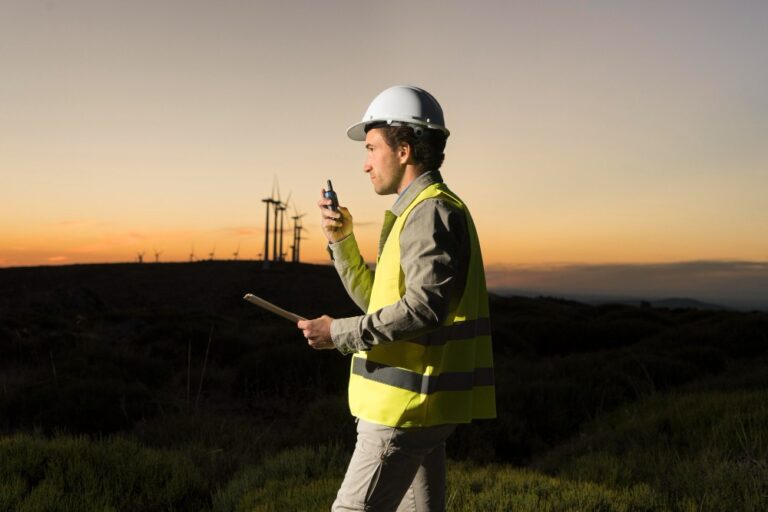
Operating a heavy industrial facility involves sending technicians into highly dangerous environments. Maintenance crews routinely enter subterranean pump rooms, high voltage zones, and toxic chemical storage areas completely alone. If you rely on a basic two-way radio to monitor these people, your facility operates with a massive physical blind spot.
A radio station is completely useless if a worker suffers from a severe medical event or fall. An unconscious person cannot call for help. To actually protect your workforce and your balance sheet, you must deploy active lone worker safety with UWB RTLS. You need undeniable physical coordinates, not an assumed location based on a clipboard.
When an accident happens in the dark, the response time dictates the severity of the financial and human fallout. You cannot afford to let a downed technician lay on the concrete for an hour. Upgrading to active wearables is the only way to establish absolute ground truth across your most hazardous zones.
Liability of Unmonitored Worker Accidents
When a slip and fall occurs in a remote catwalk, the clock starts ticking immediately. Delayed emergency responses turn minor injuries into catastrophic liabilities. Your company absorbs the massive medical costs, immediate facility shutdowns, and aggressive regulatory investigations.
The indirect financial damage of an unobserved accident heavily dwarfs the cost of proper safety infrastructure. You are bleeding capital through skyrocketing insurance premiums and legal settlements. Operations directors must eliminate these physical black holes to protect the business and the people running it.
ROI Loss on Redundant Labor
To cover this lack of visibility, plant managers often resort to the buddy system. They force two highly paid technicians to enter a confined space for a job that only requires one set of hands. One worker executes the task while the other simply stands there acting as a human monitor.
This practice absolutely ruins your shift efficiency. You are inflating your labor costs just to compensate for broken infrastructure. CFOs hate paying two salaries for a single outcome instead of investing that capital into actual operational output.
Real-Time Dashboard Data in Security Operations with Worker Safety RTLS
Legacy safety vendors love to sell complex digital command centers. However, if those screens rely on passive portals, they just deliver severe dashboard fatigue to your security team. Guards learn to ignore the meaningless alerts and delayed check-in notifications.
Knowing that a contractor swiped a badge at the main gate three hours ago provides zero value during an active gas leak. The control room needs immediate, undeniable ground truth right now. When the tracking software constantly contradicts the gritty physical reality of the plant, your security staff will abandon the system entirely.
You need a real-time locations system (RTLS) connected worker safety ecosystem that provides live and accurate data which will predict and prevent any accident. UWB RTLS aka ultra-wideband RTLS is the safest tech to rely on in these cases.
The Failure of the Passive Check In
Passive tracking requires an employee to physically walk through a specific electromagnetic doorway. In a dynamic heavy plant, maintenance teams do not walk in predictable straight lines. They route irregularly to avoid active spills or bypass structural bottlenecks.
When a technician bypasses a scanner to reach a broken valve, they fall completely off the digital grid. The software assumes they are standing safely in a hallway. This creates a catastrophic blind spot right where the actual physical danger is highest.
ZERO Hardware Lock-In Issue with LocaXion
A major hurdle in protecting your isolated workforce is the massive trap of hardware lock in. Traditional tracking vendors force facilities to buy their proprietary worker badges and closed loop antennas. When your employee headcount expands, you are held hostage by a single manufacturer.
Operations directors demand agnostic infrastructure to protect their capital budgets. You need the absolute freedom to deploy the right wearable sensor for the specific environment without paying extortionate integration fees. Open architecture ensures your safety network scales with your physical workforce.
General zone tracking is completely useless during a severe medical emergency. Paramedics cannot waste time searching a hundred thousand square feet of dense steel racking. They need the absolute precision of active UWB tracking to execute a fast rescue and save a life.
Engineering the Safety of Your Operations with UWB Tracking
LocaXion is the world’s first pure-play RTLS & Digital Twin systems integrator. We engineer systems for your business outcomes-not just “tracking.”
That means less risk, less integration of guesswork, and faster time-to-value. And because we’re not locked to one technology stack, you get the freedom to scale with the right technology – not the technology we happen to sell.
RTLS tracks your assets. LocaXion transforms how your operation runs.
That’s the difference. And it’s not a small one.
Stop unmonitored liabilities and wasted labor and engineer your outcomes today at https://locaxion.com/
