



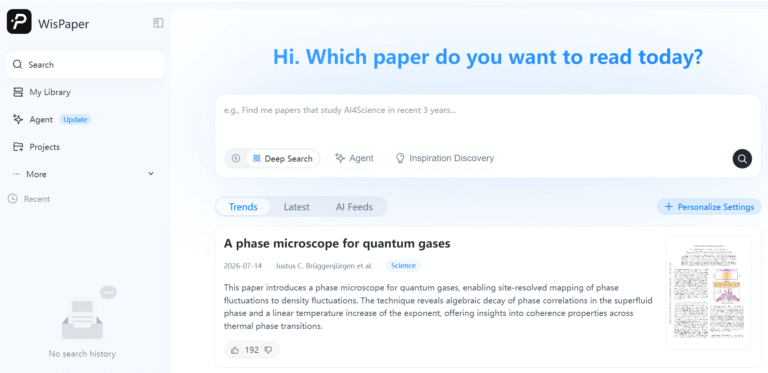
Reading academic papers is quickly changing from a slow, page-by-page grind into something faster and far more digestible. This huge and growing body of published work is basically built from dense, technical writing that few outside a narrow specialty can absorb quickly. Tools like WisPaper are stepping in to help researchers get past that density and reach the actual insight underneath. How clearly and quickly a researcher can pull meaning out of a paper will ultimately decide how much of the literature they can realistically cover.
The Weight of Academic Writing
Getting through a research paper is a massive job, like decoding a message written in a language built for specialists only. Every section, from the abstract to the methodology to the discussion, is often packed with jargon, dense notation, and assumptions that only make sense to someone already deep in the field. This includes complicated charts, statistical tables, and multi-step proofs that can take a trained reader a long time to fully unpack. For a researcher to actually use a paper, whether to inform their own work or challenge its conclusions, they need to get past the surface and understand what the data and arguments really mean. This process mixes patience with expertise to make sure nothing important gets lost in translation.
Demand for Faster Comprehension
Researchers now expect to extract meaning from a paper in minutes rather than hours, so there’s been a big jump in demand for reading tools that do more than just display text. A plain PDF viewer isn’t enough anymore. Today’s researchers often need to switch fluidly between the original language of a paper and their own, jump straight to the parts that matter, and get a plain-language explanation of a complicated chart without hunting through the whole document. This need touches every field where language and jargon are barriers to entry, from international students working through foreign literature to interdisciplinary researchers stepping outside their home field. To meet this demand, you need a reading experience that combines translation, simplification, and interactivity in one place.
Challenges in Deep Reading
Even with the growing demand, reading papers deeply is still a big challenge. It often takes repeated passes through the same section, constant cross-referencing with cited works, and a lot of mental effort just to hold all the pieces together. A single dense paper can take a researcher hours to fully digest, and that’s before comparing it against related work. When you think about the dozens of papers that go into a single literature review, this traditional way of reading becomes a major bottleneck. This challenge is key to understanding why so many researchers end up skimming abstracts instead of engaging with full papers. Getting past this obstacle is vital for making rigorous, well-informed research achievable within realistic timeframes.
Streamlining the Reading Experience
To speed up how researchers absorb literature, the field is focused on streamlining the reading process itself. New technologies and ways of working are being developed to make dense academic writing faster to parse, easier to navigate, and more approachable. AI-assisted reading tools are playing a big part, with features that offer full-text bilingual translation alongside quick navigation between the original and translated versions, so language is no longer a hard barrier. Blog-style reading modes can turn a dense, jargon-heavy paper into a structured, easy-to-follow narrative that pulls out the core contributions and explains complex figures in plain language. Alongside this, cloud-synced note-taking and annotation tools let researchers build a lasting, organized record of what they’ve read. This is the approach behind WisPaper, which combines translation, simplified reading modes, and integrated notes into a single reading environment.
More Confident, Thorough Research
Ultimately, the goal of improving how researchers read is to create more confident and thorough engagement with the literature. When a paper’s core ideas are quickly understandable, researchers can cover far more ground without sacrificing depth. This improved comprehension makes literature reviews more complete, makes cross-disciplinary work more accessible, and creates more informed critique and discussion. The smooth way a well-designed reading tool fits into a researcher’s daily routine is what turns a stack of intimidating PDFs into a genuinely usable body of knowledge.
The way academic reading evolves is directly connected to how much of the literature researchers can actually put to use. As the tools for understanding dense academic writing become more powerful and accessible, we’ll see more researchers engaging deeply with work outside their immediate specialty, making research more connected and more thorough for everyone involved.
