



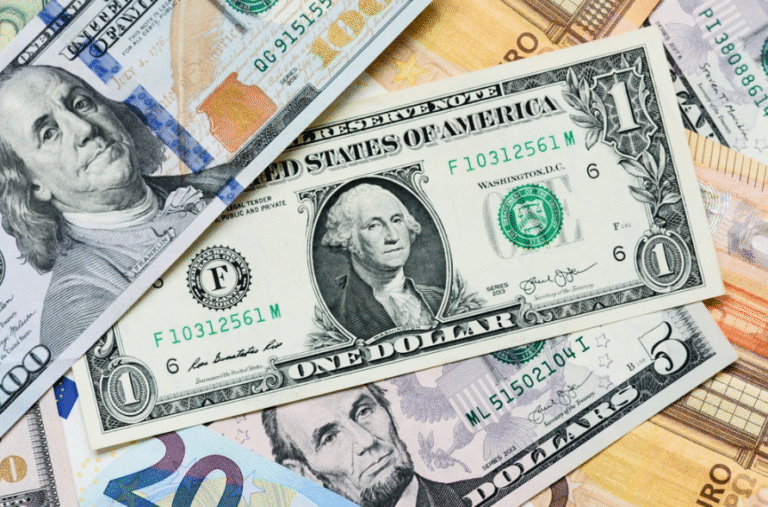
Walk into a supermarket in Zurich, then walk into one in Jakarta, and you will feel the difference long before you look at the price tags. The same dollar buys very different quantities of real goods depending on where you spend it. Exchange rates quoted on Forex markets tell you only part of the story – what a currency is worth on a trading screen. The more revealing question is what that currency actually buys in the real economy. Understanding this gap is essential not just for travelers but for anyone trading currencies, making international investments, or trying to make sense of why some economies feel expensive and others surprisingly affordable.
What Purchasing Power Parity Really Means
Purchasing power parity, or PPP, is the economic concept that describes the relationship between exchange rates and actual buying power. The theory holds that identical goods should cost the same everywhere once you adjust for the exchange rate. If a pair of shoes costs $100 in New York and equivalent shoes cost €95 in Berlin, the implied exchange rate under PPP would be roughly 1.05 dollars per euro. If the market rate is significantly different, one currency is either overvalued or undervalued relative to the other.
In practice, prices never equalize perfectly across countries. Labor costs, taxes, import duties, local wages, and structural differences in economies all push prices up or down. A haircut in Bangkok and a haircut in Paris involve the same service, but the local wage component makes them incomparable in dollar terms. This is why economists distinguish between tradeable goods, where prices tend to converge over time, and non-tradeable services, where they diverge persistently.
PPP matters for ordinary consumers because it determines the real cost of living. A salary of $50,000 per year has very different practical implications in San Francisco versus Warsaw. The nominal exchange rate tells you how to convert figures on paper – the real exchange rate, adjusted for local price levels, tells you how comfortable that income actually makes your life.
The Big Mac Index as a Practical Yardstick
The most famous informal tool for measuring PPP is the Big Mac Index, introduced by The Economist magazine in 1986. The logic is straightforward: a Big Mac is essentially the same product in every country where McDonald’s operates – same ingredients, same assembly, same portion. Comparing its local price, converted to US dollars at the current market exchange rate, reveals whether a currency is cheap or expensive relative to what it should be in pure purchasing power terms.
The table below shows how Big Mac prices compare across selected regions, using the US price of $5.79 as the baseline:Switzerland consistently tops the index because the country combines high wages, expensive real estate, and a franc that benefits from its status as a safe-haven currency. Taiwan sits at the opposite end, where low local prices reflect a combination of modest domestic wages and structural factors that keep the New Taiwan dollar well below its PPP-implied level.
Why Exchange Rates Diverge from Purchasing Power
Knowing the PPP level of a currency and knowing where the exchange rate will move are two very different things. Markets can sustain large divergences from PPP for years, sometimes decades, before any reversion occurs. The South African rand has remained significantly undervalued on the Big Mac Index for a long time while political and economic pressures keep pushing it lower rather than higher.
Several forces pull exchange rates away from PPP. Capital flows are one of the most powerful – when global investors flood into Swiss franc assets during periods of uncertainty, they push the franc up regardless of what a burger costs in Geneva. Interest rate differentials drive carry trades that move currencies far from any purchasing power equilibrium. Central bank intervention can hold exchange rates artificially fixed, as has been seen with various Asian currencies over different periods.
For a Forex trader, PPP is most useful as a long-term anchor rather than a short-term signal. Understanding the US dollar cost at Root – meaning its fundamental purchasing power stripped of market speculation and policy distortion – provides a frame of reference for evaluating whether a currency move is corrective or genuinely driven by new economic information.
How Exchange Rate Moves Hit Consumer Prices
Currency shifts feed into daily expenses through several channels, and the speed and scale of the effect depends on how import-dependent an economy is. Countries that import most of their food, fuel, and manufactured goods experience inflation quickly when their currency weakens – Turkey and Egypt have both provided sharp examples of this in recent years, where rapid depreciation translated almost immediately into surging grocery bills for ordinary households.
In more self-sufficient economies, the transmission is slower. A 10% depreciation of the British pound against the dollar raises the cost of imported goods but takes several months to work through supply chains, retail pricing decisions, and consumer behavior. The lag exists because retailers absorb some of the cost initially and adjust prices gradually to avoid losing customers.
For travelers, the relationship between exchange rates and daily costs is immediate and visible. A strong dollar makes European vacations noticeably more expensive – hotel rooms, restaurant meals, and public transport that cost €80 a day translate to more dollars when EURUSD falls from 1.12 to 1.02. The difference on a two-week trip is easily several hundred dollars, which is a meaningful amount even for people who do not think of themselves as currency watchers.
Conclusion
Exchange rates are not just numbers on a trading screen – they shape the real purchasing power of everyone who earns, spends, or saves in a currency. PPP gives a theoretical anchor for what exchange rates should be if prices were to equalize globally. The Big Mac Index translates that theory into something concrete and internationally comparable. The practical lesson is that market exchange rates and real purchasing power can diverge substantially and stay diverged for extended periods. For traders, this divergence is both a risk and an opportunity. For consumers, understanding it means making smarter decisions about where to travel, where to hold savings, and how to interpret inflation in their own economy.
