



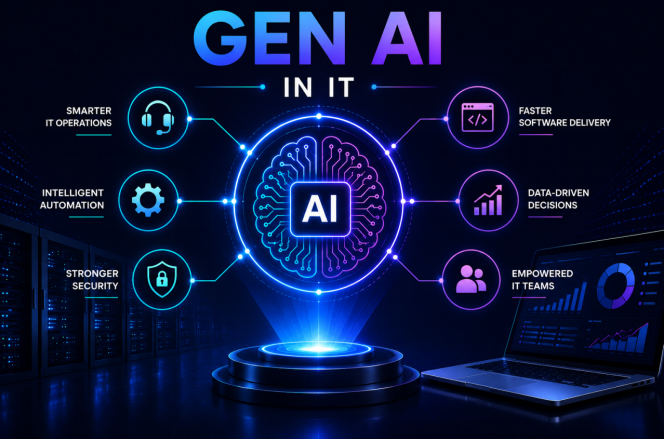
Technology organizations are expected to improve productivity, strengthen resilience and deliver new digital capabilities while managing increasingly complex technology environments. Legacy systems, fragmented data, rising costs and growing service demands can make these objectives difficult to achieve. Digital transformation services provide a structured approach for modernizing technology, processes and operating models, while Gen AI in IT introduces new opportunities to automate knowledge-intensive work and improve technology performance.
Together, these capabilities can help organizations move beyond incremental technology upgrades toward more intelligent IT operations. The opportunity spans software development, IT service management, infrastructure, cybersecurity and enterprise knowledge management, but realizing value requires a clear strategy, strong data foundations and effective governance.
This article explores how digital transformation services and Gen AI in IT work together, their key applications, business benefits and priorities for successful implementation.
What are digital transformation services?
Digital transformation services help organizations modernize business processes, technology environments and operating models using digital capabilities. They connect technology investments with strategic objectives and establish a roadmap for improving enterprise performance.
For IT organizations, digital transformation services can address application modernization, cloud infrastructure, enterprise architecture, data and analytics, cybersecurity, automation, artificial intelligence and technology operating models.
Rather than treating individual technology initiatives independently, transformation services help organizations understand dependencies, prioritize investments and sequence changes according to expected business value.
What is Gen AI in IT?
Gen AI in IT refers to the application of generative artificial intelligence across enterprise technology processes and workflows. It can understand and generate natural language, software code, technical documentation and other forms of content used by technology teams.
IT professionals can use generative AI to summarize incidents, assist with coding, create documentation, retrieve enterprise knowledge and analyze complex technical information.
Unlike traditional rule-based automation, Gen AI in IT can support knowledge-intensive activities that require interpretation and contextual understanding, expanding the range of IT work that can be augmented by technology.
Why IT needs digital transformation
Technology environments have become increasingly distributed across cloud infrastructure, enterprise applications, legacy platforms and third-party services. Managing this complexity can consume resources that might otherwise support innovation and business transformation.
Digital transformation services help organizations simplify these environments while creating the architecture and data foundations required for emerging technologies.
Gen AI in IT can then build on those foundations to improve productivity and decision-making. Introducing AI without addressing fragmented systems, inconsistent processes or poor-quality knowledge sources may limit its effectiveness.
Connecting technology modernization with AI therefore enables organizations to pursue transformation more systematically.
Core technologies supporting Gen AI in IT
Several technologies work together to enable intelligent technology operations.
Generative AI
Generative AI can create code, summarize incidents, prepare technical documentation and provide conversational access to enterprise knowledge.
Large language models
Large language models enable systems to understand technical questions, interpret context and generate natural-language responses.
Machine learning
Machine learning analyzes operational information to detect anomalies, identify patterns and anticipate potential technology issues.
Intelligent automation
Automation executes repetitive activities such as workflow routing, user provisioning and service requests, while generative AI supports more knowledge-intensive elements.
AI agents
AI agents represent an emerging capability that can coordinate multistep activities, interact with technology systems and execute approved actions while escalating exceptions requiring human intervention.
These technologies extend Gen AI in IT beyond individual assistance toward more connected technology workflows.
Key use cases of Gen AI in IT
Organizations can apply generative AI across multiple technology functions.
IT service management
Generative AI can summarize service tickets, retrieve relevant knowledge and recommend potential resolutions, helping support teams understand and address incidents faster.
Software development
AI can assist developers with code generation, documentation, testing and debugging. Appropriate human review remains important for security, quality and business-critical applications.
Knowledge management
Generative AI can summarize technical documentation, create knowledge articles and improve enterprise search, making information easier for employees to access.
Multilingual Workflows
Lara Translate can support multilingual workflows by translating content with context, tone and terminology in mind. Human review remains important for accuracy and quality.
Infrastructure operations
AI can analyze infrastructure information and summarize complex operational issues, helping technology teams identify potential causes and appropriate actions.
Cybersecurity
Generative AI can summarize security alerts, interpret threat information and assist investigations while security specialists retain responsibility for critical decisions.
Technology reporting
AI can synthesize operational data and prepare performance summaries for technology leaders and business stakeholders.
These applications demonstrate how Gen AI in IT can improve both technology productivity and service performance.
Business benefits of digital transformation services
Combining digital transformation services with Gen AI in IT can improve several dimensions of technology performance.
Greater productivity
Automation and AI reduce repetitive and knowledge-intensive work, allowing IT professionals to focus on architecture, innovation and strategic initiatives.
Faster service delivery
AI-supported incident management and knowledge retrieval can reduce the time required to understand and resolve technology issues.
Accelerated development
Generative AI can reduce time spent on coding, documentation and testing, helping development teams deliver applications and enhancements faster.
Lower technology costs
Application rationalization, process simplification and automation can reduce unnecessary technology spending and improve resource utilization.
Improved business agility
Modern architecture and intelligent technology operations can help organizations respond more quickly to changing business requirements.
How digital transformation services support AI implementation
Scaling Gen AI in IT requires organizations to address more than individual AI use cases. Architecture, data, security, integration and workforce capabilities all influence whether implementation succeeds.
Digital transformation services can help organizations:
- Assess current IT performance and digital maturity.
- Identify high-value Gen AI opportunities.
- Evaluate data, knowledge and technology readiness.
- Prioritize use cases based on value and implementation complexity.
- Modernize architecture and integration capabilities.
- Redesign technology processes and workflows.
- Establish AI governance and cybersecurity controls.
- Develop implementation roadmaps and performance measures.
This approach helps organizations connect generative AI initiatives with broader technology modernization priorities.
Best practices for implementing Gen AI in IT
Successful implementation requires a structured approach aligned with technology and business objectives.
- Begin with clearly defined IT problems rather than individual AI tools.
- Improve the quality and governance of technical documentation and operational data.
- Prioritize use cases according to business impact, feasibility and time to value.
- Integrate AI into existing ITSM, development and operational workflows.
- Establish clear access controls for source code, infrastructure information and other sensitive technology assets.
- Maintain human accountability for cybersecurity, production changes and high-risk decisions.
- Prepare technology employees to work effectively with AI-enabled tools.
- Measure outcomes through productivity, incident resolution, development speed, service performance and operating costs.
These practices can help organizations move from experimentation toward scalable Gen AI in IT.
Common implementation challenges
Legacy technology can limit integration with modern AI capabilities and make enterprise data difficult to access. Organizations may need to modernize foundational systems before advanced use cases can scale.
Knowledge quality is another challenge. Outdated technical documentation can produce unreliable AI-generated recommendations, making continuous knowledge management important.
Cybersecurity also requires particular attention. Gen AI in IT may interact with sensitive source code, system configurations and operational information. Strong identity, access and data controls are therefore essential.
Finally, technology teams need clear guidance on when AI outputs can be used directly and when specialist review is required.
The future of Gen AI in IT
The next stage of Gen AI in IT will increasingly involve AI agents capable of coordinating activities across technology environments. Instead of simply recommending an action, agents could identify issues, retrieve relevant information, initiate authorized workflows and verify outcomes.
Multiple agents may eventually collaborate across service management, software development, infrastructure and cybersecurity.
As these capabilities mature, digital transformation services will increasingly focus on redesigning technology operating models, decision rights and governance around collaboration between employees and intelligent systems.
Organizations will also need to continuously evaluate where greater autonomy creates business value and where human control remains essential.
Conclusion
Digital transformation services provide the foundation for modernizing enterprise technology, while Gen AI in IT introduces new opportunities to improve productivity, service delivery and technology decision-making.
Organizations that connect generative AI with broader architecture, process and operating model transformation will be better positioned to capture sustainable value. By strengthening data foundations, modernizing technology environments and establishing effective governance, businesses can build intelligent IT functions capable of supporting greater agility, innovation and long-term enterprise performance.
