



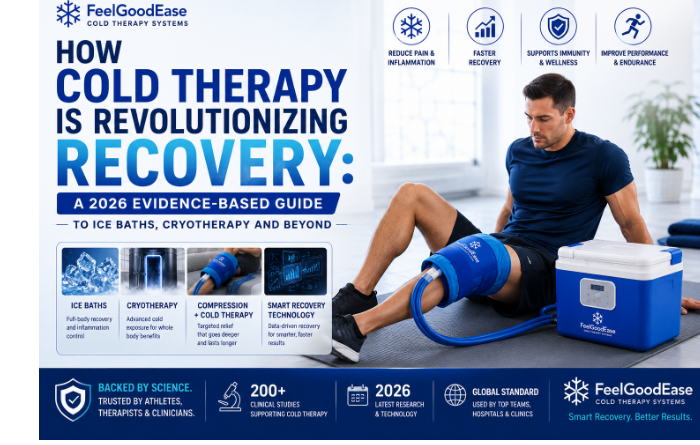
You finish a tough workout or surgery expecting to feel better each day. Instead, muscle soreness lingers, swelling won’t settle, and every source recommends something different. Ice baths, cryotherapy chambers, cold plunges or targeted cooling, which one actually works?
The confusion is understandable. Some recovery methods are supported by strong clinical evidence, while others are fueled more by marketing than science. Add social media trends promoting extreme cold exposure and it’s easy to lose sight of what the research actually says.
The good news is that cold therapy remains one of the most well-studied recovery strategies available. Used correctly, it can help reduce pain, control inflammation, manage swelling and support recovery after intense exercise or surgery. The key is choosing the right approach for your specific goal.
This guide reviews the latest 2025-2026 evidence, comparing cold water immersion (CWI), whole-body cryotherapy (WBC), and targeted cooling in real-world recovery. You’ll learn how each method works, who benefits most, and how to build an effective recovery plan without wasting time or money.
If you’re recovering from orthopedic surgery, continuous cooling with gentle compression can be especially beneficial. Unlike ice baths that cool the entire body, these systems deliver consistent therapy directly to the affected joint to help manage pain and swelling. Home options like the FeelGoodEase Cold Therapy Machine make this approach practical during rehabilitation under a healthcare provider’s guidance.
The Science of Cold Therapy: How It Works on a Cellular Level
Cold therapy does more than numb an injury. It triggers physiological changes that influence blood flow, nerve signaling, inflammation and recovery. Understanding these responses helps explain why different cooling methods are suited to different recovery goals.
The Immediate Response: Vasoconstriction and Pain Relief
The first response to cold exposure is vasoconstriction, the temporary narrowing of blood vessels. This reduces blood flow to the affected area, helping control swelling, bruising and inflammatory fluid after an acute injury or surgery.
Cold also slows nerve conduction, reducing how quickly pain signals reach the brain. That familiar numbing sensation isn’t just temporary relief, it helps improve comfort during the early stages of recovery.
For localized injuries or post-operative care, circulating cooling systems maintain a consistent temperature longer than traditional ice packs making them a practical option when extended treatment is needed.
Expert Tip: Applying cold during the first 24-48 hours after an acute injury can help control swelling and discomfort while supporting the body’s natural healing process.
The Hormonal and Metabolic Response
Cold exposure influences more than muscles and joints, it also affects the nervous system.
Studies show it increases norepinephrine, a hormone linked to alertness, focus, and pain regulation, helping explain why many people feel refreshed after a cold plunge.
It also stimulates the release of endorphins, the body’s natural pain relievers, which may temporarily reduce discomfort and improve well-being.
Emerging research suggests regular cold exposure may activate brown adipose tissue (BAT), or brown fat, which burns energy to produce heat. While promising, scientists are still investigating its long-term metabolic benefits.
The Søberg Principle: Why Consistency Matters
More isn’t always better.
Research from Dr. Susanna Søberg suggests that the total weekly dose of cold exposure may matter more than the length of any single session. Accumulating about 11 minutes per week, spread across several shorter sessions, may support recovery and metabolic adaptation.
For most people, consistency beats endurance. Short, regular sessions are easier to maintain than occasional long ice baths.
Expert Tip: Build a routine you can stick with. For many healthy adults, three sessions of 3–4 minutes each week provide a practical starting point.
Three Cold Therapy Methods Compared: Which One Fits Your Recovery?
Not every form of cold therapy serves the same purpose.
Some methods cool the entire body after intense training, while others target a specific joint or muscle to relieve pain and swelling after an injury or surgery. The best option depends on what you’re recovering from, not what’s trending.
Here’s how the three most common approaches compare.
| Method | Temperature | Session | Typical Cost | Home Use | Best For | Research Snapshot |
| Whole-Body Cryotherapy (WBC) | -110°C to -160°C | 2-4 min | $40-$100 | No | Elite recovery, systemic inflammation, mood | Meta-analyses report reduced inflammatory markers and faster short-term recovery. |
| Cold Water Immersion (CWI) | 10-15°C | 5-10 min | Free-$20 | Yes | Muscle soreness, athletic recovery | Strong evidence supports reduced delayed-onset muscle soreness (DOMS). |
| Localized Cooling (ice packs, circulating systems, compression wraps) | 0-15°C | 15-20 min | Free-$250+ | Yes | Joint injuries, post-operative recovery | Clinical studies support targeted cooling, especially when combined with compression. |
Note: Localized cooling ranges from reusable ice packs to circulating water systems that provide consistent cooling with gentle compression.
Which Recovery Method Is Right for You?
The best recovery method depends on your goal.
Recovering from a hard workout?
Choose Cold Water Immersion (CWI).
It’s one of the most practical and well-researched methods for reducing post-exercise soreness. A bathtub, stock tank, or dedicated plunge is sufficient for most people.
Recovering from surgery or a specific injury?
Choose targeted cooling.
When pain and swelling are limited to one area, cooling the entire body offers little added benefit. Localized treatment delivers therapy where it’s needed most.
For home rehabilitation, circulating cooling systems maintain a steady temperature throughout treatment, while some also provide gentle compression to help manage swelling.
Looking for the quickest session?
If you have access to a cryotherapy center, Whole-Body Cryotherapy takes just 2-4 minutes.
Its biggest drawbacks are cost and accessibility, making it less practical for routine recovery.
Whole-Body Cryotherapy (WBC)
Whole-body cryotherapy exposes you to extremely cold air inside a specialized chamber for 2-4 minutes. Because the cold is dry and brief, many people find it more tolerable than an ice bath.
Advantages
- Very short sessions
- May reduce systemic inflammation
- May improve mood and perceived recovery
- Popular among elite athletes
Limitations
- Expensive for regular use
- Requires specialized equipment
- Limited long-term safety data
- Not practical for daily recovery
What many guides miss: WBC may reduce soreness, but researchers are still studying its long-term effects on muscle growth and strength adaptations.
Cold Water Immersion (CWI)
Cold water immersion remains the most accessible whole-body recovery method. Whether you use a bathtub or a dedicated plunge, the goal is the same: reduce soreness after demanding exercise.
Advantages
- Affordable
- Easy to do at home
- Adjustable temperature and duration
- Strong evidence for reducing DOMS
Limitations
- Initial cold shock can be uncomfortable
- Requires preparation and cleanup
- Not suitable for everyone, especially those with certain cardiovascular conditions
Localized Cooling: Precision Where It Matters
Sometimes the best recovery strategy isn’t cooling your whole body, it’s treating the injured area.
Localized cooling uses ice packs, reusable wraps, ice massage, or circulating water systems to target a specific joint or muscle. It’s often the preferred option after orthopedic surgery or acute musculoskeletal injuries.
Modern systems combine continuous cooling with cold compression, helping manage pain and swelling more consistently than traditional ice packs. For home rehabilitation, the Compression Therapy Machine offers this targeted approach, making recovery sessions more convenient.
Advantages
- Targets the affected area
- Ideal for post-operative recovery
- Helps manage pain and swelling
- Convenient for home use
Limitations
- Doesn’t provide full-body recovery benefits
- Ice should never contact bare skin directly
- Less effective for generalized post-workout soreness
Cold Therapy for Injury Rehabilitation: From Acute Sprains to Post-Surgical Recovery
Recovering from an injury isn’t just about reducing pain, it’s about restoring movement, protecting healing tissue, and returning to activity safely.
Cold therapy remains an important part of rehabilitation, but modern recovery has moved beyond simply telling patients to “rest and ice.” Today’s evidence supports combining pain management with early movement and progressive exercise.
Why the RICE Protocol Has Evolved
For decades, Rest, Ice, Compression, and Elevation (RICE) was the standard approach for acute injuries.
Today, many clinicians favor the PEACE & LOVE framework, which encourages protecting the injured area early while gradually restoring movement and exercise.
Cold therapy still has an important role, it just needs to be used strategically rather than continuously.
During the first 24–48 hours, cooling helps reduce pain and swelling. As symptoms improve, the focus should shift toward restoring mobility, strength, and function.
Expert Tip: For most sprains and strains, apply cooling for 15–20 minutes every 2–3 hours during the first two days, then gradually introduce gentle movement as advised by your healthcare provider.
Why Targeted Cooling Matters After Surgery
Post-operative recovery presents different challenges than a typical sports injury.
Pain, swelling, and limited mobility can delay rehabilitation if not managed effectively. That’s why many orthopedic specialists recommend continuous cooling with gentle compression during the early recovery phase.
Unlike traditional ice packs, Circulating Cooling Systems maintain a consistent temperature throughout treatment while delivering even coverage around the joint. Combined with compression, they help manage swelling, improve comfort, and support earlier participation in rehabilitation exercises.
Research suggests this approach may provide better pain and swelling control than ice alone following procedures such as ACL reconstruction, knee replacement, and shoulder surgery.
Recovery Timeline: An Example ACL Rehabilitation Protocol
Every rehabilitation plan should be tailored to the individual, but this progression reflects common practice after ACL reconstruction.
Weeks 1-2: Control Swelling and Restore Motion
The focus is reducing pain and swelling while restoring gentle movement.
Continuous cooling with compression is often combined with simple exercises such as ankle pumps, quadriceps sets, and assisted knee motion to support early range of motion.
Weeks 3-4: Progress Activity
As swelling improves, rehabilitation becomes more active.
Many therapists use cold water immersion after supervised therapy sessions to reduce post-exercise soreness, while localized cooling helps manage temporary swelling following increased activity.
Low-impact exercises, including stationary cycling and progressive weight-bearing, are introduced according to individual progress.
Clinical Insight: Managing swelling early often allows patients to begin rehabilitation more comfortably and progress with less reliance on pain medication.
Cold or Heat: Which Should You Use?
The answer depends on the stage of recovery.
| Choose Cold When… | Choose Heat When… |
| Swelling is present | Stiffness is the main concern |
| The injury is recent (first 48–72 hours) | Muscles feel tight before activity |
| Pain follows surgery | Managing chronic muscle tension |
| You need to control inflammation | Preparing tissues for stretching or mobility work |
Neither approach is better; they simply serve different purposes during recovery.
Expert Tip: Avoid heat on a newly injured or swollen joint, as it may increase swelling. Likewise, avoid prolonged cooling immediately before activities requiring maximum strength, speed, or flexibility, since it can temporarily reduce muscle performance.
Optimizing Athletic Recovery Better Performance
Training creates the stimulus. Recovery determines the result.
Whether you’re preparing for competition or recovering after a demanding workout, the goal isn’t to eliminate every sign of fatigue. It’s to recover well enough to perform again without compromising long-term adaptation.
Cold therapy can support that process, but only when it’s used with the right timing, temperature, and purpose.
Timing Matters More Than Most Athletes Realize
When you use cold therapy can be just as important as how you use it.
For endurance athletes, cooling soon after training or competition may help reduce delayed onset muscle soreness (DOMS) and improve perceived recovery.
Strength athletes should take a more strategic approach. Research suggests that immediate cooling after resistance training may temporarily reduce some of the cellular signals involved in muscle growth. If hypertrophy is your primary goal, waiting a few hours before using an ice bath or cold plunge may help preserve those adaptations.
Expert Tip: If building muscle is your priority, wait at least four hours after heavy strength training before using whole-body cooling. Earlier recovery sessions are generally more appropriate after endurance exercise or competition.
Protocol 1: The Standard Recovery Plunge
This protocol works well for most athletes after demanding training sessions.
- Temperature: 10–15°C (50–59°F)
- Duration: 5–10 minutes
- Frequency: After intense workouts or 3–4 times per week
Submerge the body comfortably while maintaining slow, controlled breathing. Colder consistency delivers better results than extremes.
Protocol 2: The Søberg Principle
You don’t need long ice baths to benefit from cold exposure.
Dr. Susanna Søberg’s research suggests that accumulating about 11 minutes of cold exposure per week, spread across several sessions, may support recovery and metabolic adaptation.
For example:
- 3 sessions × 4 minutes
- 2 sessions × 5–6 minutes
This approach is practical, sustainable, and easier to fit into a busy schedule.
Expert Tip: Track your weekly cold exposure just as you track your training volume. Regular sessions matter more than occasional marathon plunges.
Protocol 3: Advanced Cold Exposure
Experienced athletes may choose colder temperatures to build both physical and mental resilience.
- Temperature: 5–10°C (41–50°F)
- Duration: 2–5 minutes
- Frequency: Once or twice per week
These sessions produce a stronger physiological stress response and should be approached gradually. They’re unnecessary for most beginners.
Controlled breathing helps reduce the initial cold shock response and makes the experience more manageable.
Expert Tip: Focus on slow diaphragmatic or box breathing during the first minute. Staying calm is more valuable than enduring unnecessary discomfort.
Build a Complete Recovery Strategy
Cold therapy is most effective when combined with other evidence-based recovery habits.
Pair Cooling with Compression
After localized injuries or demanding rehabilitation sessions, combining cooling with gentle compression can help manage swelling more effectively than cooling alone.
For home recovery, circulating cooling systems provide consistent temperature control while delivering light compression, making longer sessions more comfortable than repeatedly changing ice packs.
Keep Moving
Recovery doesn’t always mean complete rest.
Light walking, mobility work, or gentle cycling promotes circulation without placing unnecessary stress on healing tissues. Combined with appropriate cooling, active recovery can help you feel ready for your next session sooner.
Refuel Your Body
Recovery continues after training ends.
Protein and carbohydrates support muscle repair and glycogen replenishment, while adequate sleep and hydration complete the process. Cold therapy should enhance these fundamentals, not replace them.
The best recovery plans combine smart training, quality nutrition, sufficient sleep, and evidence-based recovery strategies.
Safety, Risks, and Contraindications: What You Should Know Before Starting
Cold therapy is generally safe when used correctly.
However, it isn’t risk-free.
The same physiological responses that reduce pain and swelling can also place extra stress on the cardiovascular and nervous systems. Knowing when to avoid cold therapy is just as important as knowing how to use it.
Medical Disclaimer: This article is for educational purposes only and is not medical advice. Always consult your physician or healthcare provider before starting cold therapy, especially if you have a medical condition, are recovering from surgery, or are pregnant.
Who Should Avoid Cold Therapy?
Cold exposure isn’t suitable for everyone.
Speak with your healthcare provider before using ice baths, cold plunges, or cryotherapy if you have:
- Uncontrolled high blood pressure
- A history of heart attack, stroke, or significant cardiovascular disease
- Raynaud’s disease or other severe circulation disorders
- Cold urticaria (cold-induced allergic reactions)
- Open wounds, untreated skin infections, or serious skin conditions
- Pregnancy, unless approved by your healthcare provider
For these individuals, sudden cold exposure may increase the risk of cardiovascular or circulatory complications.
Recognizing Cold-Related Injuries
Longer sessions don’t improve recovery, they only increase the risk of injury.
Frostbite
Although uncommon during properly supervised recovery sessions, prolonged exposure to extreme cold can damage the skin and underlying tissue.
Warning signs include:
- Persistent numbness
- White, pale, or grayish skin
- Skin that feels firm or waxy
If frostbite is suspected, stop cold exposure immediately, warm the area gradually, and seek prompt medical care.
Hypothermia
Prolonged cold-water exposure can lower your core body temperature.
Symptoms include:
- Uncontrollable shivering
- Confusion
- Slurred speech
- Extreme fatigue or drowsiness
Leave the cold environment immediately, dry off, change into warm clothing, and seek medical attention if symptoms continue or worsen.
Cold Shock Response
The first seconds of cold immersion often trigger an involuntary gasp, rapid breathing, and an increased heart rate.
This cold shock response is normal but can become dangerous if panic develops, particularly in open water.
Entering the water gradually and focusing on slow, controlled breathing helps reduce its intensity.
Expert Tip: Never perform cold plunges alone, especially if you’re new to cold exposure. Having another person nearby adds an important layer of safety.
Does Cold Therapy Reduce Muscle Growth?
This remains one of the most debated questions in sports recovery.
Resistance training creates microscopic muscle damage that stimulates repair and growth. Because cold therapy reduces inflammation, researchers have questioned whether immediate post-workout cooling may also reduce some of the signals involved in muscle adaptation.
Studies, including Roberts et al. (2015), suggest that frequent cold-water immersion immediately after resistance training may slightly reduce long-term gains in muscle size and strength.
However, the effect depends on factors such as training goals, workout type, frequency of cold exposure, and timing.
For athletes focused on hypertrophy, delaying whole-body cooling for several hours after training is a practical compromise. For endurance athletes or those training multiple times per day, faster recovery may outweigh any small impact on muscle growth.
Recovery should always match your training objective.
Cold Therapy Safety Checklist
Take a few minutes to prepare before every session.
Before You Begin
- Consult your healthcare provider if you have medical concerns.
- Check the water temperature with a thermometer.
- Set a timer.
- Keep warm clothing and towels nearby.
- Have someone nearby or let someone know you’re doing a cold immersion session.
During the Session
- Enter the water gradually.
- Maintain slow, controlled breathing.
- Stay within your planned temperature and time limits.
- Exit immediately if you experience dizziness, chest pain, confusion, severe discomfort, or difficulty breathing.
After the Session
- Dry off thoroughly.
- Put on warm, dry clothing.
- Let your body warm naturally before taking a hot shower.
- Rehydrate and eat a balanced meal or snack if needed.
Good recovery isn’t about enduring extreme cold, it’s about using cold therapy safely, consistently and with a clear purpose.
Conclusion: Build a Recovery Plan That Fits Your Goals
Cold therapy isn’t a miracle cure.
It’s a recovery tool, and its effectiveness depends on how, when and why you use it.
As you’ve seen throughout this guide, different recovery goals require different approaches. Cold water immersion remains one of the most practical methods for reducing post-exercise muscle soreness. Whole-body cryotherapy offers a convenient clinic-based option for some athletes, while targeted cooling with compression continues to play an important role in post-operative rehabilitation and localized injury recovery.
The best recovery plans are built on consistency, not extremes.
Key Takeaways
- Match your recovery method to your specific goal instead of following trends.
- For many healthy adults, 10-15°C for 5-10 minutes is an effective starting point for whole-body recovery.
- After surgery or a localized injury, continuous cooling with gentle compression may provide better comfort and swelling control than traditional ice packs. Home systems such as the FeelGoodEase Cold Therapy System can support this approach when recommended by a healthcare professional.
- Build recovery around the fundamentals: quality sleep, balanced nutrition, progressive exercise, hydration, and smart recovery strategies.
- Stay informed as new research emerges, but remember that no single recovery method replaces consistent training and healthy habits.
If you’re new to cold exposure, start small.
Finish tomorrow’s shower with 30 seconds of cold water and pay attention to how your body responds. As your confidence grows, gradually build a routine that fits your training, rehabilitation, and lifestyle.
Final Expert Tip: Consistency beats intensity. A recovery routine you can maintain week after week will deliver better long-term results than occasional extreme cold exposure.
