



Over two decades of advising companies on their technology decisions, I have watched the same pattern repeat itself. A business grows quickly, the early software does its job, and then somewhere around the next stage of scale everything begins to creak. Pages slow down. Systems that were never designed to talk to each other get stitched together with workarounds. The team spends more time maintaining what exists than building what comes next. The growth did not break anything. The underlying architecture did, and it did so quietly until the cost became impossible to ignore.
This is the moment when enterprise-grade software stops being a technical line item and becomes a business strategy. Choosing well-engineered custom web application development services early is not about buying a fancier website. It is about buying the room to grow without having to tear everything down and rebuild it a year later when demand finally arrives.
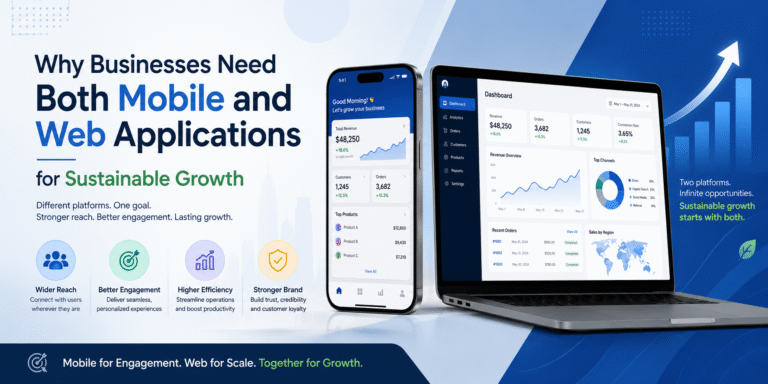
Web is only half of the picture, though. Customers, employees, and partners increasingly expect to interact with a business from wherever they are, on whatever device is closest. That is why I encourage leaders to treat custom mobile application development services as a parallel investment rather than an afterthought. Web and mobile are not competing channels. They are two halves of one experience, and sustainable growth depends on both being built to last.
What Actually Makes an Application “Enterprise-Grade”
The phrase gets used loosely, so it helps to be precise about what I look for when I assess whether software can carry a business forward.
Scalability is the first test. Can the system handle ten times the traffic, data, or transactions without a rewrite? Most software works fine on day one. The question is whether it works on the day your marketing finally lands.
Security is no longer optional or something you bolt on later. For most businesses, a single breach is more expensive than years of doing security properly from the start. Enterprise-grade applications treat data protection as a foundation, not a feature.
Performance is what customers actually feel. A slow application loses users quietly, without complaint, because they simply leave. Speed is a business metric disguised as a technical one.
Reliability is about uptime and predictability. Systems that fail under pressure erode trust faster than almost anything else, especially when the failure happens in front of a paying customer.
Integration capability ties it all together. An application that cannot connect cleanly to your other tools, your data, and your partners becomes an island. And islands do not scale.
When I evaluate software for a client, I am really evaluating these five traits. A product can look polished and still fail every one of them under the hood.
The Pillars That Support Long-Term Growth
Strong applications are not lucky. They are designed around a handful of decisions that pay off for years.
The first is architecture. The old debate between monolith and microservices is less about which is correct and more about which fits where you are. A monolith can be the right starting point for a small, focused team. A modular or microservices approach earns its complexity once you need different parts of the system to scale, deploy, and evolve independently. The mistake I see most often is committing to one without understanding why.
The second is cloud-native development. Building for the cloud from the beginning gives a business elasticity, meaning you pay for what you use and grow without buying hardware you may never need. It also makes resilience and global reach far easier to achieve.
The third is data-driven decision making. Applications that capture clean, well-structured data give leaders the ability to see what is happening and act on it. Software that treats data as an afterthought leaves you guessing.
The fourth is automation and AI readiness. This is where I spend a great deal of my time. You do not need to deploy artificial intelligence on day one, but you should architect your systems so that intelligent automation is possible later. Clean data, good APIs, and modular design are what make a business AI-ready. Bolting AI onto a tangled system rarely ends well.
The Mistakes That Quietly Cost the Most
Most of the expensive problems I am brought in to fix trace back to a few avoidable decisions.
The first is a short-term development mindset. Building only for the next quarter feels efficient and frugal. In practice it creates technical debt that compounds, and the bill always arrives at the worst possible time, usually right when the business is trying to grow.
The second is ignoring scalability until it becomes urgent. By then, scaling is not a tweak. It is a rebuild, and a rebuild under pressure is the most expensive kind.
The third is choosing the wrong technology stack. Teams often pick tools based on what is trendy or what one developer happens to know, rather than what the business actually needs over the next five years. The right stack is the one that fits your problem, your talent market, and your growth plan, in that order.
How Future-Ready Applications Get Built
The businesses that get this right tend to share a similar discipline.
They plan before they build. A few weeks spent clarifying goals, constraints, and the shape of future growth will save months of rework. I have never regretted time spent on strategy, and I have rarely seen a client regret it either.
They choose the right development partner, not just the cheapest vendor. The difference between a team that ships features and a team that understands your business is enormous, and it shows up most clearly when something unexpected happens. The right partner pushes back, asks hard questions, and helps you avoid decisions you would regret.
They treat software as a living system. The best applications are continuously optimized and iterated based on real usage, not launched once and abandoned. Markets shift, users change, and software that does not evolve slowly stops earning its keep.
What This Looks Like in Practice
A useful example comes from a mid-sized services company I advised. They had a capable web platform but treated mobile as an inconvenience, offering a thin, slow app that customers mostly ignored. Their growth had stalled, and the assumption inside the company was that they needed to spend more on marketing.
The real issue was architecture. The web and mobile experiences were built separately, on different logic, with data that did not line up. Customers who started a task on their phone could not finish it on the web. So we rebuilt the foundation around a shared, modular backend, with web and mobile drawing from the same clean data and services.
The marketing budget never changed. Within two quarters, mobile engagement climbed sharply, support tickets dropped because the two channels finally agreed with each other, and the company could launch new features in days rather than weeks. The growth they had been chasing with ad spend was waiting inside their own architecture the entire time.
The Long View
Sustainable growth is rarely a matter of working harder or spending more. More often it is a matter of building on a foundation that can carry the weight of success. Web and mobile applications, designed together and built to enterprise standards, are not parallel expenses competing for the same budget. They are complementary investments in the same outcome, which is a business that can grow without tripping over its own technology.
My advice to the leaders I work with is consistent. Invest early in scalability, security, and clean architecture, even when a cheaper shortcut is tempting. Bring in expertise before the decisions are made, not after the problems appear. The cost of getting this right is visible and finite. The cost of getting it wrong is hidden, and it grows quietly until the day it does not.
In my experience, the companies that thrive over the long run are the ones that stopped treating software as a cost to minimize and started treating it as the infrastructure their growth is built on.
