



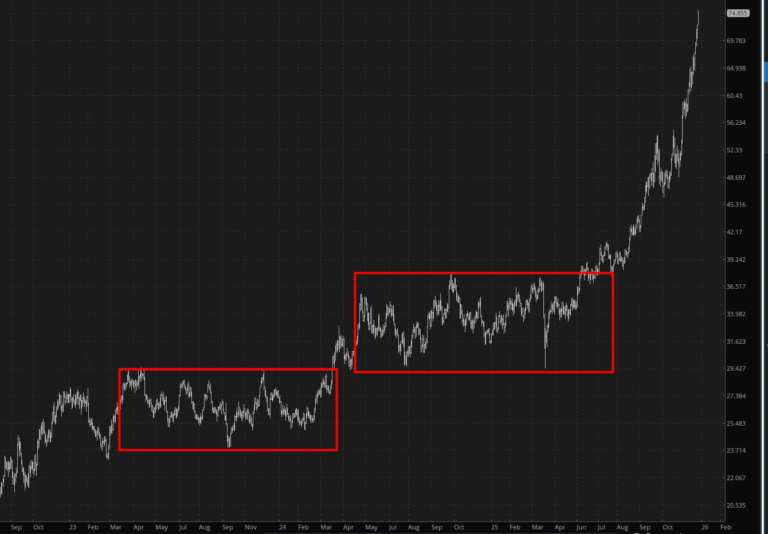
Silver price behavior in global markets is often analyzed using technical charts that reflect real-time buying and selling pressure. A silver chart helps traders understand how market sentiment shifts over time and how momentum strengthens or weakens across different phases of price action. Instead of depending only on news updates or fundamental data, chart analysis focuses on price structure, candlestick patterns, and trend behavior to identify possible turning points in the silver market.
By observing highs, lows, support zones, and resistance levels, traders can better interpret shifts in demand and supply dynamics. This approach provides clearer insight into potential market direction changes.
Understanding Silver Price Action and Market Behavior
Silver is influenced by both industrial demand and investment demand, which makes its price movement more dynamic than many other assets. On charts, this results in alternating phases of strong trends, pullbacks, and consolidation.
Price action represents the direct interaction between buyers and sellers. When buyers dominate, prices rise in structured waves. When sellers take control, prices decline in similar patterns. These movements form the foundation of technical analysis.
Understanding these waves is essential because momentum shifts often begin subtly before becoming visible in larger trends.
Trend Structure and Momentum Shifts
One of the most important elements in chart analysis is market structure. Trends are defined by a sequence of highs and lows.
In an uptrend:
- Higher highs are formed
- Higher lows are maintained
In a downtrend:
- Lower highs are formed
- Lower lows continue
A change in this structure often signals that momentum is shifting. For example, if silver stops forming higher highs and begins creating equal highs, it may indicate that bullish momentum is slowing. Similarly, if lower lows stop forming during a downtrend, selling pressure may be weakening.
These structural changes are often early indicators of a possible reversal or consolidation phase.
Support and Resistance as Momentum Zones
Support and resistance levels are key areas where the price reacts repeatedly.
- Support is a level where buying interest appears strong enough to stop further decline.
- Resistance is a level where selling pressure prevents further upward movement.
When silver repeatedly fails to break resistance, it shows that bullish momentum is weakening. On the other hand, a strong breakout above resistance often indicates renewed buying strength.
Similarly, repeated rebounds from support suggest accumulation, while a breakdown below support indicates increased bearish momentum.
These levels act as psychological zones where market participants make trading decisions.
Volume and Confirmation of Trend Strength
Volume plays a crucial role in confirming price movement strength. It shows how much participation is behind a move.
- High volume during an upward move suggests strong buying interest
- Low volume during a breakout may indicate weak momentum
- Rising volume during a breakdown confirms bearish strength
Without volume confirmation, price movements can be misleading. Strong trends are usually supported by increased participation from market participants.
Consolidation Phases and Market Build-Up
Markets do not trend continuously. They often enter consolidation phases where price moves within a narrow range.
During consolidation:
- Buyers and sellers are in balance
- Volatility decreases
- Direction becomes unclear
Although it may look like inactivity, consolidation often represents accumulation or distribution. This is where the market prepares for its next major move.
A breakout from consolidation typically leads to strong momentum in the direction of the breakout.
Breakouts and Acceleration of Momentum
A breakout occurs when the price moves beyond a key support or resistance level.
When silver breaks above resistance:
- It signals bullish momentum
- Often attracts new buyers
- Can lead to strong upward acceleration
When silver breaks below support:
- It signals bearish momentum
- Can trigger panic selling
- Often results in sharp declines
However, false breakouts are also common. These occur when the price briefly moves beyond a level but fails to sustain the move, leading to a reversal.
Confirmation is essential to avoid misleading signals.
Candlestick Patterns and Market Psychology
Candlestick formations provide insight into short-term sentiment.
Key signals include:
- Long bullish candles showing strong buying pressure
- Long bearish candles indicate aggressive selling
- Wicks showing rejection of higher or lower prices
For example, a long upper wick suggests that buyers attempted to push prices higher but were rejected. A long lower wick indicates that sellers were absorbed by buyers.
When these patterns appear near important levels, they often signal potential momentum shifts.
Moving Averages and Trend Direction
Moving averages help smooth price data and identify the underlying trend.
Common interpretations:
- Price above moving averages suggests bullish momentum
- Price below the moving averages suggests bearish momentum
- Crossovers between short and long averages may indicate trend changes
While moving averages lag behind price, they are useful for confirming trend direction and filtering market noise.
Momentum Indicators and Early Warning Signals
Momentum indicators such as RSI and MACD help measure the strength and speed of price movements.
These tools are useful for identifying:
- Overbought or oversold conditions
- Divergences between price and momentum
- Weakening trends before reversals
For example, if silver makes a new high but momentum indicators fail to confirm it, this divergence may signal weakening bullish strength.
Macroeconomic Influence on Silver Trends
Silver price movements are also shaped by global economic conditions.
Key influencing factors include:
- Interest rates
- Inflation expectations
- Currency strength
- Industrial demand
- Global uncertainty
During uncertain economic conditions, silver often gains demand as a safe-haven asset, leading to stronger upward momentum. In contrast, rising interest rates can reduce demand for non-yielding assets and weaken price momentum.
Final Market Interpretation
Successful chart analysis involves combining multiple signals rather than relying on a single indicator. Trend structure, support and resistance, volume, and momentum indicators all work together to form a complete market view.
When these elements align, they provide clearer insight into whether silver is strengthening, weakening, or preparing for a major directional shift.
Conclusion
A silver chart is more than just a visual representation of price; it reflects market psychology, economic forces, and trader behavior in real time. By studying chart movements, traders can detect early momentum shifts and understand how supply and demand dynamics are evolving across different phases of the market.
Consistent analysis of structure, volume, and momentum helps identify trend changes more accurately and strengthens overall market interpretation without depending on speculation or assumptions.
