



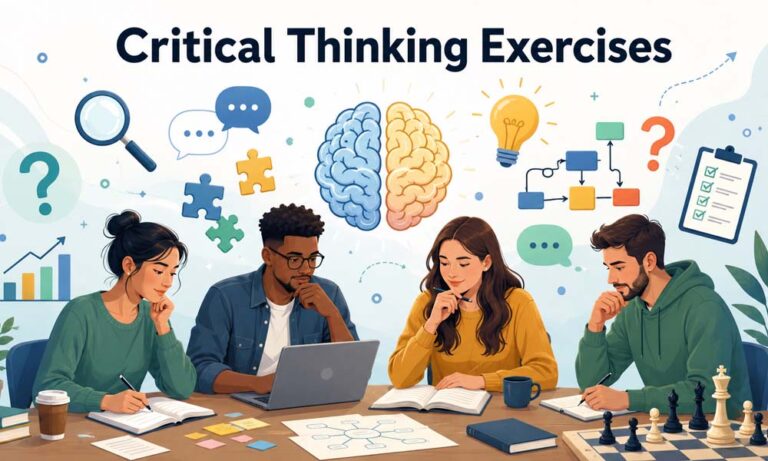
Every day, we see too much information. We see news, posts, videos, comments, advice, ads, and strong opinions. Some of it is true. Some of it is half-true. Some of it is only made to get attention. This can make life confusing.
That is why critical thinking exercises are so useful in 2026. They help you slow down and think clearly. They teach you how to ask better questions, check facts, understand other sides, and make smarter choices.
Critical thinking does not mean you must argue with everyone. It also does not mean you must doubt everything. It simply means you think before you believe, speak, or decide. In this article, we will look at simple ways to train your brain better. These exercises can help you at work, in school, online, and in daily life.
What Are Critical Thinking Exercises?
Critical thinking exercises are simple activities that help your brain think in a better way. They help you look at information carefully. They also help you understand what is true, what is weak, and what needs more proof.
Think of your brain like a muscle. If you never train it, it can get lazy. But when you practice asking questions, solving problems, and checking facts, your brain becomes sharper. You start to notice things that many people miss.
These exercises are not only for students or teachers. They are for everyone. A worker can use them in a meeting. A parent can use them before making a family choice. A student can use them while studying. Even someone scrolling social media can use them before believing a viral post.
Why Your Brain Needs Critical Thinking
Your brain is powerful, but it also takes shortcuts. Sometimes, it makes quick judgments before you know the full story. For example, if someone does not reply to your message, you may think, “They are ignoring me.” But maybe they are busy. Maybe their phone is off. Maybe they forgot.
This is where critical thinking exercises help. They teach you to pause before jumping to a conclusion. They help you ask, “Do I really know this?” or “Is there another reason?” This small pause can save you from stress, wrong choices, and unfair judgments.
In today’s fast world, this skill is even more important. People often share strong claims online without checking them. Some headlines are made to scare people. Some posts are made to create anger. Critical thinking helps you stay calm and clear when others react too fast.
Main Skills Behind Critical Thinking Exercises
Before we learn the exercises, it is helpful to understand the main skills behind them. The first skill is analysis. This means breaking information into smaller parts. When something feels confusing, you do not try to understand it all at once. You look at one part at a time.
The second skill is evaluation. This means checking if something is strong, true, and useful. For example, if someone says, “This product is the best,” you can ask, “Who said this? Is there proof? Is it just an opinion?” This helps you avoid weak information.
The third skill is inference. This means making a smart conclusion from the facts you have. A good conclusion should not be based only on feelings. It should be based on reason, proof, and clear thinking. These skills grow when you practice critical thinking exercises often.
Critical Thinking Exercises for Asking Better Questions
One of the easiest critical thinking exercises is learning to ask better questions. Good questions can open your mind. They help you see what is missing. They also stop you from accepting something too quickly.
For example, when you hear a strong claim, you can ask, “What proof supports this?” You can also ask, “Is there another side to this?” or “Who benefits if I believe this?” These questions are simple, but they are powerful.
Let’s say you see a post online that says a certain habit will make you rich in 30 days. Instead of believing it right away, ask: “Who wrote this?” “Do they have real results?” “Are they selling something?” This does not mean you are being negative. It means you are being careful.
Critical Thinking Exercises to Find the Real Problem
Many people try to fix problems without finding the real cause. This is like cleaning water from the floor while the tap is still open. The problem keeps coming back because the root cause is still there.
One of the best critical thinking exercises for this is the Five Whys method. It is very simple. You take one problem and ask “Why?” again and again until you reach the deeper reason.
For example, imagine you are always late to work. Why are you late? Because you leave home late. Why do you leave home late? Because you wake up late. Why do you wake up late? Because you sleep late. Why do you sleep late? Because you spend too much time on your phone at night. Now you have found the real problem. It is not traffic. It is your night routine.
This exercise is also useful at work. If a team misses a deadline, the first answer may be, “People were slow.” But after asking why several times, you may find that the real issue was poor planning, unclear tasks, or not enough workers.
Critical Thinking Exercises to Stop Quick Judgments
Another helpful method is called the Ladder of Inference. The name may sound big, but the idea is very easy. It means we often climb from what we see to what we believe too quickly.
For example, you are in a meeting. You see a coworker checking their phone again and again. You may think, “They do not care about this meeting.” Then you may believe, “They are not serious about the project.” After that, you may stop including them in important talks.
But what if they were checking a message about a family emergency? What if they were waiting for an urgent project update? What if they were taking notes on their phone? This is why critical thinking exercises are so important. They help you slow down and check your thinking.
A simple question can help here: “What else could be happening?” This question can stop unfair judgment. It can also improve your relationships because you do not assume the worst about people right away.
Critical Thinking Exercises for Better Decisions
Every choice has results. Some results happen right away. Others come later. This is why it helps to think about the “domino effect” of your decisions. One small choice can push many other things forward.
For example, imagine you want to buy an expensive phone. Before buying it, ask yourself a few simple questions. Do I really need it? Can I afford it? What will I not be able to buy later if I spend this money now? Will this still feel like a good choice next month?
This is one of the most useful critical thinking exercises for daily life. It helps you think before you act. It also helps you avoid choices based only on excitement, fear, or pressure from others.
You can use this method for bigger choices too. Should you change jobs? Should you start a business? Should you move to another city? Before deciding, think about the good results, the bad results, and the backup plan. This makes your decision stronger and safer.
Critical Thinking Exercises for Seeing Both Sides
It is easy to believe that our own view is always right. But real growth starts when we listen to other sides too. This does not mean you must agree with everyone. It means you are open enough to understand why someone may think differently.
One strong exercise is called the devil’s advocate method. In this exercise, you take the opposite side of your own view. If you support an idea, try to argue against it. If you dislike an idea, try to find something useful in it.
For example, let’s say your team wants to launch a new product. Everyone is excited. But you can ask, “What if this fails?” “What will customers dislike?” “What are we not seeing?” These questions may feel uncomfortable, but they can save the team from big mistakes.
Critical Thinking Exercises for Checking Facts
Now that we have talked about seeing both sides, let’s move to another very important skill: checking facts. In 2026, this matters more than ever. We see news, short videos, social media posts, and bold claims every day. Some of them look true, but they may not be fully correct.
One of the best critical thinking exercises is learning how to separate facts from opinions. A fact is something you can check. An opinion is what someone thinks, feels, or believes. Both can be useful, but they are not the same.
For example, this is a fact: “Sales increased by 15% last month.” You can check this with real data. But this is an opinion: “This means the company is doing amazingly well.” That may be true, but it is still someone’s view. Maybe sales went up because of one discount. Maybe profits are still low.
You can practice this exercise while reading any article or watching any video. Stop and ask, “Is this a fact or an opinion?” Also ask, “Can I check this somewhere else?” These small questions help you avoid fake news, weak advice, and emotional claims.
Critical Thinking Exercises for Stronger Arguments
A strong argument is not just a loud opinion. It needs a clear point, real proof, and fair thinking. This is why argument mapping is one of the most helpful critical thinking exercises for school, work, and daily talks.
Argument mapping means breaking an idea into simple parts. First, find the main claim. Then, look at the proof. After that, look at the opposite view. Finally, think about how strong the answer is.
Let’s say someone says, “Our company should allow hybrid work.” The main claim is clear. The proof may include lower office costs, happier workers, and better work-life balance. But there may also be opposite points, like weaker team bonding or communication problems.
A critical thinker does not ignore the other side. Instead, they ask, “How can we solve these issues?” Maybe the company can use better meeting rules. Maybe teams can meet in person once a month. Maybe managers can set clearer goals. This makes the argument stronger and more useful.
You can use this method in many areas. It can help you write better articles, prepare for debates, make business choices, or even solve family disagreements. When you map the argument, the topic feels less confusing.
Critical Thinking Exercises for Creative Ideas
Many people think critical thinking is only about logic. But that is not true. It can also help you become more creative. When you think deeply, you often find new ideas that others miss.
One fun exercise is a thought experiment. This means you imagine a “what if” situation and think about what could happen. For example, what if people could travel anywhere in the world in one second? How would work change? How would schools change? How would travel businesses change?
This type of thinking helps your mind leave the usual path. It makes you question old ideas. It also helps you see fresh answers to problems. That is why thought experiments are useful for writers, business owners, teachers, students, and team leaders.
Another creative method is called “Autonomy of an Object.” This means you imagine your problem as if it were a person or object. For example, if your problem is poor time management, you can imagine time as a thief. It steals your focus and energy.
Now ask, “How can I protect myself from this thief?” You may build “walls” around your focus time. This means setting quiet work hours. You may create “guards” by using a daily schedule. You may use “alarm bells” only for truly urgent tasks. This simple picture can lead to smart and fresh ideas.
Critical Thinking Exercises for Teamwork
Critical thinking becomes even more powerful when a team uses it together. Many teams struggle because people talk over each other. Some people only focus on risks. Some only focus on ideas. Some only care about feelings. This can make meetings messy.
The Six Thinking Hats method is one of the best critical thinking exercises for teamwork. It helps a team look at one problem from different sides. Each “hat” stands for one kind of thinking.
The white hat is for facts and data. The red hat is for feelings. The black hat is for risks and warnings. The yellow hat is for benefits. The green hat is for new ideas. The blue hat is for managing the whole discussion.
For example, imagine your team wants to start a new project. With the white hat, you look at numbers and facts. With the red hat, you share how people feel about it. With the black hat, you look at what could go wrong. With the yellow hat, you talk about the good results. With the green hat, you suggest new ideas. With the blue hat, you keep the meeting clear and on track.
This method helps everyone speak in a fair way. It also stops one person from controlling the whole talk. It makes team decisions more balanced, calm, and useful.
How to Practice Critical Thinking Exercises Daily
The best way to improve critical thinking is to practice a little every day. You do not need a long course. You do not need a special tool. You only need small habits that help your brain slow down and think better.
One easy daily habit is to read one news story and find the facts and opinions inside it. Ask yourself, “What can be checked?” and “What is just someone’s view?” This helps you become a smarter reader.
Another simple habit is keeping a decision journal. Whenever you make an important choice, write down why you made it. Also write what you expected to happen. Later, check the result. Did your thinking work? Did you miss something? This helps you learn from your own choices.
You can also practice with puzzles, brain games, and simple logic questions. These may feel like fun, but they train your brain to find patterns and solve problems. Even 10 minutes a day can help if you do it often.
Best Critical Thinking Exercises for Beginners
If you are new to this topic, do not try to learn everything at once. Start small. Choose one or two critical thinking exercises and practice them until they feel natural.
The Five Whys is a great exercise for beginners. It is easy to understand and easy to use. You can use it when something goes wrong at work, at home, or in your daily routine. It helps you find the real problem instead of only fixing the surface problem.
The fact vs opinion exercise is also perfect for beginners. You can use it while reading online posts, watching videos, or listening to advice. It helps you become more careful with the information you accept.
The Ladder of Inference is another good starting point. It helps you stop quick judgments. Before you assume someone is lazy, rude, careless, or wrong, pause and ask, “What else could be true?” This one habit can improve your thinking and your relationships.
Common Mistakes to Avoid
One common mistake is thinking that critical thinking means being negative. It does not. A critical thinker does not reject everything. A critical thinker checks things carefully and fairly.
Another mistake is only looking for proof that supports your own view. This is easy to do. We all like information that agrees with us. But strong thinking means you also look at the other side. You ask, “What if I am missing something?”
Some people also make the mistake of ignoring emotions completely. Feelings matter. They can show you what you care about. But feelings should not be the only reason for a decision. A wise person uses both clear thinking and emotional awareness.
The biggest mistake is rushing. Fast choices are not always bad, but many important choices need time. Before you decide, pause. Ask a few better questions. Check the facts. Think about the results. This simple habit can protect you from many problems.
Conclusion
Critical thinking is not something you learn once and then forget. It is a skill you build over time. The more you practice, the easier it becomes to think clearly, ask better questions, and make smarter choices.
These critical thinking exercises can help you in many parts of life. They can help you at work, in school, in business, in relationships, and even while using social media. They help you slow down, check facts, understand other views, and solve problems in a better way.
You do not need to start with every exercise today. Start with one. Ask better questions. Try the Five Whys. Separate facts from opinions. Think about the other side. These small steps can make a big difference.
In a world full of noise, clear thinking is a real strength. When you train your brain with simple critical thinking exercises, you become calmer, wiser, and more confident. And that is one of the best skills you can carry into 2026 and beyond.
You may also read: Geekzilla Podcast: The Fun Tech and Geek Culture Show Everyone Should Know
