



Think about this for a second. What if your organization needed to make an urgent decision, but it took weeks just to get people to vote? By the time the decision is made, the opportunity is already gone. This is exactly what is happening in many DAOs today.
DAOs were created to be fair, open, and community-driven. But in reality, most of them struggle. Very few people vote. Decisions take too long. And sometimes, a few big holders control everything. This is where Quack AI governance comes in, and that’s why people are talking about it so much in 2026.
In this article, we will break everything down in a very simple way. You will learn what Quack AI governance is, why traditional DAOs are failing, and how this new system is changing the way decisions are made in Web3. By the end, you will clearly understand why many people believe this is the future of governance.
What Is Quack AI Governance in Simple Words?
Let’s keep it very simple.
Quack AI governance is a smart system that uses AI to help DAOs make decisions faster and better. Instead of waiting for humans to vote on every small thing, AI agents step in and do the hard work.
In a normal DAO, you have to read long proposals, understand complex details, and then vote. Most people don’t have time for that. So they simply ignore it. But with Quack AI governance, AI agents read, analyze, and even vote based on rules and data.
You can think of it like this. Imagine you hire a smart assistant who understands your thinking and makes decisions for you when you are busy. That is what this system does, but on the blockchain.
The main goal is very clear. Make governance:
-
faster
-
fairer
-
and easier for everyone
Why Traditional DAOs Are Slow and Broken
Now let’s understand the real problem.
Most DAOs look good in theory. But in real life, they don’t work as smoothly as expected. One of the biggest problems is low participation. In many cases, less than 10% of people actually vote. That means a small group is making decisions for everyone.
Another big issue is time. Voting can take days or even weeks. But in Web3, things move very fast. Prices change in minutes. Opportunities come and go quickly. If a DAO cannot react fast, it loses its edge.
There is also the problem of “whales.” These are people who hold a large number of tokens. Because voting power depends on tokens, these whales can control decisions. This makes the system unfair for smaller users.
On top of that, humans are not always perfect decision-makers. Emotions, bias, and lack of information can lead to poor choices. All these problems together make traditional DAO governance slow, unfair, and inefficient.
How Quack AI Governance Solves These Problems
This is where things start to get interesting.
Quack AI governance was built to fix these exact problems. Instead of depending only on humans, it brings AI into the system to help with decision-making.
First, it removes the need for everyone to vote manually. AI agents can handle voting based on user preferences. This means participation stays high, even if people are busy or offline.
Second, it makes everything faster. AI does not need days to think. It can analyze data and make decisions in seconds. This helps DAOs keep up with fast-moving markets.
Third, it reduces unfair control. Since decisions are based on data and rules, it becomes harder for whales to manipulate outcomes. The system becomes more balanced.
In simple words, Quack AI governance turns governance from a slow process into a smooth and fast system.
How Quack AI Governance Works Step by Step
Let’s break it down step by step so it’s easy to understand.
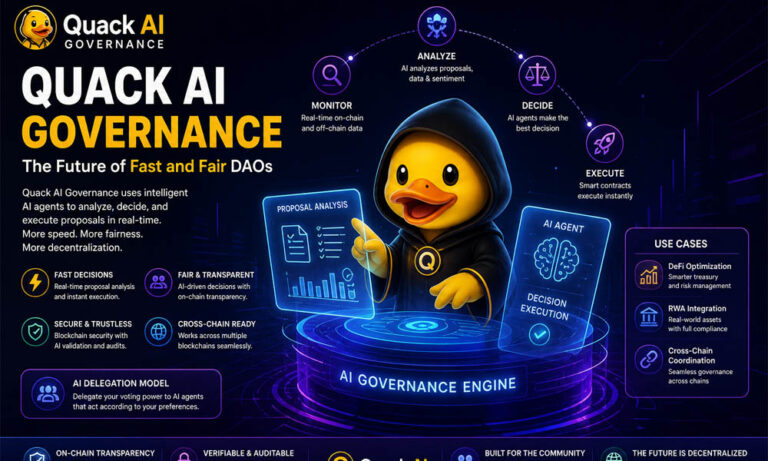
First, proposals are created just like in a normal DAO. These proposals can be about funding, changes, or new ideas. But instead of leaving everything to humans, AI agents step in early.
These AI agents read the proposal. They look at data, past results, and even community discussions. They try to understand if the idea is good or risky.
Next comes decision-making. Based on the analysis, AI agents vote or recommend actions. If users have delegated their power, the AI votes on their behalf.
Finally, execution happens. Once a decision is made, smart contracts automatically carry out the action. This could be sending funds, updating rules, or making changes in the system.
So the full flow is:
-
analyze
-
decide
-
execute
All of this happens quickly and smoothly with Quack AI governance.
Quack AI Governance AI Delegation Model Explained
This is one of the most powerful parts of the system.
The AI delegation model allows users to give their voting power to AI agents. Instead of voting every time, you simply set your preferences once.
For example, you might say:
-
support safe investments
-
avoid risky proposals
-
focus on long-term growth
The AI agent will then follow these rules and vote for you. It acts like your personal decision-maker.
This solves a very common problem called voter fatigue. Many people don’t vote because it takes time and effort. But with Quack AI governance, your voice is still counted even if you are offline.
Another benefit is consistency. Humans can change their mood or miss details. But AI follows clear rules every time. This leads to more stable decisions.
Quack AI Governance Proposal Analysis System
Before any decision is made, proposals need to be understood clearly. This is where the proposal analysis system plays a big role.
AI agents go through every proposal in detail. They read documents, check data, and even look at community opinions. This helps them understand the full picture.
They also look for risks. For example:
-
Is this proposal too expensive?
-
Does it create long-term problems?
-
Has something like this failed before?
Instead of giving raw data, the AI turns everything into simple insights. This makes it easier for both humans and AI agents to make better decisions.
Think of it like having a smart advisor who explains everything in a simple way before you decide.
Quack AI Governance and Real-Time Decision Making
Speed is everything in Web3.
In traditional systems, you might wait weeks for a decision. But with Quack AI governance, decisions can happen in real time. This means almost instantly.
Why does this matter? Imagine a DeFi project facing a sudden market drop. If it takes days to react, losses can grow. But if decisions are made instantly, the system can adjust quickly and reduce risk.
This real-time ability also helps with opportunities. If a good investment appears, the DAO can act fast instead of missing out.
In simple terms, Quack AI governance helps DAOs move at the same speed as the market.
Where Quack AI Governance Is Used in Real Life
Now you might be thinking, where is all of this actually used?
The truth is, Quack AI governance can be used in many areas of Web3. It is not limited to just one type of project.
Because it is flexible, developers can use only the parts they need. For example, some may use it for risk checks, while others may use full automation.
From finance to real-world assets and even multi-chain systems, this technology is designed to fit many use cases. It acts like a smart layer that improves how decisions are made everywhere.
Quack AI Governance in DeFi Platforms
Now let’s look at how this works in real life, starting with DeFi.
DeFi platforms deal with money, and money moves fast. Prices can go up or down in seconds. In such an environment, slow decision-making can be very risky. This is why Quack AI governance is very useful here.
One big use is treasury management. Instead of humans deciding where to spend funds, AI can analyze past data and suggest the best way to use money. It can decide how much to invest, save, or distribute. This helps projects grow in a smarter way.
Another important use is risk control. Markets can crash quickly. AI agents can monitor changes in real time and take action instantly. For example, they can adjust liquidity or stop risky moves before damage happens. This makes DeFi systems safer and more stable.
Quack AI Governance for Real-World Assets (RWA)
Now let’s talk about real-world assets.
These are things like real estate, gold, or other physical assets that are turned into digital tokens. This area needs strong trust and clear rules. People want to know that everything is safe and fair.
This is where Quack AI governance helps. It can manage compliance automatically. It can track rules, check contracts, and make sure everything follows the right process.
It also improves transparency. Every action is recorded on the blockchain. This means anyone can check what happened and why. For banks or big companies, this level of trust is very important.
In simple words, it helps connect traditional finance with Web3 in a safe and smart way.
Quack AI Governance for Cross-Chain Systems
Web3 is not built on just one blockchain. There are many, like Ethereum, Solana, and others. Managing decisions across all of them can be very difficult.
Imagine a DAO that works on three different blockchains. Without a smart system, it would need separate votes and processes for each one. This creates confusion and delays.
With Quack AI governance, everything can be managed from one place. AI agents can coordinate actions across multiple chains at the same time.
This means smoother operations and better results. It also helps large projects work more efficiently without getting stuck in complex systems.
Is Quack AI Governance Safe and Transparent?
A common question people ask is, “Can we trust AI to make decisions?”
This is a fair question. No one wants a system where decisions happen without clarity. That’s why Quack AI governance focuses heavily on transparency.
Every decision made by AI is recorded on-chain. This means there is a clear record of what happened. Anyone can go back and check it.
The system also uses extra checks. There are tools that review decisions before they are executed. This reduces the chance of mistakes or unfair actions.
So instead of being a “black box,” the system is open and easy to track. This builds trust and makes users feel more confident.
How Quack AI Governance Uses Tokens and Rewards
Now let’s understand how users take part in this system.
Quack AI governance uses a token system, often called the Q token. This token plays an important role in keeping everything balanced.
Users can stake tokens to support certain AI agents or decisions. This creates a system where people have a reason to act honestly. If someone tries to cheat, they risk losing their tokens.
Another interesting part is Governance Certificates. These are earned by being active in the system. They give users voting power, even if they don’t hold large tokens.
This helps make governance more fair. It gives more people a voice, not just the biggest holders.
Benefits of Quack AI Governance for DAOs
By now, you can already see many benefits. But let’s quickly look at them in a simple way.
First, it makes decisions much faster. No more waiting for weeks. Everything happens quickly and smoothly.
Second, it increases participation. Even if users are busy, AI agents can act on their behalf. This keeps the system active all the time.
Third, it improves fairness. Decisions are based on data, not power or emotions. This reduces the influence of whales.
Finally, it helps DAOs grow. As projects become bigger, managing them becomes harder. But with Quack AI governance, scaling becomes much easier.
Are There Any Risks or Challenges?
No system is perfect, and it’s important to talk about risks too.
One concern is trust in AI. Some people may feel unsure about letting AI make decisions. This is natural, especially in the early stages.
Another challenge is accuracy. AI systems depend on data. If the data is wrong or incomplete, decisions may not be perfect.
There is also the risk of over-automation. If everything is handled by AI, humans may lose control. That’s why a balance is important.
The good news is that systems like Quack AI governance are designed with checks and transparency. This helps reduce these risks over time.
Future of Quack AI Governance in Web3
Looking ahead, the future looks very exciting.
In 2026 and beyond, more DAOs are expected to adopt AI-powered systems. As projects grow, manual governance will become harder to manage.
Quack AI governance could become a standard tool for Web3 projects. It offers speed, fairness, and scalability, which are all very important.
We may also see it used outside Web3. Businesses, communities, and even governments could explore similar systems.
The idea is simple. Use smart technology to make better decisions, faster and more fairly.
Conclusion
Traditional DAOs have clear problems. They are slow, often unfair, and hard to manage. But Quack AI governance offers a new way forward.
By using AI, it makes decisions faster and smarter. It keeps participation high and reduces human errors. It also brings more fairness and transparency to the system.
Of course, it is still growing. There are challenges to solve. But the direction is clear.
If Web3 wants to scale and succeed, governance must improve. And right now, Quack AI governance looks like one of the strongest solutions for the future.
(FAQs)
What is Quack AI Governance in simple words?
Quack AI governance is a smart system that uses AI to help DAOs make decisions faster and better. Instead of waiting for people to vote manually, AI agents analyze proposals, vote, and even execute actions automatically. This makes governance quick, simple, and more efficient.
How is Quack AI Governance different from a normal DAO?
In a normal DAO, people must read proposals and vote themselves, which takes time and effort. In Quack AI governance, AI agents handle most of this work. They analyze data, follow user preferences, and make decisions quickly, so the system runs smoothly without delays.
How does Quack AI Governance solve low voter participation?
It solves this problem with the AI delegation model. Users can give their voting power to AI agents. These agents vote on their behalf based on their preferences. This means decisions still happen even if users are busy or offline.
Is Quack AI Governance safe to use?
Yes, it is designed to be safe and transparent. Every decision is recorded on the blockchain, so anyone can check it. The system also uses extra checks and verification tools to reduce mistakes and ensure fair decisions.
Can AI make better decisions than humans in DAOs?
AI can make faster and more data-based decisions. It does not get emotional or biased like humans. However, it still depends on the data and rules given to it. So, while AI improves decision-making, human input is still important.
What is the AI Delegation Model in Quack AI Governance?
The AI delegation model allows users to assign their voting power to AI agents. These agents follow the user’s preferences and vote automatically. It is like having a smart assistant who makes decisions for you when you are not available.
How does Quack AI Governance help in DeFi projects?
In DeFi, speed is very important. Quack AI governance helps by making real-time decisions, managing funds smartly, and reducing risks. It can react instantly to market changes, which helps protect and grow the project.
What are Governance Certificates in Quack AI Governance?
Governance Certificates are rewards users earn by being active on the platform. These certificates give them voting power, even if they do not hold many tokens. This helps make the system more fair and gives more people a voice.
Does Quack AI Governance work on multiple blockchains?
Yes, it supports multiple blockchains like Ethereum, Solana, and others. This means it can manage decisions across different networks at the same time, making it easier for projects that operate on more than one chain.
What is the future of Quack AI Governance in Web3?
The future looks very strong. As Web3 grows, DAOs need faster and smarter systems. Quack AI governance can become a standard way to manage decisions. It may also expand beyond Web3 into other industries that need better governance systems.
You may also read: Dashboard Anywhere: How It Makes Work Easy for Everyone
