



Introduction: Why Connectivity Matters in Wearable Device Design
Wearable electronics have become increasingly compact, combining sensors, batteries, processors, and wireless communication systems in devices designed for continuous everyday use. Smartwatches, fitness trackers, smart rings, and other wearable products must deliver reliable performance while remaining lightweight and comfortable. Achieving this balance requires careful attention to every component, including the electrical connectors used for charging and communication.
Traditional connectors can create design challenges when devices have limited space or require frequent charging. Small ports may be difficult to align, while repeated insertion and removal can gradually wear contact surfaces. Magnetic connectors offer an alternative by using magnetic attraction to help position compatible contact points, making certain charging connections easier to attach and detach.
However, magnetic attachment alone does not guarantee electrical reliability, durability, or environmental protection. Connector selection must account for current requirements, contact resistance, mechanical tolerances, moisture exposure, and expected operating conditions. Understanding these factors helps engineers develop wearable devices that combine compact construction with dependable electrical connections.
1. The Engineering Challenges of Building Smaller Wearable Devices
Designing compact wearable electronics requires manufacturers to accommodate several components within a restricted enclosure. Batteries, printed circuit boards, sensors, antennas, and structural supports all compete for space. The connector must fit into this arrangement without interfering with other components or compromising the device’s comfort and appearance.
Connector dimensions are particularly important in smartwatches and fitness trackers, where limited enclosure thickness can restrict the available mounting space. A bulky connector may increase the overall size of the device, while an unsuitable contact arrangement can complicate circuit-board routing and assembly. Engineers must therefore evaluate connector dimensions alongside the enclosure, battery position, and charging interface early in the design process.
Weight distribution also influences wearable comfort. A connector that requires additional structural support or a larger housing can affect how a device sits against the wrist. In smaller products, such as smart rings, even minor dimensional differences may influence the feasibility of a particular connection design.
Accessibility presents another challenge. A charging interface must be positioned where users can attach the cable without unnecessary effort. Designers must also consider whether the connection will remain exposed, sit within a recessed area, or form part of a removable accessory.
These requirements make connector selection an important part of wearable product engineering. A suitable design balances electrical performance, compact dimensions, ease of assembly, and everyday usability rather than prioritizing size alone.
2. How Magnetic Connectors and Spring-Loaded Contacts Work Together
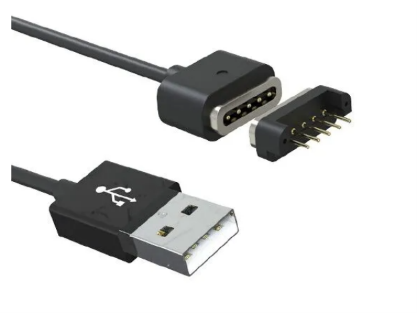
Magnetic connectors combine magnetic attraction with conductive contact points to create a detachable electrical interface. In many designs, magnets help align the two connector halves, while spring-loaded pogo pins establish the electrical connection. This arrangement can be particularly useful in wearable electronics, where small charging interfaces must remain practical for repeated everyday use.
Pogo pins contain a movable plunger, an internal spring, and a conductive barrel. When the connector halves meet, the plunger compresses slightly, creating contact pressure against the corresponding conductive surface. This spring action helps accommodate small variations in alignment and component dimensions. However, reliable operation depends on maintaining the correct working stroke and contact force.
Magnets serve a different purpose. Their attraction helps guide the connector into position and can hold the mating surfaces together. The strength and arrangement of the magnets must be balanced against the force required to separate the connection. Excessive retention can make detachment inconvenient, while insufficient retention may allow the connector to separate unexpectedly.
Contact configuration also matters. A simple charging interface may require positive and negative power contacts, whereas a more complex design may need additional pins for data transmission or device identification. Each contact must be positioned to prevent unintended electrical bridging.
Understanding these separate functions helps engineers evaluate magnetic pogo pin connectors as complete mechanical and electrical systems. The magnets establish positioning and retention, while the contacts determine electrical continuity and much of the interface’s performance.
3. Selecting Electrical Specifications for Compact Wearable Applications
Electrical specifications are central to selecting magnetic connectors for wearable electronics. A connector must support the device’s power requirements without excessive voltage drop, unwanted heating, or unstable electrical contact. Its suitability depends on the complete current path, including the connector contacts, cable conductors, circuit-board connections, and the device’s charging circuitry.
Current rating is an important starting point, but it should not be considered in isolation. Contact resistance influences power loss and temperature rise, particularly when current flows continuously or during demanding charging conditions. Contact materials, surface plating, spring force, and the quality of the mating surfaces all influence electrical performance. Engineers should therefore assess the manufacturer’s specifications alongside the intended operating conditions.
For product developers evaluating magnetic charging interfaces, Magnetic cable connectors by QH Industrial provides a relevant reference for exploring connector options. QH Industrial specializes in pogo pin connectors, magnetic connectors, magnetic charging cables, and customized cable assemblies for consumer electronics, wearable devices, and smart home applications. These connection solutions are relevant to designs where compact dimensions and dependable electrical contact are important considerations. Engineers can also review the available information and go now to investigate whether a particular configuration warrants further evaluation for their application.
Before selecting a connector, designers should establish the required voltage, continuous and peak current, number of contacts, and any data-transfer requirements. They should also confirm operating-temperature limits, working stroke, and expected connection cycles. Published ratings must be checked against the exact model rather than assumed to apply across an entire product range.
Finally, prototype testing should confirm that the connector performs as expected in the assembled device. Measurements of contact resistance and temperature rise under representative loads can reveal problems that may not be apparent from dimensions or catalogue specifications alone.
4. Managing Sweat, Moisture, Dust, and Everyday Exposure
Wearable devices operate in environments where moisture and contamination can affect electrical contacts. Fitness trackers may encounter perspiration during exercise, while smartwatches can be exposed to rain, splashes, skin oils, and cleaning products. These conditions make environmental protection an important part of magnetic connector design.
Several considerations help engineers manage these risks:
– Contact corrosion: Moisture and perspiration can contribute to corrosion or residue formation on exposed conductive surfaces. Appropriate contact materials and plating can improve resistance, but the finished interface must still be evaluated under relevant exposure conditions.
– Enclosure protection: The connector’s location, surrounding housing, seals, and drainage paths influence whether moisture reaches sensitive components. A magnetic connection does not automatically make a device waterproof, so protection must be assessed at the complete product level.
– Dust and surface contamination: Particles and accumulated residue can interfere with contact between mating surfaces. Connector placement and accessibility should allow inspection and cleaning where necessary, particularly when the interface is repeatedly exposed.
– Material compatibility: Housing materials, adhesives, seals, and conductive finishes should be suitable for the chemicals and environmental conditions expected during use. Compatibility testing can help identify degradation that might affect long-term reliability.
– Environmental validation: Temperature changes, humidity exposure, and other application-specific tests help determine whether the connector remains functional under expected conditions. Testing should reflect the intended use rather than relying solely on general component ratings.
These measures help manufacturers distinguish between a connector that performs well under controlled conditions and one that remains dependable throughout the wearable device’s intended operating life.
5. Designing for Repeated Charging and Long-Term Mechanical Reliability
Wearable devices may be charged frequently throughout their useful lives, making connection-cycle durability an important design consideration. Each attachment and removal can affect the mating surfaces, spring mechanisms, magnetic retention, and cable assembly. Over time, wear or contamination may increase contact resistance or cause intermittent electrical connections.
The mechanical design must account for both normal use and foreseeable handling errors. Users may pull a cable sideways, attach the connector at an angle, or accidentally drop a device while it is connected. These actions can place stress on the connector housing, solder joints, and cable termination. Appropriate strain relief and stable mounting help distribute these forces and reduce the risk of damage.
Magnetic retention requires particular attention. Some interfaces are designed to separate when a cable is pulled accidentally, helping limit the force transferred to the device. Whether this breakaway behaviour is beneficial depends on the application. The connector must remain attached during ordinary use while allowing separation at an appropriate force when required.
Engineers should also evaluate spring performance. Pogo pins need sufficient travel to maintain contact across manufacturing tolerances, but excessive compression may accelerate wear or damage the mechanism. The mating surfaces must remain properly aligned, and the housing must prevent unwanted lateral movement.
Reliability testing should include repeated mating cycles, contact-resistance measurements, mechanical inspection, and temperature monitoring under representative electrical loads. Additional vibration or drop testing may be appropriate depending on the product.
These evaluations provide evidence that the connector can withstand expected use. A reliable design depends not only on the connector itself but also on how it is integrated into the wearable device.
6. Integrating Magnetic Connectors into a Wearable Product Development Process
Successful connector integration requires coordination between electrical engineering, mechanical design, and manufacturing. Establishing clear requirements before selecting a component helps reduce redesigns and ensures that the connector fits the product’s intended use.
A structured development process can include the following steps:
– Define the electrical requirements: Establish voltage, current, contact count, and any required signal functions. These requirements determine the appropriate connector configuration and help prevent the selection of an interface that cannot support the intended load.
– Confirm mechanical compatibility: Review connector dimensions, mounting arrangements, working stroke, and enclosure clearances. The design should accommodate manufacturing tolerances while maintaining suitable contact pressure and alignment.
– Evaluate customized assemblies: Different wearables may require specific cable lengths, contact arrangements, mounting orientations, or compact housings. Customized cable assemblies can address these constraints when standard configurations do not meet the product’s requirements.
– Build and test prototypes: Test representative assemblies for electrical continuity, contact resistance, temperature rise, connection-cycle durability, and mechanical stability. Prototype evaluation can reveal integration problems before production tooling is finalized.
– Review manufacturing consistency: Confirm that assembly procedures, component tolerances, soldering methods, and inspection criteria support repeatable results. Consistent production quality is essential when connectors must fit precisely within compact enclosures.
– Document maintenance and validation requirements: Record connector specifications, cleaning guidance where applicable, inspection procedures, and relevant test results. Clear documentation helps manufacturing teams and service personnel maintain consistent handling practices.
Following these steps allows product teams to assess magnetic connectors according to measurable requirements. It also helps ensure that electrical performance, mechanical fit, and environmental suitability remain aligned throughout product development.
Conclusion: Building Wearables Around Dependable Connectivity
Reliable magnetic connections can support the development of compact wearable electronics by combining convenient attachment with carefully engineered electrical contacts. Their suitability, however, depends on more than magnetic attraction or a small physical footprint. Current capacity, contact resistance, mechanical tolerances, environmental protection, and connection-cycle durability all influence long-term performance.
Engineers should evaluate these factors early in the design process and verify them through prototype testing under realistic operating conditions. Appropriate cable routing, secure mounting, and compatible enclosure materials are equally important for maintaining dependable connections.
By treating the connector as an integral part of the complete wearable system, manufacturers can make informed design decisions that balance compact construction, user convenience, and electrical reliability.
