



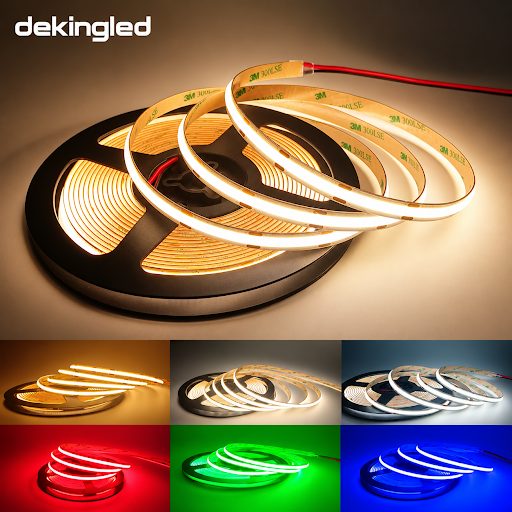
When purchasing lighting for a large commercial, architectural, or residential project, selecting the right products is only part of the process. A well-planned LED strip bulk order should also consider voltage, power consumption, LED density, protection rating, cutting requirements, installation method, and the intended application. Working with an experienced manufacturer can make it easier to keep these specifications consistent across a large quantity of products.
Start With the Project Requirements
Before ordering large quantities, define where the LED strips will be installed and what type of illumination is required. DekingLED’s product range includes strips designed for architectural lighting, signage, decorative applications, indoor spaces, and outdoor environments.
For example, its 5050 LED strip contains 300 LEDs across 5 meters and supports a maximum power of 17W per meter. It is available with IP65 and IP68 protection options, making the series suitable for applications such as cove lighting, architectural lighting, signage backlighting, path marking, and decorative lighting.
Understanding the environment first helps prevent purchasing a strip that does not match the project’s requirements.
Compare Voltage Before Ordering
Voltage is another important consideration for large installations. Different products in the DekingLED range operate at different input voltages.
The 5050-WW-300 series, for instance, supports DC12V or DC24V input and has a maximum power rating of 72W. It can be cut by 3 LEDs for DC12V or 6 LEDs for DC24V, with accessories available for reconnecting the sections. The product also uses 3M adhesive backing for installation.
For longer runs, the company’s product information notes that 24V systems experience less voltage drop than 12V systems, helping maintain more consistent brightness along the strip.
This makes voltage planning particularly important when buying lighting for large areas.
Consider LED Density and Brightness
LED density can influence how continuous and powerful the illumination appears. Projects requiring strong, closely spaced illumination may need a higher-density strip, while simpler decorative applications may require less power.
The 2835 high-density strip uses 900 LEDs across 5 meters, with 26–30 lumens per LED, operates at DC24V, and has a maximum power rating of 48W. It also uses 3oz copper foil and is designed for 10,000 switching tests.
Another option is the 3014 LED strip, which provides 1,200 LEDs across 5 meters, operates at DC24V, and has a maximum rating of 12W per meter. It also uses 3oz copper foil and is specified for 10,000 switching tests.
These specifications can help buyers select different strip configurations according to the lighting requirements of each project.
Match Protection to the Installation Environment
A bulk purchase should never treat all LED strips as interchangeable. Indoor decorative lighting may not require the same protection level as an outdoor installation.
DekingLED offers products with different protection ratings. Its 3528 strip, for example, is rated IP65, while its 2010 Silicone Neon Light is also specified as IP65. The silicone neon product uses SMD2835 LEDs rated at 32–34 lumens per LED, operates at DC24V, has a maximum power of 14W, and includes aluminum installation accessories for firmer mounting.
For demanding waterproof applications, the company also describes an IP68 strip that can remain resistant to water ingress at 3 meters depth.
Plan Packaging, Cutting, and Installation
Large orders should also account for how the strips will be delivered and installed. The standard 5050 strip is supplied as 5 meters per reel, with a 5000mm × 10mm × 0.3mm PCB and a 100mm cutting length. Its specified viewing angle is 120 degrees.
The 5050-WW-300 series provides another useful option because its copper or white PCB can be selected, while the adhesive backing simplifies mounting. Before installation, the manufacturer specifically recommends checking that the power supply meets the LED strip’s required specifications.
For bulk projects, documenting these details before production can reduce installation problems and help different project teams work with consistent materials.
Work With a Manufacturer That Supports Different Applications
A supplier’s product range can also matter when one project requires several lighting types. Shenzhen Dekingled Co., Ltd., established in 2014, lists fast delivery, cost-effectiveness, product quality, and technical support among its service advantages. Its portfolio includes SMD, RGB, RGBW, silicone neon, high-voltage, and COB LED strip solutions.
For example, its RGBW strip combines RGB with warm white, uses 24V DC input, has 88W maximum power, and provides 2700K–3000K CCT with CRI options of WW-80/90.
This variety can be useful when a single project needs both functional white lighting and decorative color-changing sections.
Final Considerations Before a Large Purchase
A successful bulk lighting purchase should be based on more than quantity and price. Buyers should confirm voltage, wattage, LED density, cutting intervals, protection rating, reel length, installation method, and compatibility with the planned power supply.
DekingLED’s range includes products with different specifications for architectural lighting, signage, homes, entertainment spaces, decorative installations, and other applications. Its COB solutions additionally provide uniform, dot-free illumination, while the company identifies free-cutting 12V/24V COB LED strips as a featured product.
For projects requiring consistent quantities and specifications across multiple installations, choosing suitable Wholesale LED Strip Lights and confirming the technical requirements before production can help create a more organized procurement process.
