



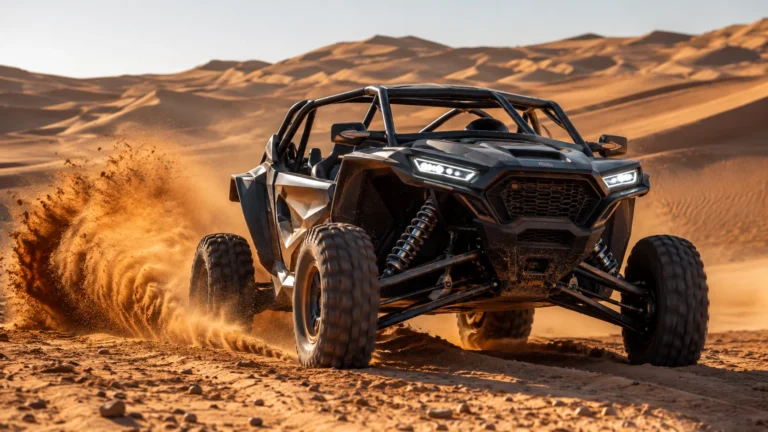
A buggy can have plenty of power and still feel out of its depth once the terrain gets difficult. In the UAE, performance depends just as much on how well the vehicle keeps traction and absorbs impacts as it does on engine output. Modern off-road technology is increasingly focused on solving those problems. These are the innovations worth looking at when choosing a new buggy car.
Suspension that adapts to terrain in real time
Semi-active suspension has moved from race-only territory into mainstream buggies cars, with systems now adjusting damping automatically based on terrain rather than requiring a rider to manually dial in settings before a ride. Alongside that, adjustable piggyback shocks with multiple compression and rebound settings — once an aftermarket upgrade — are increasingly available straight from the factory on higher trims, giving riders real tuning range for sand versus rockier terrain without swapping components.
Differentials that lock themselves
Traction management has gotten noticeably smarter too. Front differentials on several current UTV platforms now lock automatically the moment they sense wheel slip, rather than requiring the driver to engage 4WD manually. It sounds like a small thing until you’re mid-climb on a soft dune face and don’t have a free hand to flip a switch — the system reacts faster than a person can.
Safety innovations
Modern buggies increasingly combine stronger rollover structures with four- or five-point harnesses, reinforced doors and better occupant containment. Some newer models also use hill-descent assistance or traction-related electronic systems to help the driver maintain control on steep or loose terrain.
Electronic Power Steering (EPS)
EPS reduces the steering effort needed when tyres hit ruts, rocks or uneven sand. It also filters some of the kickback through the steering wheel, which can make a new buggy car easier to control during long UAE off-road rides and reduce driver fatigue.
Beadlock wheels as standard, not aftermarket
Beadlock wheels — which let a rider run significantly lower tire pressure for better flotation on sand without risking the tire unseating from the rim — used to be something you added yourself. They’re increasingly showing up as factory-standard on higher-trim off-road models, which matters directly for anyone doing real dune riding rather than occasional trail use.
Electric buggies entering the mainstream
Electric UTVs have gone from novelty to genuine option in the last year or two, with several manufacturers now offering electric 4×4 models built around dual direct-drive motors and instant torque delivery. They’re not yet the obvious choice for sustained heavy dune work, where combustion engines still generally hold the range and heat-management advantage, but for lighter recreational use or resort-style riding, they’re a legitimately competitive category now rather than a gimmick.
Engine durability: Sharmax’s UltraCore Tech
One example worth knowing about on the durability side is UltraCore Tech, a proprietary engine architecture Sharmax has introduced across its higher-output off-road motorcycles, ATVs, and buggies — generally models above 500cc and roughly 40+ horsepower. The reasoning is straightforward: more power means more mechanical stress, and in this region that stress gets compounded by heat, sand, and long off-road sessions.
A few specifics behind it:
- Reinforced chromoly steel construction, rated to withstand peak loads 30–40% longer than standard materials
- Sustained efficiency at high RPM under load — relevant on deep sand, rocky ground, and steep inclines where the engine works continuously hard
- Reduced vibration through a balancing approach applied to key components, lowering wear on connected parts and improving ride comfort
- Lower long-term maintenance demands, since less wear on critical components means fewer replacement parts over time
It’s a good illustration of where a lot of real innovation in this space is actually happening — not always visible on a spec sheet, but relevant every time the machine gets pushed hard for an extended stretch.
What this means when you’re comparing options
More advanced engineering doesn’t arrive free. When you’re weighing the price of buggy car in the UAE listings against each other, a model built around durability-focused engineering or adjustable suspension will often sit higher upfront than a comparable machine without it — but the trade-off tends to show up later, in fewer repairs and a longer working life under real riding conditions.
A few questions worth asking before settling on a buggy to buy:
- Is the suspension adjustable or terrain-adaptive, or fixed-rate across all conditions?
- Does traction control or differential locking engage automatically, or does it require manual input mid-ride?
- For higher-output models, does the manufacturer make any specific durability claims about the engine under sustained load?
- Are beadlock wheels available factory-standard, or would that require aftermarket work?
- What does the warranty actually cover on drivetrain and engine components specifically?
Where to start looking for new buggy car with innovations
If you’re browsing buggies for sale in the UAE, the fastest way to filter a crowded market is to start with the manufacturers who talk specifically about engineering for regional conditions, rather than listing generic specs and hoping heat and sand aren’t an issue.
A few practical ways to narrow things down:
- Check the dealer’s own technical content, not just the listing page. Manufacturers that have actually invested in durability engineering — like Sharmax with UltraCore Tech — tend to publish details about it separately from the sales page. If a brand can’t explain what makes its engine or suspension suited to local conditions beyond a spec sheet, that’s worth noting.
- Ask directly about factory-standard vs. aftermarket features. Beadlock wheels, adjustable shocks, and locking differentials are increasingly available from the factory on higher trims, but plenty of listings still quietly mean “available as an add-on.” Get a straight answer before comparing prices.
- Look for models explicitly built above the entry tier. Durability-focused engineering like UltraCore Tech is generally reserved for higher-output machines — above 500cc and roughly 40hp — so if you’re shopping in that range, ask specifically whether the engine has any stated durability rating, not just a displacement number.
- Visit a showroom that can show you the machine, not just describe it. Suspension travel and adjustability are hard to evaluate from a spec sheet alone. Sitting on the machine and asking a technician to walk through the suspension settings tells you more in five minutes than another hour of comparing listings online.
- Check whether the manufacturer has a genuine local presence. A dealer with an authorized service center in the UAE — not just a regional distributor — is a reasonable signal that the brand is actually invested in supporting the vehicle here long-term, not just selling into the market once.
Sharmax’s buggy catalog is a reasonable starting point if you want to compare current models against these criteria directly — displacement, power, and which durability or suspension technology each one actually carries, rather than working from marketing copy alone.
