



Road salt doesn’t dissolve paint. What it does is convert ordinary road spray into a conductive brine that works its way into every existing chip, scratch and stone strike, then drives corrosion of the exposed metal underneath far faster than plain rainwater would. Paint that’s still intact comes through a gritted winter fine. Paint that’s already broken does not.
Most people get this backwards. They worry about how often the car gets washed while ignoring the four chips on the bonnet edge that are the actual point of entry. Salt is hygroscopic, meaning it draws moisture out of the air and holds it against bare steel even on a cold, dry day, so a chipped panel stays damp long after the roads have dried out.
How Salt Gets Past the Paint and Reaches Bare Metal
Factory paint is a layered system: an electrocoat primer bonded to galvanised steel, a colour basecoat, and a clear coat doing most of the protective work. All three together come to roughly 100 to 150 microns, about the thickness of a sheet of paper. Tougher than it sounds, but thin.
A stone flicked up at 60mph carries enough energy to punch clean through the lot. What you’re left with is a tiny well with exposed steel at the bottom, and salt water sitting in it. Dissolved sodium chloride acts as an electrolyte, which lets the electrochemical reaction we call rust proceed at a pace fresh water never achieves. Corrosion research has consistently linked heavily salted winter roads to higher rates of paint blistering and panel perforation than equivalent mileage in regions that don’t grit.
The spread is sideways, not downwards, which is why it stays hidden. Rust occupies more volume than the steel it replaces, so it lifts the surrounding paint from underneath. That brown-edged blister on an older wheel arch is usually sitting above an affected area two or three times its visible size.
Why Gritted Roads Cause More Chips Than Summer Driving
UK gritting uses rock salt, spread as coarse angular granules rather than fine powder. The angularity is intentional, because sharp edges bite into ice instead of skating across it, and that same property makes it considerably harder on paintwork than ordinary road grime. Councils and National Highways typically spread from late October through March, with the heaviest concentration in January and February.
The result compounds. More loose material on the carriageway means more chips, and every chip created in January immediately fills with the substance that made it. Salt also loses its effectiveness somewhere around minus 6°C to minus 10°C, which is why authorities spread more of it during genuine cold snaps, and why the coldest fortnight of the year is also the worst one for your bodywork.
Geography changes the picture more than people assume. A car in Aberdeenshire or over the Pennines sees gritting on the majority of winter days. The same car in coastal Cornwall may see comparatively little rock salt but plenty of airborne sea salt, which does the identical electrochemical job all year rather than for five months. Park within a mile of the water and your paint is effectively in permanent winter.
What Salt Damage Costs to Repair Compared With Preventing It
The economics are lopsided enough to be worth sitting with. Sealing a handful of chips with properly matched paint runs somewhere between £20 and £40 in materials plus an afternoon of your time. Once corrosion has established itself, a bodyshop has to sand back to clean steel, treat the area, prime, paint and blend, which lands between £250 and £600 per panel. London and the South East occupy the top of that range, with the Midlands and North often 20 to 30 percent lower.
Wheel arches and sills are worse, partly because the damage is usually extensive by the time it becomes visible and partly because the panels are awkward to work on. Those repairs commonly start near £400 and climb sharply if the arch lip needs cutting and welding. On a car worth £5,000, that single job is a meaningful percentage of the whole vehicle.
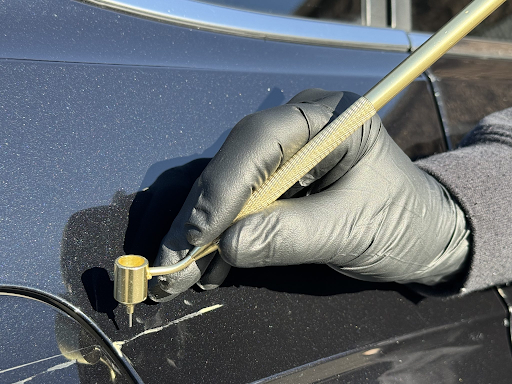
The prevention window is late autumn, before the first frost. Walk round in good daylight, find every chip, and seal it with paint mixed to the vehicle’s factory code rather than a generic shade from a shelf. Owners of Swedish estates and SUVs, for instance, can order Volvo touch up paint matched to codes like 707 Ice White or 019 Black Stone, which matters because the metallic and pearl finishes common across that range are the ones where a near miss looks worse than the original damage.
How Different Cars and Driving Habits Fare Through a Salted Winter
Vehicles don’t suffer equally, and the variation tells you something useful. Cars with substantial aluminium bodywork, which now includes a good deal of Land Rover, Jaguar and Audi production, don’t rust in the conventional sense but can develop white powdery oxidation and are vulnerable to galvanic corrosion wherever aluminium sits against steel fixings, since two dissimilar metals in electrical contact through an electrolyte will see the more reactive one corrode preferentially. Brine is an extremely effective electrolyte, which is why the effect surfaces in winter rather than summer. Anything built before galvanised bodyshells became standard is the most exposed group of all.
Driving pattern counts for as much as the car itself. Someone covering 25,000 motorway miles a year accumulates chips at a rate a low-mileage town car never approaches, because the damage comes from debris thrown up by the wheels ahead at speed. Following distance is a genuine lever. Two seconds back rather than one noticeably cuts both how often stones reach your bonnet and how hard they land.
Storage is the counterintuitive one. A garaged car that arrives home wet and salted, then sits in a still, slightly warmer space, can corrode faster than one left outside where rain rinses it periodically. Hosing the underside and arches every couple of weeks through the gritting season, aiming away from panel seams rather than blasting directly at them, does more for the car’s longevity than any amount of attention to the panels you can actually see.
The Point Where Most Owners Notice Too Late
Salt damage never announces itself. There’s no moment where the paint visibly gives way, which is precisely why it goes unaddressed for two or three winters until a blister appears on a wing and the estimate arrives. The owners who avoid all of it are simply the ones who treat late October as a paintwork checkpoint rather than a car wash.
If you intend to keep the car past its fifth or sixth winter, or sell it within the next couple of years, the chips visible right now are the ones that decide how that goes. Take a torch to the bonnet, front bumper, wing mirrors and the leading edge of the roof before the gritters start their season. Whatever’s there in November is what the salt spends the next four months working on.
