



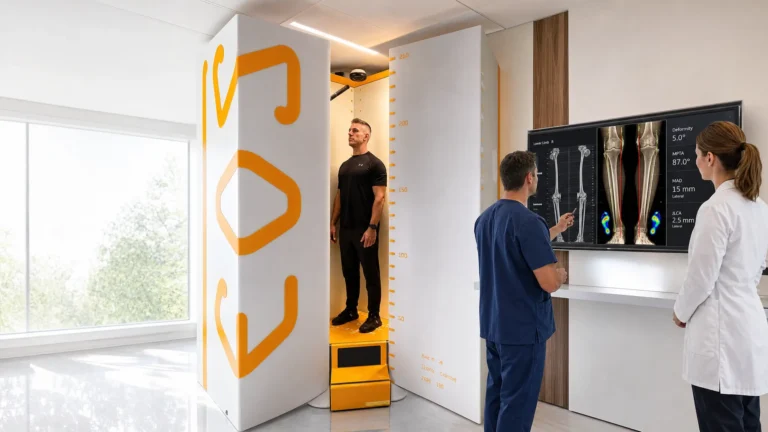
You know how it goes. Your back hurts, or your hip feels off, but every scan comes back “normal.” It’s frustrating. Most of those scans were done lying down. But when do you ever stand still and flat? Never. Life happens on your feet. EOS imaging finally looks at your body the way you actually use it standing up, with gravity pulling on you. That simple change? It can show doctors what’s been hiding all along.
What Is a 3D Medical Scanner?
Think of a 3D medical scanner as a step up from those flat, one-angle X-rays. It builds a fuller picture of your bones and how they fit together.
Doctors use it to check things like:
- Whether your spine is standing straight
- If your hips are level
- How your knees line up
- Whether one leg is shorter than the other
- Your everyday posture
- The way you walk
Instead of guessing why something hurts, the scan helps your doctor see the whole story.
What Is EOS Imaging?
EOS is a special kind of scan. The main thing that sets it apart? You stand up. No lying on a cold table. Just you, standing naturally, while the machine does its thing.
People usually get an EOS scan for:
- Checking scoliosis
- Figuring out back pain
- Looking at hip problems
- Seeing how the knees are lining up
- Measuring leg length differences
- Planning surgery or treatment
The machine gives doctors both 2D and 3D pictures. That means they can see how everything works together, not just one bone at a time.
How an EOS Scan Works
Honestly? It’s easier than you’d think. You stand inside the scanner, stay still for a few seconds, and it’s done. The machine takes pictures from the front and the side all at once.
Here’s what usually happens:
- You walk in and stand naturally inside the scanner
- You hold still just for a few seconds
- The machine captures your whole body
- It builds detailed alignment views
- Later, a specialist sits down with you to go over everything
Here’s something most people don’t realise. Some alignment problems only show up when you’re standing. Lie down, and they practically disappear. That’s why this matters.
Why Standing Medical Scanning Matters
Gravity isn’t your enemy. But it does change everything about how your body holds itself together.
Think about lying down for a second. When you’re flat:
- Your spine relaxes in a way it never does during the day
- Your joints aren’t carrying any weight
- Your posture shifts without you even knowing
- All that natural pressure from standing? Gone.
So, a problem that looks small on a lying-down scan might actually be a big deal when you’re on your feet. Standing scans show the real you.
Understanding Full-Body Alignment
Here’s a simple way to think about it. Your body is like a chain. If one link is slightly off, every other link feels it.
Take a look at how problems travel:
| Body Area | What Can Happen |
| Spine | You start slouching or your back aches |
| Pelvis | One side feels higher than the other |
| Hips | Your walk changes without you noticing |
| Knees | Extra pressure builds up over time |
| Legs | Your muscles work unevenly |
When you look at the whole chain instead of just the sore spot, the real problem often jumps right out.
EOS Scan vs Traditional Imaging
Every type of scan has its job. EOS just happens to be the best fit for standing posture and alignment.
| Imaging Type | What It’s For | Do You Stand? | Shows Whole Body? |
| EOS Scan | Posture and alignment | Yes | Yes |
| X-Ray | Broken bones | Sometimes | No |
| MRI | Muscles and soft tissue | No | No |
| CT Scan | Inside structures | No | Not really |
EOS won’t replace an MRI if you tore something. But for posture and alignment? Nothing else quite does the same thing.
Conditions Where EOS Imaging May Help
Some problems just beg for a standing scan.
1- Spine and Posture Problems
Curves, slouching, weird posture EOS catches all of it while you’re standing naturally.
2- Hip Alignment Concerns
If your hips are off, you might not even feel it at first. But your walk changes. Your back compensates. Over time, things get worse.
3- Knee and Leg Alignment
Bow legs, knock knees, uneven loading EOS can help sort it all out.
4- Leg Length Difference
Even a tiny difference like half a centimetre can throw everything off. Your pelvis tilts. Your spine curves. Your shoulders get uneven. It’s crazy how much one short leg can do.
5- Ongoing Back Pain
You’ve tried everything. Scans, physio, rest. Nothing works. Maybe because everyone kept looking at your back instead of your feet or your hips. Full-body alignment scans have a way of finding what single-area scans miss.
Just remember: Always have a real specialist someone who knows posture and alignment go over your results with you.
Benefits of EOS as a Medical Scanner 3D System
People are switching to EOS for a few good reasons.
1- Full-Body Perspective
You stop looking at one sore knee and start looking at the whole skeleton. That’s usually where the answer is hiding.
2- Natural Standing Position
Because you’re standing, the scan actually matches your real life. Not some fake, lying-down version of you.
3- Lower Radiation Exposure
This is a big one. EOS uses way less radiation than regular X-rays or CT scans. Like, significantly less.
4- Better Understanding of Alignment
Doctors can finally see how your posture might be causing your pain. That connection is everything.
5- Helpful for Monitoring Changes
Got a condition that changes over time? EOS is perfect for checking in every year or two to see what’s shifted.
What Happens During the Appointment?
Don’t overthink it. The whole thing is quick and painless.
Here’s what you’ll probably do:
- Wear something comfortable nothing fancy
- Take off any metal stuff if they ask
- Stand inside the scanner like you’re just waiting for the bus
- Hold still for a few seconds while it clicks away
Afterwards, a specialist looks everything over carefully. Then they call you in to talk about what they found.
Why ScanAlign Uses EOS Imaging
ScanAlign isn’t about treating every body part like it lives on its own. They look at the whole picture. How your spine talks to your hips. How your hips talk to your knees. How your knees talk to your feet.
Using standing EOS scans helps them see:
- Whether your posture is balanced or falling apart
- If your spine is straight or leaning
- Where your hips are actually sitting
- Whether your knees match up
- How you move as one complete person
If you’ve been struggling for years with posture or joint problems, this kind of big-picture assessment might finally give you some real answers.
Conclusion
Here’s the bottom line. EOS gives doctors a honest look at your body while you’re standing and carrying your own weight. For anyone dealing with posture trouble, spine issues, hip pain, or walking problems, that honest look can change everything. Instead of guessing why one spot hurts, you finally see how everything connects. More clinics are catching on because standing scans just make more sense. They show the real you.
Get a Clearer Picture of Your Alignment
If posture, spine, hip, or knee problems have been messing with your daily life, a standing EOS scan might finally give you some clarity. Head over to ScanAlign to learn more about EOS imaging and their posture assessments.
Book your free video consultation
FAQs
- What is a 3D scan in medical imaging?
A 3D scan builds a more complete picture of your bones and joints than a regular flat X-ray. - What is an EOS scan used for?
Mostly for checking posture, spine health, hip alignment, knee balance, and how your whole body lines up. Regular lying-down scans can hide problems that only show up when you stand. EOS sees those hidden problems because it scans you exactly how you live on your feet. - Why is standing imaging important?
Because your body acts totally different when gravity is pulling on it. Standing scans show real life. - Is EOS imaging safe?
Yes. It actually uses much less radiation than standard X-rays or CT scans.
Two-line answer: The team at ScanAlign keeps your scan as low-dose as possible. You can ask them anything about safety during your free video chat before booking anything. - Can EOS imaging help with posture problems?
Absolutely. It’s one of the best tools out there for really understanding what’s going on with your posture and skeletal balance.
