



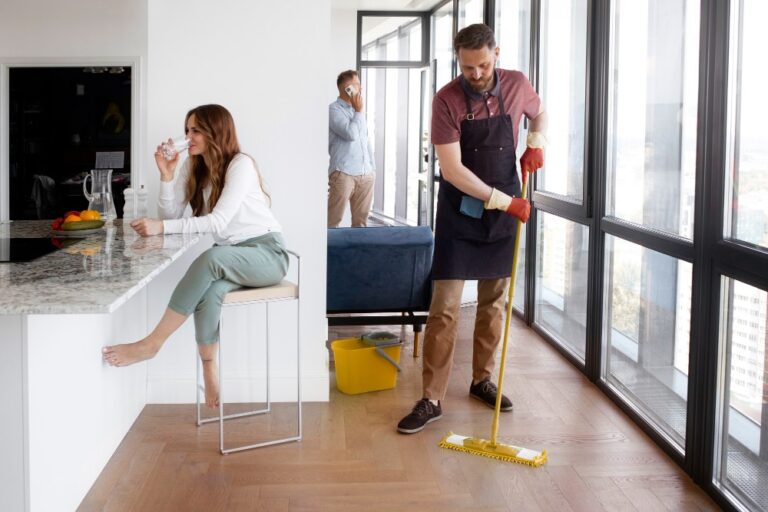
Something has shifted in how Dublin homeowners think about domestic cleaning. It used to be that hiring a house cleaning service was something associated with a particular income bracket or a particular stage of life, the very busy, the very wealthy, or the elderly. That association has been dissolving for several years, and the pace has picked up. Professional cleaning services are increasingly part of how ordinary households in Dublin manage their time and their homes, and the reasons are more practical than they might appear.
This isn’t a lifestyle trend. It’s a recalculation.
The Time Question Has Changed
The single biggest driver is the value of time. Dublin’s working patterns have intensified over the past decade. Longer commutes, longer working hours in competitive sectors, dual-income households with children: the hours available for domestic tasks have shrunk while the expectations around what a well-kept home looks like have, if anything, increased.
Cleaning a home properly takes time. Not the maintenance wipe-down of surfaces but the actual cleaning, the kind that involves skirting boards, bathroom grout, the inside of appliances, and the accumulated dust in corners that nobody notices until visitors arrive. A thorough clean of a modest Dublin home takes several hours. For households where those hours represent either lost income, lost rest, or lost time with family, the arithmetic of paying someone else to do it has changed.
This isn’t about laziness. It’s about opportunity cost, which is a real concept with real implications for how time should be allocated. When the cost of a professional clean is lower than the value of the hours it frees up, the choice is economically rational regardless of income level.
The Standard Argument
There’s a practical case beyond time. Professional cleaners clean better than most people clean their own homes, not because of any particular moral failing but because it’s what they do repeatedly, with the right products, to a defined standard.
The specific areas that professional cleaning consistently outperforms domestic self-cleaning are the ones that require either specialist products, specific technique, or the kind of sustained attention that the household member doing the cleaning is unlikely to give to a task they find tedious. Limescale on shower screens. The build-up in extractor fans. The seal around the bath. These areas get done properly in a professional clean and are done intermittently at best in most self-cleaning households.
Cleanbee house cleaning Dublin is among the services that has built its reputation around delivering this kind of thorough, consistent standard rather than a surface clean that looks fine on first impression. For homeowners who’ve previously hired cleaning services and been disappointed by the gap between what was promised and what was delivered, the operational consistency behind a properly managed service is the specific thing worth looking for.
The Mental Load Factor
This one gets less acknowledgment than the time and cost arguments but is probably just as significant for many households.
The mental load of domestic tasks doesn’t end when you put the mop away. It includes remembering that the bathroom needs doing, noticing that the kitchen floor hasn’t been properly mopped in two weeks, and carrying the low-level awareness of an environment that isn’t quite as it should be. For households where that mental load is already strained by other demands, offloading the cleaning reduces something real even when the physical time involved would have been manageable.
Regular professional cleaning removes the task from the household’s mental inventory in a way that having cleaning supplies in the cupboard and good intentions to use them on Saturday doesn’t. The task gets done on schedule without requiring anyone to organise it, motivate themselves to do it, or carry awareness of it as an outstanding item.
The Shift in What’s Considered Normal
There’s also a cultural dimension that’s worth acknowledging. The stigma around hiring domestic help has largely disappeared from Dublin’s professional households. Services like Cleanbee house cleaning have become normalised options rather than markers of either extravagance or the inability to manage one’s own home.
This normalisation matters because it removes the social calculation that used to accompany the decision. People who might have benefited from a cleaning service but felt awkward about it are less likely to feel that awkwardness now. The decision has become more straightforwardly practical, which is probably the right way to evaluate it.
What’s Actually Changing
The pattern underlying all of this is that Dublin households are applying the same logic to cleaning that they apply to other skilled services: plumbing, electrical work, car maintenance. These are tasks that require time, specific skill, and attention to detail. Most people don’t do them themselves. The reasoning that domestic cleaning is different, that it’s something you should be doing yourself regardless of the value of your time or the quality of the outcome, is losing its hold.
Not every household benefits equally from professional cleaning, and not every household can accommodate the cost. But the households choosing it aren’t making a luxury decision. They’re making a practical one, and the calculation that leads them there is becoming more common because it increasingly makes sense.
