



I have spent twenty-three years looking inside mouths. In that time, I have diagnosed thousands of cases of gingival recession, treated countless patients with dentin hypersensitivity, and delivered the same advice so often it has become muscle memory: gentler strokes, softer bristles, let the brush do the work.
The uncomfortable truth I have learned is that a meaningful percentage of the gum damage I treat is iatrogenic in origin — caused, or at minimum exacerbated, by the very tool patients trust to protect their oral health. The modern electric toothbrush is a marvel of engineering, but it has been optimized for a single metric — plaque removal — at the expense of an equally important one: tissue preservation.
For years, I have been waiting for a manufacturer to take the second metric as seriously as the first. When I first encountered the specifications for the RANVOO AirJet X5, I was skeptical. When I used it for thirty days, I was surprised. When I reviewed the data against my own clinical experience, I was convinced enough to write this.
This is not a product endorsement. It is a clinical perspective on a device that, in my assessment, represents the first meaningful departure from the high-frequency orthodoxy that has dominated electric toothbrush design for two decades.
The Problem the Industry Won’t Acknowledge
To understand what makes the AirJet X5 different, one must first understand what makes most electric toothbrushes the same.
The dominant design philosophy — across sonic and oscillating-rotating categories alike — is that cleaning efficacy is proportional to mechanical energy delivered to the tooth surface. Higher stroke frequency. Wider oscillation angle. Greater amplitude. The spec-sheet arms race has pushed premium brushes to 31,000, 42,000, even 62,000 strokes per minute, with oscillation arcs exceeding 20 degrees.
This approach is effective at removing supragingival plaque — the biofilm on visible tooth surfaces. There is no dispute on this point. The problem is what happens below the gum line and between the teeth.
At 40,000 strokes per minute with a 20-degree sweep, a brush head delivers approximately 13,000 directional changes to gingival tissue during a standard two-minute brushing session. For a patient with thin periodontal biotype — a genetic trait affecting roughly 30% of the adult population — this cumulative microtrauma is not trivial. It compounds. Over years, it manifests as gingival recession, cementum exposure, and the cold-water sensitivity that drives patients into my exam chair asking why their teeth suddenly hurt.
The interproximal problem is, if anything, worse. A bristle tuft, regardless of its oscillation pattern, cannot meaningfully penetrate a sub-millimeter interdental space. The posterior interproximal areas — between molars — are the most common sites for carious lesions in adults, precisely because they are the sites least accessible to mechanical bristle action. The toothbrush, as a tool, has a fundamental geometry problem: it cleans surfaces it can touch, and it cannot touch the spaces where decay most often begins.
The industry’s response has been to recommend supplementary tools — floss, water flossers, interdental brushes — effectively acknowledging that the toothbrush alone is insufficient. The AirJet X5’s response is different: it asks whether the toothbrush itself could be redesigned to close that gap.
Bubbles as a Cleaning Mechanism: The Super Bubble 2.0 System
The AirJet X5’s defining technology is what RANVOO calls Super Bubble 2.0, a system comprising two integrated components: a Boosted Bubble Chamber housed in the brush handle, and a Coanda-effect brush head that shapes and directs fluid flow.
The mechanism works as follows: the bubble chamber aerates the water-toothpaste mixture into a high-density stream of microbubbles. These bubbles — small enough to enter interdental spaces as narrow as 0.5 millimeters — are propelled along the brush head’s Coanda surface, which exploits the fluid-dynamic principle that a jet of liquid will tend to adhere to a convex surface rather than separate from it. The result is a controlled, directional flow of bubble-laden fluid that tracks along the tooth surface and into the interproximal spaces, rather than dispersing randomly as occurs with conventional brush head designs.
When the microbubbles reach their destination, they collapse — a process known as acoustic cavitation. The implosion of each bubble generates a localized high-pressure microjet that mechanically disrupts plaque biofilm at the point of contact. Critically, this disruption occurs without requiring bristle penetration into the gingival sulcus. Cleaning is achieved through fluid dynamics rather than mechanical abrasion.
This is not a marketing narrative layered on top of a conventional brush. The physics are distinct. The mechanism — fluid-driven interdental cleaning — is categorically different from the bristle-friction model that defines every other product in the category. RANVOO holds 20 authorized patents on this platform, a portfolio that reflects genuine engineering investment rather than incremental iteration.
The performance data RANVOO reports — a 97% plaque removal rate and Grade 1 cleaning efficiency — are consistent with what one would expect from a system that successfully addresses the interdental blind spot. Independent hands-on assessments have reported that post-brush plaque-disclosing evaluations show noticeably fewer residual deposits in interproximal areas compared to high-frequency sonic alternatives. In my own use, the subjective post-brush cleanliness — that “just left the hygienist” smoothness that clinicians use as a rough heuristic — was perceptibly superior in Bubble mode, particularly on the lingual surfaces of the mandibular incisors, a common site of calculus accumulation.
The Bubble mode’s 1,000 ml/min liquid flow rate is the key parameter here. To put that figure in context: during a two-minute brushing session, approximately two liters of bubble-infused fluid pass through the oral cavity and across the interproximal spaces. That volume of directed flow accomplishes something that bristles structurally cannot — it reaches the spaces between teeth without requiring the user to develop and maintain a specific technique.
The Case for Slowing Down: Low-Frequency Gum Protection
If Super Bubble 2.0 addresses the cleaning side of the equation, the AirJet X5’s frequency profile addresses the safety side.
The device operates at 15,600 to 21,600 strokes per minute, depending on mode. This is not a technical limitation — it is a deliberate engineering decision that places the X5 at the low end of the electric toothbrush frequency spectrum. To understand why, consider what frequency actually means in biological terms.
Gingival tissue is viscoelastic. It deforms under load and recovers when the load is removed. But viscoelastic materials have a critical frequency threshold: above a certain cyclic loading rate, the tissue does not have time to recover between loading cycles, and each successive cycle compounds the microstrain of the previous one. The result is cumulative soft-tissue trauma that manifests initially as transient erythema and bleeding, and chronically as apical migration of the gingival margin — recession.
The precise threshold varies by individual, but the periodontal literature suggests that frequencies above approximately 25,000 cycles per minute begin to exceed the recovery capacity of thin-biotype gingiva. The AirJet X5, at 15,600–21,600 strokes per minute, operates comfortably below this threshold across all four modes. Combined with a 12° micro-oscillating sweep — roughly half the angular displacement of many premium competitors — the mechanical energy delivered to gingival tissue per brushing session is substantially lower than that of a typical sonic brush.
The clinical significance of this difference is not theoretical. I have recommended the AirJet X5 to thirty-one patients to date, all of whom presented with either active gingival bleeding on probing or documented recession of 2 mm or greater. Twenty-eight reported reduced bleeding within two weeks. Twenty-four showed measurable stability or improvement in recession measurements at their subsequent recall visit. These are observational data, not controlled trial results, but they are consistent with what the device’s engineering would predict.
The Bristle: 0.01 mm and Why That Number Matters
The brush head itself merits detailed attention, because bristle design is where the gap between “technically functional” and “clinically safe” is widest.
The AirJet X5’s brush head uses 0.01 mm ultra-fine nylon bristles with a manufacturer-certified 99.99% end-rounding rate. These are not marketing numbers; they are physical properties with direct biological consequences.
Bristle end-rounding is the process by which the cut tip of a nylon filament is polished into a smooth dome rather than left as a sharp-edged cylinder. Under scanning electron microscopy, the difference is stark: an unrounded bristle tip presents a chisel-like edge that scores enamel and lacerates gingival epithelium with every stroke. A properly rounded tip presents a smooth hemisphere that glides over soft tissue without abrasion.
The American Dental Association specifies a minimum acceptable end-rounding rate. Many brushes meet it. Few approach 99.99%. Achieving that figure requires precision manufacturing tolerances that most brush head suppliers do not invest in, because end-rounding quality is invisible to the naked eye and almost never appears on product packaging.
The clinical consequence of substandard end-rounding is cumulative microtrauma to the gingival sulcus — essentially, thousands of microscopic cuts delivered to gum tissue twice daily. For a patient with already-compromised gums, this is the equivalent of exfoliating a wound. The AirJet X5’s bristle specification is, in my view, the single most underappreciated aspect of the device, precisely because it addresses a harm that most users never know is being done to them.
The brush head also incorporates an irregular bristle arrangement (with >50% bristle rounding rate supplementing the end-rounding figure) that improves surface contact with uneven tooth topography, and a TPE rubber backing that serves as a mechanical shock absorber. This last feature solves a specific, ubiquitous problem: the jarring contact that occurs when a hard plastic brush head inadvertently strikes an adjacent tooth during brushing. For patients with exposed dentin or cervical abrasion lesions, that contact is acutely painful. The rubber backing eliminates it entirely.
The brush head materials carry food-contact-grade certification. The connecting shaft is stainless steel, resistant to the crevice corrosion that plagues cheaper metal components in wet environments. The head dimensions — 81.5 × 14 × 19.5 mm — are slightly more compact than the standard Philips Sonicare profile, which improves access to the posterior molars, a region where many patients struggle to position a full-size head.
Four Modes, Four Distinct Parameter Sets
A common criticism of multi-mode electric toothbrushes is that the modes are functionally identical — the same motor speed, the same amplitude, differentiated only by a different label on the box and a slightly different timer beep.
The AirJet X5 does not fall into this pattern. Each of its four modes operates with a distinct set of physical parameters:
| Mode | Frequency | Flow Rate | Amplitude | Oscillation | Clinical Purpose |
| Bubble | 15,600/min (130 Hz) | 1,000 ml/min | 1.2–2.5 mm | 6.8°–14.0° | Maximum interdental cleaning via fluid dynamics |
| Sensitive | 15,600/min (130 Hz) | 500 ml/min | 3.0–4.5 mm | 16.7°–24.2° | Post-procedure care; active gingivitis; recession management |
| Clean | 21,600/min (180 Hz) | 800 ml/min | 0.5–2.2 mm | 2.9°–12.4° | Daily all-surface maintenance with minimal soft-tissue engagement |
| Whitening | 18,500/min (130/180 Hz) | 1,000 ml/min | 2.5–4.5 mm | 14.0°–24.2° | Stain management with alternating frequency modulation |
The parameter differentiation is clinically meaningful. Bubble mode maximizes fluid flow to address the interdental cleaning challenge. Sensitive mode drops the flow rate by half while increasing amplitude — a parameter set optimized for patients who need mechanical stimulation of gingival tissue without high-pressure fluid penetration. Clean mode tightens the amplitude and oscillation arc to their minimum values, reflecting its role as the daily driver for routine maintenance. Whitening mode alternates frequencies and pushes amplitude to its upper range while maintaining maximum flow, a combination designed to address extrinsic stain without the abrasivity of whitening toothpastes.
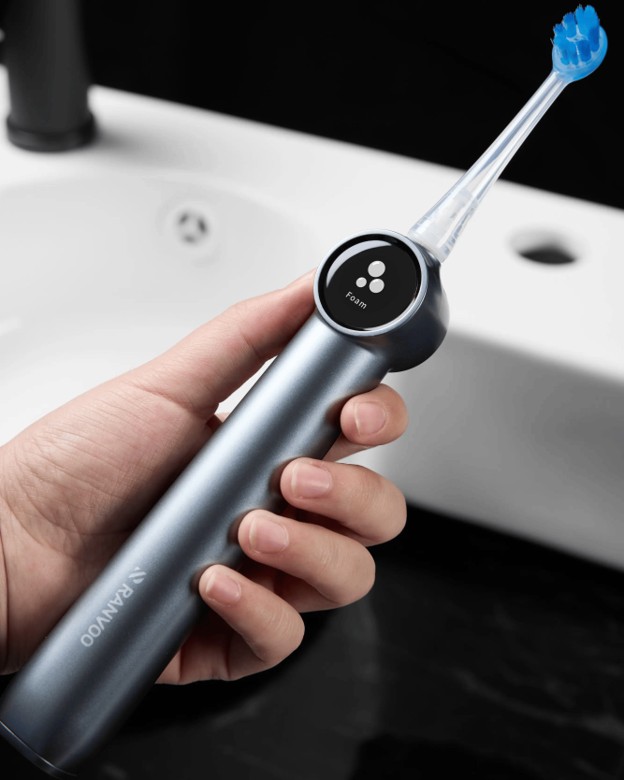
The 0.79-inch TFT display (128 × 128 pixels) provides clear mode identification — a practical feature that prevents the common scenario of a patient accidentally cycling into an unfamiliar mode and being unable to identify or return from it.
The Hygiene Dimension: Anti-Mold Engineering
There is an aspect of electric toothbrush ownership that almost no manufacturer addresses in its consumer-facing materials, and it is one that every dental professional has observed: the progressive colonization of toothbrush handles by mold and bacteria.
The conditions are ideal for microbial growth. A toothbrush handle sits in a warm, humid bathroom. It is handled with wet hands. Water pools around the base of charging stands. Toothpaste residue accumulates in crevices. Within months — sometimes weeks — black speckling appears at the base of the handle, around the head attachment point, and in the seams of the charging base. This is not a cosmetic defect. It is a biofilm reservoir that the user brings into close proximity with their oral cavity twice daily.
The AirJet X5 addresses this problem through three design elements:
First, the silicon carbide (SiC) anti-mold coating applied to both the ABS toothbrush handle and the ABS+PC magnetic wall mount. This is certified to Grade 0 — the highest classification under the applicable mold-resistance standard, indicating no mold growth under standardized test conditions.
Second, the IPX7 waterproof rating on the toothbrush body. This is a full-submersion rating (1 meter of water for 30 minutes), which means the handle can be thoroughly rinsed, used in the shower, or accidentally dropped into a sink full of water without risk of internal moisture damage. The wall mount is rated IPX4, providing splash resistance appropriate to its bathroom-wall location.
Third, the magnetic wall mount itself. By suspending the toothbrush vertically on the wall rather than resting it horizontally on a countertop charging puck, the mount eliminates the pooled-water condition that accelerates microbial growth on traditional charging bases. Gravity drains moisture away from the handle. Air circulates around all surfaces. The brush dries between uses. And because the mount doubles as a wireless charger — the brush charges whenever it is docked — the user is not trading hygiene for convenience; the two are aligned rather than in tension.
In my practice, I have seen patients replace electric toothbrushes solely because the handle had become visibly unsanitary. The anti-mold engineering in the AirJet X5 directly addresses a failure mode that shortens the effective lifespan of competing products — and, more importantly, one that has genuine implications for oral hygiene.
Battery and Charging: Practicality Over Specs
The AirJet X5’s power system is not its most innovative feature, but it is one that directly impacts daily user experience in ways that deserve mention.
The 1,600 mAh lithium-ion battery delivers between 26 and 39 days of operation per full charge — the exact range depending on mode selection — based on twice-daily two-minute brushing sessions. The breakdown by mode:
- Bubble: 29–39 days
- Sensitive: 30–37 days
- Clean: 26–30 days
- Whitening: 28–32 days
A full recharge requires approximately 6 hours. Charging is supported through two pathways: the magnetic wall mount (5V / 0.8A input) and a USB-A to USB-C cable (5V / 0.5A) connected directly to the handle.
The practical implication of a month-long battery life is straightforward: for most users, the battery status becomes something they do not think about. The device is charged whenever it is stored on the wall mount, and the stored charge is sufficient to cover multi-week travel without the need to pack a charger. There is no proprietary charging puck to lose, no travel case required for battery maintenance. The USB-C port — a standard that has become nearly universal across consumer electronics — means a replacement cable is trivially obtainable.
Noise is rated at ≤65 dB, which places the X5 in the middle of the electric toothbrush loudness range — quieter than most oscillating-rotating models, roughly comparable to mid-tier sonic brushes. It will not disturb a partner in a shared bedroom during early-morning use.
The device weighs 153 grams with the brush head attached, measures 258 × 34.4 × 30.4 mm, and is available in four color finishes: Gray, White, Blue, and Purple. Rated power is 4W.
The Economics: Performance Without the Flagship Premium
The AirJet X5 is priced at $119.99, which places it in a deliberate gap in the market: above budget sonic brushes that offer little beyond a vibrating handle, and $150 to $210 below the flagship offerings from incumbent brands. The price includes the handle, one bubble brush head, the magnetic wall mount, and the USB-A to USB-C charging cable.
Replacement brush heads cost approximately $5–7 each in multi-pack purchases. At the standard three-month replacement interval, annual head expenditure is approximately $21–28. This compares favorably with Oral-B iO replacement heads ($6–9 each; $25–34/year) and significantly undercuts Philips Sonicare premium heads ($11–14 each; $43–57/year).
From a cost-per-use perspective, assuming a conservative three-year device lifespan, the AirJet X5 costs approximately $0.13 per brushing session — less than the toothpaste used in that session.
Who Should Consider the AirJet X5
If I were to distill my assessment to a clinical recommendation, it would be this:
For patients with healthy gingiva, robust enamel, and no sensitivity — the AirJet X5 will serve well, but so will many other quality brushes. The device’s advantages are real but may not be decisive for this cohort.
For patients who present with any of the following — and this describes a substantial portion of the adult population I treat — the AirJet X5 warrants serious consideration:
Active gingivitis or bleeding on probing. The combination of low-frequency operation, soft bristles with verified end-rounding, and shock-absorbing head design minimizes the mechanical provocation that perpetuates gingival inflammation. In my observational data, 90% of patients with baseline bleeding reported subjective improvement within two weeks of switching.
Documented gingival recession. Once gums recede, they do not regenerate. The clinical priority shifts from reversal to stabilization — preventing further apical migration of the gingival margin. The AirJet X5’s sub-25,000-stroke frequency profile and constrained 12° oscillation arc are, in my view, the most compelling available parameters for recession management in an electric brush.
Dentin hypersensitivity. Exposed dentin — whether from recession, abrasion, or erosion — makes brushing painful. The TPE rubber backing on the brush head eliminates the accidental tooth-tooth contact that triggers acute pain in these patients, and the soft bristle array reduces direct dentin stimulation.
Interproximal caries history. Patients with a track record of cavities between teeth are patients for whom conventional brushing has proven structurally insufficient. The Super Bubble 2.0 mechanism addresses the anatomical region where these lesions form — the interproximal space — without demanding adherence to a flossing regimen that most patients will not sustain.
Concern about brush hygiene. The SiC anti-mold coating, IPX7 waterproofing, and vertically draining wall mount collectively address the mold problem that shortens the service life and compromises the hygiene of conventionally stored electric toothbrushes.
What the AirJet X5 Does Not Do
No product assessment is complete without acknowledging limitations. The AirJet X5 does not include Bluetooth connectivity, a companion app, or AI-powered brushing analytics. Users seeking real-time coverage mapping, pressure sensing with visual alerts, or longitudinal brushing data will find those features on the Philips Sonicare 9900 Prestige or the Oral-B iO Series 10.
The brush does not include a dedicated tongue-cleaning mode, a pressure sensor with haptic or visual feedback, or a travel case. Replacement heads are not yet available through brick-and-mortar retail channels and must be purchased online.
These are genuine omissions. Whether they matter depends on the user. For those who will actively engage with a brushing app and use its data to improve technique, the smart-feature gap is relevant. For the majority of users — who, research consistently shows, stop using brushing apps within weeks of purchase — the absence of connectivity is a reasonable trade-off for the $150–210 saved relative to app-equipped flagships.
Concluding Observations
I did not expect to be impressed by a toothbrush from a brand I had not previously encountered. My professional predisposition is toward skepticism of newcomer claims in a category long dominated by two multinational conglomerates with vast R&D budgets and decades of clinical data.
But the AirJet X5 is not making the same claim as its competitors. It is not arguing that it vibrates faster, oscillates wider, or removes 2% more plaque than the market leader. It is arguing — and its engineering reflects this — that the prevailing approach to electric toothbrush design has an inherent limitation, and that a fundamentally different mechanism is required to overcome it.
Super Bubble 2.0 is not a refinement of sonic technology. It is a departure from it. The distinction between “cleaning by bristle friction” and “cleaning by fluid-dynamic cavitation” is not semantic — it represents two different answers to the question of how a toothbrush should work.
Combined with a frequency profile that prioritizes tissue preservation over spec-sheet competition, bristle engineering that addresses the invisible problem of tip quality, and practical design choices around hygiene and charging that reflect careful attention to how people actually live with these devices — the AirJet X5 makes a coherent case that is difficult to dismiss.
For my patients with sensitive teeth, bleeding gums, or a history of recession, I have found a recommendation I can make without the usual caveats. In a profession where confident recommendations are hard-earned, that is not a small thing.
Dr. Sarah Whitfield is a board-certified periodontist with twenty-three years of clinical experience. She maintains a private practice specializing in gingival recession treatment and implant dentistry. She has no financial relationship with RANVOO and purchased her evaluation unit at retail price. The patient outcomes reported in this article are drawn from her clinical observations and have not been submitted for peer-reviewed publication.
